Home » Posts tagged 'UKIP'
Tag Archives: UKIP
The hostile environment: Labour’s response
In the first blog in this series (https://bobmouncer.blog/2025/03/22/hostile-environment-the-windrush-scandal-i/), I showed how the announcement of a “hostile environment” for migrants by UK Home Secretary Theresa May in 2012 led to suffering and trauma for thousands of people, the Windrush generation. In the second blog (https://bobmouncer.blog/2025/03/26/hostile-environment-the-windrush-scandal-ii/), I told the story of Hubert Howard, who was one of its victims. In the third blog (https://bobmouncer.blog/2025/03/30/hostile-environment-the-windrush-scandal-iii/), I showed how documents that could have prevented the disaster to Hubert and thousands of others were deliberately destroyed; I described how the scandal slowly emerged and the government’s obstinate refusal to roll back on the policy; and I showed how a compensation scheme was finally devised and how it failed so many Windrush victims. In the last blog (https://bobmouncer.blog/2025/04/02/hostile-environment-the-mediterranean-scandal/) I described the Mediterranean scandal, in which the EU, including the UK, stopped rescue operations in the Mediterranean and how a UK government tried to deny its responsibility for the ensuing tragedy.
In this blog, I examine Labour’s response to the hostile environment.
Labour’s response
The two major scandals examined in my previous blogs in this series unfolded, first, under a Tory/LibDem coalition government and then under the subsequent Tory government. But what was Labour’s response to May’s hostile environment? Maya Goodfellow describes it as “the most minimal resistance”.[1] Labour, the official opposition, abstained in the final Commons vote on the Immigration Bill. Sixteen MPs voted against it, but only six of them were Labour MPs: Diane Abbott, Kelvin Hopkins, John McDonnell, Fiona Mactaggart, Dennis Skinner and Jeremy Corbyn. Corbyn said the Bill was
dog-whistle politics, the mantras being that every immigrant is an illegal immigrant who must somehow be condemned, and that immigration is the cause of all the problems in our society … If we descend into a UKIP-generated xenophobic campaign, it weakens and demeans all of us and our society, and we are all the losers for that.[2]
One of the other MPs was Sarah Teather, a LibDem MP and former minister, who had told The Guardian in 2013 that the proposals in the Bill were “hewn from the same rock” as earlier welfare cuts, much of which were “about setting up political dividing lines, and trying to create and define an enemy”.[3] But apart from the six rebels, Labour MPs obeyed their leader, Ed Miliband, and the Labour whips, and abstained in the Commons vote.
By October, Miliband had moved further right. In a by-election campaign in the Rochester and Strood constituency, which UKIP was hoping to win, Miliband declared he would toughen immigration policy if Labour won the general election in May the following year.[4] Echoing Theresa May, he raised familiar spectres and fears about immigration, ignoring its advantages. The UK, he said, “needs stronger controls on people coming here” and promised a new immigration reform Act if he became Prime Minister. His message was:
- If your fear is uncontrolled numbers of illegal migrants entering the country, Labour will crack down on illegal immigration by electronically recording and checking every migrant arrive in or depart from Britain
- If your fear is of widespread migrant benefit fraud, Labour will make sure that benefits are linked more closely to workers’ contributions
- If the spectre that haunts you is, as Margaret Thatcher had put it, that immigrants were bringing an “alien culture” to Britain, Labour understands, and will ensure that migrants integrate “more fully” into society
- Miliband turned his attention to the EU. Arguments about Britain’s EU membership were coming to a head at this time, with both the Tory right and UKIP agitating for the UK to leave. In 2013, Prime Minister David Cameron had agreed to renegotiate Britain’s terms of membership. The renegotiation would be followed by an in/out referendum to take place after the 2015 general election. Miliband, in his by-election speech in 2014, included migration from the EU in his new immigration promises. He claimed that Labour under Tony Blair had wrongly opened the UK to Eastern Europeans when their countries had joined the EU in 2004. He would not let that happen again. If he won the 2015 election, there would be longer “transitional controls” for new EU members before they could move to Britain.
He even told the voters of Rochester and Strood that they didn’t need to vote for UKIP to get these policies: Labour would do the job.
One pledge seemed at first sight to be protective of migrants. Miliband said he wanted to ensure that migrants were not exploited by employers. However, this was, in fact, a reference to another fear – that migrant workers undercut native workers’ wages because bosses often pay lower wages to migrants (often below the minimum wage). However, where this problem exists, its solution lies not in immigration law but in employment law and its enforcement. It also lies in union recognition and legally binding agreements.
As promise followed promise and pledge followed pledge, Miliband began to sound like Theresa May. A few months later, as the 2015 election approached, Labour’s campaign included the issuing of mugs with “Controls on immigration” printed on them.
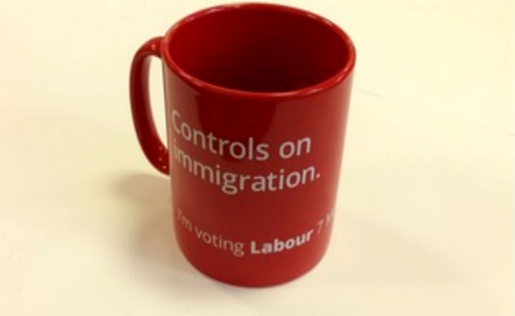
Labour’s immigration controls mug
None of this saved Miliband or his party, and the Tories won the 2015 election; the referendum vote in 2016 in favour of leaving the EU led to David Cameron’s resignation as Prime Minister; he was succeeded by Theresa May; Ed Miliband resigned as Labour leader; Jeremy Corbyn was elected in his place; the process of leaving the EU began. In 2017, Theresa May called another general election, hoping to increase her majority. In the event, the Tory party lost its small overall majority but won the election as the largest single party. But from then on it had to rely on Democratic Unionist Party (DUP) votes to get its business through the Commons.
These parliamentary changes meant nothing for the Windrush generation. The scandal began to come to light in 2017 but their suffering continued beyond the end of the decade, one of the main reasons being that the compensation scheme was seriously flawed. This remained a problem in April 2025, almost a year after the election of a Labour government. The Parliamentary and Health Service Ombudsman (PHSO), Rebecca Hilsenrath, had found that
further harm and injustice are still being caused by failings in the way the scheme is working. We found recurrent reasons for this, suggesting these were not one-off issues but systemic problems.[5]
In response, the Home Office sought to give some reassurance:
This government is committed to putting right the appalling injustices caused by the Windrush scandal and making sure those affected receive the compensation they rightly deserve.[6]
Nevertheless, given the Home Office’s record, we should hesitate before we are reassured. In 2020, the Williams review of the Windrush scandal had made 30 recommendations to the government, all of which were accepted by Priti Patel, Tory Home Secretary at the time. In January 2023, the Home Office unlawfully dropped three of them.[7] Moreover, the department prevented the publication of a report prepared in response to the Williams Review. Williams had said that Home Office staff needed to “learn about the history of the UK and its relationship with the rest of the world, including Britain’s colonial history, the history of inward and outward migration and the history of black Britons.” As a result, the Home Office commissioned an independent report: The Historical Roots of the Windrush Scandal. In the words of Jim Dunton, the report
lays much of the blame for the Windrush scandal on essentially racist measures introduced to restrict the ability of Commonwealth citizens to move to the UK in the years since the second world war.[8]
The report has been available internally since 2022 but, writes Dunton, “the department resisted attempts for it to be made publicly available, including rejecting repeated Freedom of Information Act requests and pressure from Labour MP Diane Abbott.” Then, in early September 2024, after a legal challenge was launched,
a First Tier Tribunal judge ordered the document’s publication, quoting George Orwell’s memorable lines from 1984: “Who controls the past controls the future. Who controls the present controls the past.”[9]
So the Home Office, reluctantly, made the report publicly available, and I will refer to its findings in future blogs. But it is not yet time to take Home Office reassurances at face value. Or Labour’s reassurances, come to that.
In future blogs: more on Labour’s record on immigration and race; and the necessary exposure of a long-standing myth.
[1] Goodfellow, M. (2019), Hostile Environment: How immigrants became Scapegoats, Verso Books, London, loc. 167.
[2] Jack Peat, “Just 6 Labour MPs voted against the 2014 Immigration Act”, The London Economic, 19/04/2018:
[3] Decca Aitkenhead, “Sarah Teather: ‘I’m angry there are no alternative voices on immigration’.”, The Guardian, 12 July 2013.
[4] Andrew Grice, “Ed Miliband attempts to take on Ukip – with toughened immigration policies”, The Guardian, 24 October 2014: Ed Miliband attempts to take on Ukip – with toughened immigration policies | The Independent | The Independent
[5] Adina Campbell, “Payments for Windrush victims denied compensation”, BBC News, 5 September 2024: Payments for Windrush victims denied Home Office compensation – BBC News
[6] Ibid.
[7] Ashith Nagesh & André Rhoden-Paul, “Home Office unlawfully axed Windrush measures”, BBC News, 19 June 2024: Windrush Scandal: Home office unlawfully axed recommendations, court rules – BBC News
[8] Jim Dunton, “Home Office publishes internal ‘roots of Windrush’ report after FoI battle”, Civil Service World, 27 September 2024: Home Office publishes internal ‘roots of Windrush’ report after FoI battle
[9] Ibid.
REVISITING UKIP
I’ve had a bit of feedback to my blog on UKIP. So I have revisited the questions I raised, i.e. whether UKIP is a fascist party, and the question of legal status.
It’s often too easy, if we’re lazy, to label the political right as fascist. It was often said that the Thatcher government was fascist but, in one meeting I attended back then, someone rightly pointed out that if that were true we wouldn’t be holding the meeting! So maybe I’ve fallen into the lazy trap. But as I say that, I am still uneasy.
What can’t be denied is that UKIP is a party of the hard right which campaigns not just against the EU but also against LGBT equality, for harsher immigration controls, deeper spending cuts and a quicker break-up of the NHS. In the European Parliament it is in a grouping which includes the far-right, anti-gay United Poland party and the right-wing Northern League of Italy.
The aim of fascism is to smash all working class organisation and ultimately all forms of democracy. Its aim is to use parliamentary democracy in order to destroy it. And fascism means violence, and fascists today encourage and engage in violent street attacks on blacks and Asians (especially Muslims), asylum seekers, LGBT people, trade unionists, the left and so on. This description doesn’t fit UKIP as a party, and its party organisation doesn’t have the disciplined combat form characteristic of fascist parties.
And yet … The history of some of its core members is fascist: HOPE not Hate has highlighted the case of Robert Ray, an Essex councillor, once National Front (NF) organiser for Newham, who canvassed with Nigel Farage during the recent Thurrock council by-election; Nigel Farage himself seems to have such a history, with teachers at his school worried about him being appointed a prefect. One alleged that he was among pupils who marched late at night through a Sussex village shouting Hitler Youth songs.
The words and actions of other prominent UKIP members give rise to similar worries about the core beliefs and attitudes of UKIP. Much of this is documented by HOPE not Hate. Alexandra Phillips, UKIP’s Head of Media, has a particularly bad record when using – well, yes – the media. On Facebook, she frequently mocks the disabled, often referring to herself or others as “spaz” or “spasticated”, both words, says HOPE not Hate, “that have thankfully dropped out of common usage as the majority of British society regard them as offensive.” She also refers to an online friend as an “autistic wanker”. She says she is “hungrier than a Biafran”, a mocking reference to those who starved during the 1960s Nigerian-Biafran war. She said she was “bored of being Anne Frank”, referring to the iconic Dutch victim of Bergen-Belsen concentration camp.
Farage, like Enoch Powell before him, likes to raise impossible spectres so that voters, fearful of the future, will turn to him. Powell’s spectre was of a kind of bloodbath that would take place as a result of immigration: “As I look ahead I am filled with foreboding. Like the Roman, I seem to see ‘the River Tiber foaming with much blood.’” Compared to that, Farage’s effort at this year’s conference, like much of what he does, is laughable. And yet it isn’t. For the aim is the same. So he says that from 1 January next year,
nearly 30 million of the good people of Bulgaria and Romania have open access to our country, our welfare system our jobs market. How many will take advantage of that no one knows. The Home Office don’t have any idea at all. The previous estimate was 13,000 in total. Migration Watch thinks 50,000 a year. It could be many times that.
Then he gets to crime, and the threat becomes more sinister, more dangerous:
There is an even darker side to the opening of the door in January. London is already experiencing a Romanian crime wave. There have been an astounding 27,500 arrests in the Metropolitan Police area in the last five years. 92 per cent of ATM crime is committed by Romanians. This gets to the heart of the immigration policy that UKIP wants, we should not welcome foreign criminal gangs and we must deport those who have committed offences.
The statistics here are used in an extremely doubtful way, and HOPE not Hate explains this better than I can – go to the following link and scroll down a bit:
FactCheck: Nigel Farage’s Ukip conference speech
All this is worrying. Of course, some of the scandals associated with UKIP are about the usual jealousies and infighting that go on in any political party. But we should take their racism and xenophobia seriously. When Powell talked of blood, ethnic minorities were attacked and people died. There are similar consequences when Farage does his anti-Romanian rant. HOPE not Hate tells how, in the Eastleigh by-election, the UKIP candidate linked Romanians with “a natural propensity to crime”. Shortly after, two young Romanian workers were attacked in Brighton because their language sounded “East European”. It is partly the rhetoric used, and the images conjured up, by Farage and UKIP as well as the fascists of the BNP and the EDL, that has led to the spate of recent racist attacks on my Afghan-British neighbours as they drive their taxis in the small hours.
And I suppose the question is: Do we want UKIP to get its hands on the levers of power? Because I suspect that, if they do, hostilities will cease between UKIP, the BNP and the EDL. And then we’ll find out whether UKIP is fascist or not.
I think that fascist parties should be banned. And UKIP?
 Bob Mouncer's blog