Home » Posts tagged 'Tony Blair'
Tag Archives: Tony Blair
The hostile environment: Labour’s response
In the first blog in this series (https://bobmouncer.blog/2025/03/22/hostile-environment-the-windrush-scandal-i/), I showed how the announcement of a “hostile environment” for migrants by UK Home Secretary Theresa May in 2012 led to suffering and trauma for thousands of people, the Windrush generation. In the second blog (https://bobmouncer.blog/2025/03/26/hostile-environment-the-windrush-scandal-ii/), I told the story of Hubert Howard, who was one of its victims. In the third blog (https://bobmouncer.blog/2025/03/30/hostile-environment-the-windrush-scandal-iii/), I showed how documents that could have prevented the disaster to Hubert and thousands of others were deliberately destroyed; I described how the scandal slowly emerged and the government’s obstinate refusal to roll back on the policy; and I showed how a compensation scheme was finally devised and how it failed so many Windrush victims. In the last blog (https://bobmouncer.blog/2025/04/02/hostile-environment-the-mediterranean-scandal/) I described the Mediterranean scandal, in which the EU, including the UK, stopped rescue operations in the Mediterranean and how a UK government tried to deny its responsibility for the ensuing tragedy.
In this blog, I examine Labour’s response to the hostile environment.
Labour’s response
The two major scandals examined in my previous blogs in this series unfolded, first, under a Tory/LibDem coalition government and then under the subsequent Tory government. But what was Labour’s response to May’s hostile environment? Maya Goodfellow describes it as “the most minimal resistance”.[1] Labour, the official opposition, abstained in the final Commons vote on the Immigration Bill. Sixteen MPs voted against it, but only six of them were Labour MPs: Diane Abbott, Kelvin Hopkins, John McDonnell, Fiona Mactaggart, Dennis Skinner and Jeremy Corbyn. Corbyn said the Bill was
dog-whistle politics, the mantras being that every immigrant is an illegal immigrant who must somehow be condemned, and that immigration is the cause of all the problems in our society … If we descend into a UKIP-generated xenophobic campaign, it weakens and demeans all of us and our society, and we are all the losers for that.[2]
One of the other MPs was Sarah Teather, a LibDem MP and former minister, who had told The Guardian in 2013 that the proposals in the Bill were “hewn from the same rock” as earlier welfare cuts, much of which were “about setting up political dividing lines, and trying to create and define an enemy”.[3] But apart from the six rebels, Labour MPs obeyed their leader, Ed Miliband, and the Labour whips, and abstained in the Commons vote.
By October, Miliband had moved further right. In a by-election campaign in the Rochester and Strood constituency, which UKIP was hoping to win, Miliband declared he would toughen immigration policy if Labour won the general election in May the following year.[4] Echoing Theresa May, he raised familiar spectres and fears about immigration, ignoring its advantages. The UK, he said, “needs stronger controls on people coming here” and promised a new immigration reform Act if he became Prime Minister. His message was:
- If your fear is uncontrolled numbers of illegal migrants entering the country, Labour will crack down on illegal immigration by electronically recording and checking every migrant arrive in or depart from Britain
- If your fear is of widespread migrant benefit fraud, Labour will make sure that benefits are linked more closely to workers’ contributions
- If the spectre that haunts you is, as Margaret Thatcher had put it, that immigrants were bringing an “alien culture” to Britain, Labour understands, and will ensure that migrants integrate “more fully” into society
- Miliband turned his attention to the EU. Arguments about Britain’s EU membership were coming to a head at this time, with both the Tory right and UKIP agitating for the UK to leave. In 2013, Prime Minister David Cameron had agreed to renegotiate Britain’s terms of membership. The renegotiation would be followed by an in/out referendum to take place after the 2015 general election. Miliband, in his by-election speech in 2014, included migration from the EU in his new immigration promises. He claimed that Labour under Tony Blair had wrongly opened the UK to Eastern Europeans when their countries had joined the EU in 2004. He would not let that happen again. If he won the 2015 election, there would be longer “transitional controls” for new EU members before they could move to Britain.
He even told the voters of Rochester and Strood that they didn’t need to vote for UKIP to get these policies: Labour would do the job.
One pledge seemed at first sight to be protective of migrants. Miliband said he wanted to ensure that migrants were not exploited by employers. However, this was, in fact, a reference to another fear – that migrant workers undercut native workers’ wages because bosses often pay lower wages to migrants (often below the minimum wage). However, where this problem exists, its solution lies not in immigration law but in employment law and its enforcement. It also lies in union recognition and legally binding agreements.
As promise followed promise and pledge followed pledge, Miliband began to sound like Theresa May. A few months later, as the 2015 election approached, Labour’s campaign included the issuing of mugs with “Controls on immigration” printed on them.
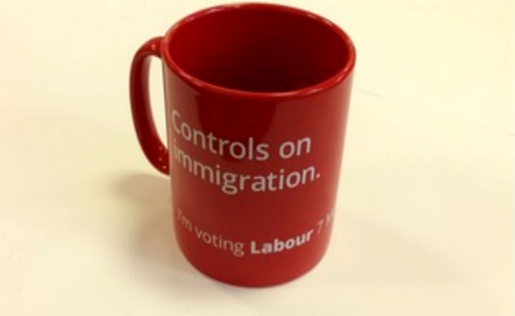
Labour’s immigration controls mug
None of this saved Miliband or his party, and the Tories won the 2015 election; the referendum vote in 2016 in favour of leaving the EU led to David Cameron’s resignation as Prime Minister; he was succeeded by Theresa May; Ed Miliband resigned as Labour leader; Jeremy Corbyn was elected in his place; the process of leaving the EU began. In 2017, Theresa May called another general election, hoping to increase her majority. In the event, the Tory party lost its small overall majority but won the election as the largest single party. But from then on it had to rely on Democratic Unionist Party (DUP) votes to get its business through the Commons.
These parliamentary changes meant nothing for the Windrush generation. The scandal began to come to light in 2017 but their suffering continued beyond the end of the decade, one of the main reasons being that the compensation scheme was seriously flawed. This remained a problem in April 2025, almost a year after the election of a Labour government. The Parliamentary and Health Service Ombudsman (PHSO), Rebecca Hilsenrath, had found that
further harm and injustice are still being caused by failings in the way the scheme is working. We found recurrent reasons for this, suggesting these were not one-off issues but systemic problems.[5]
In response, the Home Office sought to give some reassurance:
This government is committed to putting right the appalling injustices caused by the Windrush scandal and making sure those affected receive the compensation they rightly deserve.[6]
Nevertheless, given the Home Office’s record, we should hesitate before we are reassured. In 2020, the Williams review of the Windrush scandal had made 30 recommendations to the government, all of which were accepted by Priti Patel, Tory Home Secretary at the time. In January 2023, the Home Office unlawfully dropped three of them.[7] Moreover, the department prevented the publication of a report prepared in response to the Williams Review. Williams had said that Home Office staff needed to “learn about the history of the UK and its relationship with the rest of the world, including Britain’s colonial history, the history of inward and outward migration and the history of black Britons.” As a result, the Home Office commissioned an independent report: The Historical Roots of the Windrush Scandal. In the words of Jim Dunton, the report
lays much of the blame for the Windrush scandal on essentially racist measures introduced to restrict the ability of Commonwealth citizens to move to the UK in the years since the second world war.[8]
The report has been available internally since 2022 but, writes Dunton, “the department resisted attempts for it to be made publicly available, including rejecting repeated Freedom of Information Act requests and pressure from Labour MP Diane Abbott.” Then, in early September 2024, after a legal challenge was launched,
a First Tier Tribunal judge ordered the document’s publication, quoting George Orwell’s memorable lines from 1984: “Who controls the past controls the future. Who controls the present controls the past.”[9]
So the Home Office, reluctantly, made the report publicly available, and I will refer to its findings in future blogs. But it is not yet time to take Home Office reassurances at face value. Or Labour’s reassurances, come to that.
In future blogs: more on Labour’s record on immigration and race; and the necessary exposure of a long-standing myth.
[1] Goodfellow, M. (2019), Hostile Environment: How immigrants became Scapegoats, Verso Books, London, loc. 167.
[2] Jack Peat, “Just 6 Labour MPs voted against the 2014 Immigration Act”, The London Economic, 19/04/2018:
[3] Decca Aitkenhead, “Sarah Teather: ‘I’m angry there are no alternative voices on immigration’.”, The Guardian, 12 July 2013.
[4] Andrew Grice, “Ed Miliband attempts to take on Ukip – with toughened immigration policies”, The Guardian, 24 October 2014: Ed Miliband attempts to take on Ukip – with toughened immigration policies | The Independent | The Independent
[5] Adina Campbell, “Payments for Windrush victims denied compensation”, BBC News, 5 September 2024: Payments for Windrush victims denied Home Office compensation – BBC News
[6] Ibid.
[7] Ashith Nagesh & André Rhoden-Paul, “Home Office unlawfully axed Windrush measures”, BBC News, 19 June 2024: Windrush Scandal: Home office unlawfully axed recommendations, court rules – BBC News
[8] Jim Dunton, “Home Office publishes internal ‘roots of Windrush’ report after FoI battle”, Civil Service World, 27 September 2024: Home Office publishes internal ‘roots of Windrush’ report after FoI battle
[9] Ibid.
The liberal agenda: a warning
In this Guardian article (see link below) Lord Adonis (sorry, he writes as Andrew Adonis; he clearly doesn’t approve of the title he’s accepted – how democratic, indeed how liberal, that is!) describes the late Roy Jenkins as “the most transformational liberal home secretary ever” because, apparently, “he legalised both homosexuality and abortion in one of the most skilful ministerial manoeuvres of parliamentary history.” It’s true that Jenkins was Home Secretary at the time. But it was, of course, the determined campaigns by gays and women that were the crucial elements leading to those changes in the law, not really Jenkins. His image at the time, and his image as handed down through the decades, is that he was the great white hope of the liberal intelligentsia. But I’ll tell you what else he did. He voted to cancel the British passports of the Kenyan Asians who fled to the UK from Kenya in 1967-68, thus pandering to the hostile campaigns against them by Enoch Powell, Duncan Sandys and the fascists of the National Front.
The Kenyan Asians were never called refugees but, effectively, that’s what they were. Their presence in Kenya was part of colonial history and their departure a result of the decolonisation process in East Africa. After independence in 1963 Kenya adopted a policy of Africanisation: in the civil service, Africans had to be rapidly promoted; in private firms, Africans had to be employed at worker and management levels. At the time of independence Asians had been offered Kenyan or British citizenship, and many of them chose British. But the 1967 Trade Licensing Act in Kenya made it illegal for non-citizens to trade in rural or outlying urban areas and in a wide range of goods, and many Asians were forced out of business. Many turned to the UK for help. In 1963 the Conservative government, though fresh from passing the first restrictive Commonwealth Immigrants Act, reassured the Kenyan Asians that their UK citizenship was secure. In March 1968 the Labour government, though fresh from declaring Jenkins’ liberal agenda, cancelled this agreement and passed a new Commonwealth Immigrants Act which removed their UK citizenship. In the space of 72 hours. And what happened to the bright, shiny new liberals in the Labour cabinet when the vote was taken? They voted for it. Roy Hattersley expressed remorse 31 years later in an interview (the following quotation and the later quotation from the Jenkins interview come from the Channel 4 documentary Playing the Race Card, which was first broadcast in October-November1999; they are reproduced from memory and are correct in their substance, but may not be word-for-word):
Shirley [Williams] and I stayed up into the small hours discussing what we should do. When you go into politics you want to achieve certain things, but you can’t achieve everything and you often have to make compromises. But there are some things you shouldn’t compromise on, and this was one of them. We should have resigned rather than vote for it.
And Jenkins? He had become Chancellor by the time the Act was passed. He also explained himself 31 years later: he was Chancellor, he explained, travelling abroad and signing deals and agreements with a host of countries. So, he explained,
I think people would have thought it really rather trivial if I had resigned on this issue.
So beware of liberals bearing gifts. And beware of Lord Adonis, who says in the article that Jenkins “was my hero and later my mentor”. He also says that he “fell politically in love with Tony Blair” (what a careful statement that is!). I’m glad he’s against the idea of breaking away from Labour to form a new party (at least at the moment – remember he’s a liberal). But I suspect he will do his best to undermine Corbyn every chance he gets.
To end on a lighter note: he points out that the SDP failed in their aim in the 1980s to “break the mould of British politics”. Tony Benn once captured this failure perfectly to a Question Time audience:
The SDP was formed to break the mould of British politics and last week they held their annual conference in a telephone kiosk in Plymouth.[1]
His Lordship’s article: https://www.theguardian.com/commentisfree/2018/aug/24/labour-party-split-sdp-tories-england
[1] David Owen, a former Labour Foreign Secretary and one of the “Gang of Four” who founded the SDP, was the MP for Plymouth.
Hypocrisy, two kidnappings and a wedding
Let me just say: this wedding of a royal personage to a “woman of colour” has taken place against the background of Theresa May’s continuing “hostile environment” for the Caribbean Windrush generation as well as for recent migrants. However much Theresa May pretends to be sorry, she hasn’t ended the hostile environment. Another man was jailed this week after responding to a government invitation, to people whose status has been questioned, to contact the authorities with a promise that they would be safe. He turned up at his MP’s surgery last week for advice, was given an appointment at the Home Office, and when he got there the police were there to arrest him, charge him with an offence of “handling stolen goods” allegedly committed (he says not) 20 years ago, and throw him into Pentonville prison before he’s even been tried.[1] That’s the British state for you, the state whose head is Her Majesty the Queen, whose grandson today got married to a “woman of colour”, an occasion described by the press as marking a sea change in British society.
There’s something else. Before the wedding took place, the streets of Windsor were cleared of homeless people. They sleep on the streets of Windsor, the town where the big castle is, because they have nowhere else to go. They were pushed off the streets by the police. That was an act of the British state too, whose head is, etc., etc.
Why do I emphasise that it was the British state doing all this stuff? Because the “hostile environment” has existed no matter what government has been in power. In the 2000s, when the Labour government was in power, it operated an “agenda of disbelief” and set targets for the deportation of refugees, who were assumed to be guilty of lying unless they could prove they were innocent. Where possible, the state made sure that they were deported before they got the chance to prove their innocence. It’s now happening today under the Conservatives.
My point is this: a couple of weeks ago Theresa May apologised on behalf of the state for being party to the “rendition” and torture of two British citizens, dissidents from Libya, Abdel Hakim Belhaj and his wife Fatima Boudchar. They were handed over to Gaddafi in 2004 as a reward for the Libyan state’s cooperation with the British state on a number of issues. May wasn’t apologising for the Conservatives, because these events took place during Tony Blair’s Labour government, when Jack Straw was Foreign Secretary. She was apologising for the state. If Jeremy becomes prime minister, he and his government will be put under the same pressure to do the bidding of the state, especially the security services (MI5, MI6), and powerful civil service bureaucrats, in all sorts of different areas of policymaking. It’s unlikely, to say the least, that Blair and Straw put up any resistance at all to the Belhaj “rendition”. Labour Home Secretaries like David Blunkett didn’t resist when it came to the agenda of disbelief. Jack Straw, when he was Home Secretary in 1998, seemed keen for a while to have former Chilean dictator Pinochet extradited to Spain to be tried for crimes against humanity. But his resolve failed after 16 months of argument (while Pinochet was held under luxurious house arrest in a large country mansion). A secret medical report was produced, allegedly stating that the General’s deteriorating health made him unfit to stand trial. He was allowed to go home to Chile. Duncan Campbell later wrote:
When Pinochet arrived in Chile, he magically abandoned his wheel-chair in a gesture that was widely seen as an indication that he had fooled the English doctors who had examined him and proclaimed him unfit.[2]
Jeremy will resist. Successfully? Who can tell? But he could put down a marker now, so that they know. During the Belhaj apology, he and his front bench sat there looking grim and embarrassed and then thanked the government for the apology! But he could do more. Soon after he became Labour leader, he apologised on behalf of the Labour Party for the Iraq war. He had never supported it. He was at the head of the anti-war movement. But he apologised for the war because it happened under a Labour government.[3] Perhaps he should apologise now, on behalf of the Labour Party, for the treatment of Mr Belhaj and Fatima Boudchar. And perhaps that will make it easier when he comes to resist future demands from his officials to commit high crimes and misdemeanours.
[1] His MP, David Lammy, tweeted to Home Secretary Sajid Javid: “Your officials asked to come to my constituency surgery. Your officials asked for my advice on an outreach strategy because people are too scared to come forward. My constituent followed your advice and went to his interview. The police were waiting with handcuffs to arrest him.” https://twitter.com/DavidLammy/status/997576317913780226
[2] The Guardian, 11 December 2006: https://www.theguardian.com/commentisfree/2006/dec/11/post783
[3] The Guardian, 6 July 2016: https://www.theguardian.com/politics/video/2016/jul/06/jeremy-corbyn-apologises-for-iraq-war-on-behalf-of-the-labour-party-video
Henry V, Williams and Iraq
Well, when you feel a theme coming on …
Henry V, eh? Well, I’ve sometimes thought (not recently) that if someone had sent Tony Blair the following bit from Henry V the whole Iraq fiasco could have been avoided. In this scene Bates and Williams are debating in the trenches (well, you know) with the king (they don’t know it’s him) the merits or otherwise of the war. Henry describes his cause as “just and his quarrel honourable”:
“Williams: That’s more than we know.
Bates: Ay, or more than we should seek after. For we know enough if we know we are the king’s subjects. If his cause be wrong, our obedience to the king wipes the crime of it out of us.
Williams: But if the cause be not good, the king himself hath a heavy reckoning to make, when all those legs and arms and heads chopped off in a battle shall join together at the latter day, and cry all, ‘We died at such a place’ – some swearing, some crying for a surgeon, some upon their wives left poor behind them, some upon the debts they owe, some upon their children rawly left. I am afeard there are few die well that die in a battle, for how can they charitably dispose of anything, when blood is their argument? Now, if these men do not die well, it will be a black matter for the king that led them to it …”
So do I think that if someone had quoted Williams to Blair (“the king who led them to it”) he would have listened? No, I don’t. But I still wish someone had done it.
 Bob Mouncer's blog