Home » Posts tagged 'refugees'
Tag Archives: refugees
Immigration policy Mahmood-style: no one is safe
In an earlier blog,[1] I explained the first steps in the UK’s new asylum and immigration policy announced by Home Secretary Shabana Mahmood last November. Her hostility to asylum seekers is clear in these proposals: she sees them as abusers of the asylum system. She declares (wrongly) that if you are an asylum seeker off a small boat arriving in Dover you are “illegal”. But her hostility doesn’t stop at asylum seekers. It is extended to recognised refugees and, as we shall see, to a whole range of other migrants.
A quick reminder of the story so far: after you have been granted asylum, you will only be given temporary protection for 30 months instead of the permanent protection offered under the old system. If, before the end of that period, you apply for an extension and the government decides, without consulting you, that you no longer need protection, you will be deported back to your country. If the government does decide that you still need protection, you will get it for another 30 months. You can apply for an extension four times, at a cost of £3,908.50 a throw. If the government eventually agrees that you still need protection, you will nevertheless not be able to apply for indefinite leave to remain (ILR), which gives you permanent status, until you have been here for 10 years (under the previous system it was five years). If you are receiving social security benefits you will have to wait longer (15 or 20 years) before you can apply for ILR.
If you think all this delay and uncertainty is harmful and destabilising to people already traumatised by the experiences that forced them to leave their home countries in the first place, you are right.[2] But Mahmood claims to have provided a solution: the Protection Work and Study Visa scheme. When we last saw this scheme,[3] it was up for consultation. Now the consultation process has ended. The scheme is being rolled out. Against the background of the current changes, it may seem to have one advantage: if you’re on a work-and-study visa, you may get a shorter qualifying period to ILR.[4] This sounds consistent with Mahmood’s claim that migrants are welcome here if they are willing to work and contribute to society. However, we should not take that claim at face value. We should remember that the government’s overriding aim as it introduces the new policy is to discourage all but the most determined (or, indeed, desperate) people from applying, not just for ILR, but for asylum in the first place. It hopes that people seeking safety will see the obstacles being erected and rule out coming here at all. Mahmood says this ploy works, that other European countries have tried it and asylum applications have fallen. She believes that applications must be made to fall in the UK too, and this is the way to do it. She doesn’t say what the solution is for those who need to flee their countries. But then none of her favourite European countries, including Denmark, Belgium and the Netherlands,[5] seem to address that question either.
Mahmood’s policy contradicts her claim that migrants are welcome if they’re ready to knuckle down and work. For one thing, the policy reduces the number of people allowed to work, regardless of the need for labour in any sector of the economy. For example, jobs counted as medium-skilled can no longer be sponsored unless the Migration Advisory Committee[6] recommends an exemption from the new rules, and unless “the industry demonstrates efforts to recruit domestically”.[7] The fact that the policy operates regardless of the need for labour is most clearly seen in the case of social-care workers (generally counted as low-skilled). They were urgently recruited during the Covid pandemic on a promise that, after five years of work in the sector, they would be able to apply for permanent settlement and bring their families here. That promise has now been broken. Indeed, employers can no longer recruit social-care workers from abroad at all: together with the reduction in the number of skilled jobs eligible for visa sponsorship, “overseas recruitment of social care workers also ended on 22 July 2025.”[8]
The government says that to do otherwise would be too costly. A Reuters report notes that between 2022 and 2024,
around 616,000 workers and their dependants moved to Britain on a specific visa for care workers, nurses and doctors. Around 384,000 are expected to become eligible for ILR between 2027 and 2029.[9]
The Home Office claims that, as a result, around 350,000 low-skilled workers and their dependants would cost about £10 billion in public services and benefits, including pensions, during their lifetimes.[10] Is this claim tenable? Not according to Jonathan Portes, Professor of Economics and Public Policy at King’s College, London. He described the estimate as “at best deliberately misleading”. The rule change would only save that amount if “every single person” modelled in the projection left the country.[11]
On the need for workers, the same report notes that:
job vacancies in the sector already stand at nearly three times the national average – a problem that can affect the running of the National Health Service when it cannot discharge patients into care homes, and a major challenge for Britain’s ageing population.[12]
But the government insists that “restricting foreign labour would force care homes to pay higher wages to attract local staff”.[13] At the time of blogging, however, there is no sign that care homes are ready to fulfil this fantasy. Meanwhile, “Britain’s ageing population” will continue to suffer.
Mahmood claims that she wants refugees on temporary core protection to move to the Protection Work and Study Visa route to ILR:
We want to encourage refugees to integrate more fully into the communities providing them sanctuary. To address this, we will encourage refugees to switch out of the Core Protection route wherever possible. We will introduce a new, in-country Protection Work and Study route. A person granted protection will be eligible to apply to move into this route if they obtain employment or commence study at an appropriate level and pay a fee. Once on this route, they will become eligible to “earn” settlement sooner than they would under core protection alone.[14]
It is difficult to see how refugees counted as medium or low skilled will be able to do that under the new scheme, either through employment or through study. Not only are there now increased employment restrictions on medium- and low-skilled migrants, but there are also tougher rules for universities if they want to sponsor students.[15]
However, these restrictions do not apply to all migrants. In particular they do not apply to those the government sees as having more to contribute to the UK, and who are also likely to be more affluent, than your average small-boat traveller. Take, for example, those who are eligible to apply for the Global Talent Visa. This visa has been created “for talented and promising individuals in the fields of science, digital technology and arts and culture wishing to work in the UK”.[16] According to the Home Office,
we are making it easier for top design talent to use the Global Talent visa and come to the UK. To do this, we are expanding the route to include a design pathway, covering additional design roles which are not currently catered for.[17]
Such individuals will not have to spend time worrying about temporary status. The Home Office reassures them:
There’s no limit to how long you can stay in the UK in total, but you will need to renew (“extend”) your visa when it expires. Each extension can last from 1 to 5 years – you choose how long you want the extension to be.[18]
For most migrants, however, this is an impossible dream.
Resistance
Mahmood’s changes to asylum and immigration policy have not gone unchallenged, even from within the Labour Party. A joint letter opposing the asylum changes was sent to Mahmood in January. It was signed by Neil Duncan-Jordan, the Labour MP for Poole, Andrea Egan, the General Secretary of the Unison trade union, and Doctor Gloria-Olivia Vicol, CEO of the Work Rights Centre. It was signed by 53 MPs, 21 peers and 33 civil society organisations. Duncan-Jordan, highlighting the care workers, said:
A Labour Government has lost its way when it’s making policy designed to chase Nigel Farage’s tail instead of doing what’s best for the country. I worked with migrant care workers for years as a trade unionist – they’re decent, hardworking people who do a challenging job in difficult conditions, often for low pay.[19]
He said the policy “pushes a struggling sector closer to crisis” and argued that the government “must not apply these changes to people already here – we punish those who have already built their home and their work around promises our government made them.”
In the next blog: Vanishing rights of appeal.
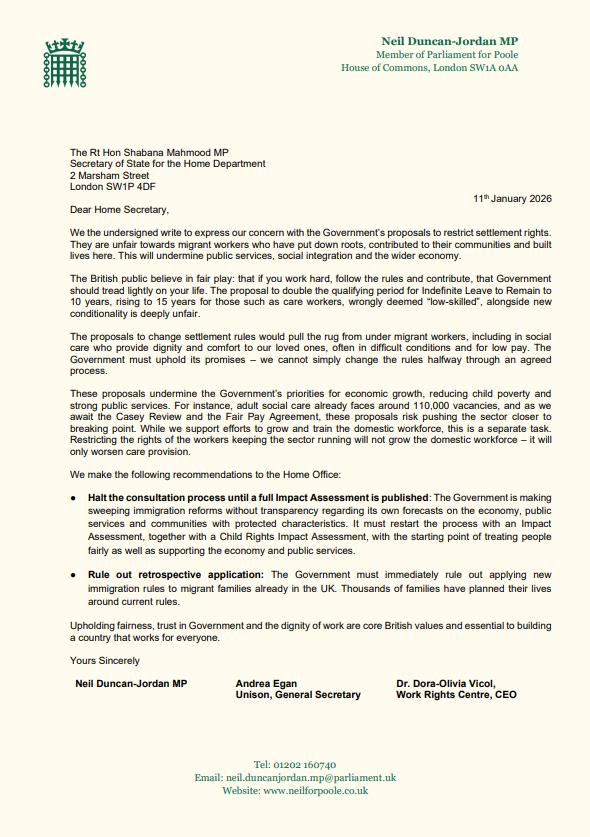
The first page of the letter to Mahmood.
[1]The new asylum regime: the first steps: https://bobmouncer.blog/2026/03/27/the-new-asylum-regime-the-first-steps/
[2] See my earlier blog for concerns expressed by others: The new asylum regime: the first steps, Concerns: The new asylum regime: the first steps « Bob Mouncer’s blog
[3]New and old hostilities: New and old hostilities « Bob Mouncer’s blog
[4] See New and old hostilities, Earn your keep: New and old hostilities « Bob Mouncer’s blog
[5] Restoring Order and Control: A statement on the government’s asylum and returns policy, Foreword from the Home Secretary, and para 2: Restoring Order and Control: A statement on the government’s asylum and returns policy (accessible) – GOV.UK
[6] The Migration Advisory Committee is a public body that advises the government on migration policy (see Migration Advisory Committee – GOV.UK).
[7] Changes to UK visa and settlement rules after the 2025 immigration white paper, House of Commons Library, 20 March 2026, section 1: Changes to UK visa and settlement rules after the 2025 immigration white paper – House of Commons Library
[8] Changes to UK visa and settlement rules after the 2025 immigration white paper, House of Commons Library, 20 March 2026, section 2: Changes to UK visa and settlement rules after the 2025 immigration white paper – House of Commons Library
[9] UK’s migration crackdown risks care home staffing crunch, 22 April 2026: UK’s migration crackdown risks care home staffing crunch | Reuters
[10] UK’s migration crackdown risks care home staffing crunch, 22 April 2026: UK’s migration crackdown risks care home staffing crunch | Reuters
[11] Cited, UK’s migration crackdown risks care home staffing crunch, 22 April 2026: UK’s migration crackdown risks care home staffing crunch | Reuters
[12] UK’s migration crackdown risks care home staffing crunch, 22 April 2026: UK’s migration crackdown risks care home staffing crunch | Reuters
[13]Cited, UK’s migration crackdown risks care home staffing crunch, 22 April 2026: UK’s migration crackdown risks care home staffing crunch | Reuters
[14] Restoring Order and Control: a statement on the government’s asylum and returns policy, 21 November 2025: Restoring Order and Control: A statement on the government’s asylum and returns policy (accessible) – GOV.UK
[15] Changes to UK visa and settlement rules after the 2025 immigration white paper, 20 March 2026: Changes to UK visa and settlement rules after the 2025 immigration white paper – House of Commons Library
[16] Explanatory memorandum to the statement of changes in the Immigration Rules:Explanatory memorandum to the statement of changes in the Immigration Rules: HC 1691, 5 March 2026 (accessible) – GOV.UK
[17] Explanatory memorandum to the statement of changes in the Immigration Rules, para. 5.67: Explanatory memorandum to the statement of changes in the Immigration Rules: HC 1691, 5 March 2026 (accessible) – GOV.UK
[18] Apply for the Global Talent Visa: Apply for the Global Talent visa : Overview – GOV.UK
[19] “Neil Duncan-Jordan MP opposes Home Office planned changes”, Bournemouth Echo: Neil Duncan-Jordan MP opposes Home Office planned changes | Bournemouth Echo
No change from Labour, whatever the Observer says
The Observer article below welcomes Labour leader Keir Starmer’s statement on Labour’s approach to small boats, people smugglers, deportations and refugee policy generally. In contrast to the left’s view that there is little to “differentiate a possible future Labour government from the present Conservative one”, it claims to detect “a sharp dividing line between the government and Labour on asylum policy.” It says Labour is offering a humane, pragmatic and commonsense approach in contrast to the Tories’ populism and its “cruel, unworkable policy”.
The paper is right to say that the government has removed the right of all migrants who have arrived in small boats to claim asylum, when most of them would qualify for refugee status if they did; it is right to deplore the measures the government have introduced “to detain them until they can be deported to another country for their claim to be processed”; in the light of the government’s keenness to deport asylum seekers it deems to be “illegal”, the article is right to point out that no deportation deals have been achieved with any country except Rwanda (and the Supreme Court has yet to rule on the legality of that deal); it is also right to criticise the backlog the government has allowed to develop in the processing of asylum claims, so that “83% of claims made in 2018 had not been processed five years later”. The article is right to condemn the Tory policy package.
But the Observer is wrong to say that the “real difference” between Labour and the Tories is that Labour “would scrap the government’s unworkable and cruel detention and deportation policies, restoring the right of people to claim asylum in the UK.” It will do this, the Observer seems to believe, by investing in “1,000 extra case workers and a returns unit of 1,000 staff to process claims much more quickly and deport those whose claims are rejected.” This would work because Labour would come to a deal with the European Union (EU) “in which the UK would accept a quota of refugees in exchange for being able to return those who cross the Channel in small boats.” But even if such a deal could be reached, we would still be left, under Labour, with the same old “detention and deportation” policy. None of the refugees in small boats will have their claims considered here. If the Observer thinks that shunting vulnerable and desperate people around Europe as they wait for decisions on their future is what it calls “a far better approach”, so be it. The refugees may not agree. Moreover, in the same article, the Observer admits that “pan-European cooperation has never worked well in the bloc and has broken down further in recent years.” The Observer must know it’s clutching at straws.
But there is one thing Starmer has to do before we can believe in this tale of “differentiation” between Labour and the Tories on asylum. He has to commit the Labour Party to repealing the Illegal Migration Act 2022. While the Act remains, Tory policy remains unchanged. Unless it is repealed, there can be no “differentiation” between the parties. In its guidance to the Act, the government makes clear that
anyone arriving illegally in the United Kingdom will not have their asylum claim, human rights claim or modern slavery referral considered while they are in the UK, but they will instead be promptly removed either to their home country or to a safe third country to have their protection claims processed there. (https://www.legislation.gov.uk/ukpga/2023/37/notes/division/3/index.htm)
Obviously the Act must be repealed. But both Starmer and shadow immigration minister Stephen Kinnock have refused to commit to repealing it. While it stands, so does the policy.
The article begins by setting the “Observer view” in the context of Starmer’s political approach as a whole. Keir Starmer, it says,
has made clear that under his leadership a first-term Labour government would stick to tough fiscal rules, and has ruled out making any unfunded spending commitments in the run-up to the next election. That has fuelled criticism from some on the left of his party, who argue that this has limited the extent to which he has been able to differentiate a possible future Labour government from the present Conservative one.
It says Starmer’s asylum policy makes Labour different. It doesn’t.
What that means for our voting intentions next year is up to us all. But it puts a very big strain on mine.
Punishing refugees: a policy quietly dropped? No, it’s still a crime to travel by boat
According to the article below, the government has “quietly dropped” the policy they’ve been boasting about for months as the gold standard way of stopping asylum claims by people who have, in their desperation, crossed the Channel in small boats to get here. Originally, their claims for asylum were going to be heard but, even if they were successful, they would be granted “Group 2” status, get only temporary leave to remain and would soon be deported. Only those with passports or visas, or who had managed to find one of what the government calls its “safe routes” (they are becoming increasingly difficult to detect, even with up-to-date technology) would be given Group 1 status, indefinite leave to remain, the right to family reunification and eventually be able to apply for UK nationality. That was the plan. It was called “differentiation”. People who travelled in unauthorised ways had to be punished.
All this has now been “paused”, there will be no “differentiation”, according to Robert Jenrick, the Immigration Minister. Now, migrants who arrive on boats and get their asylum claims granted will get “the same conditions” as the ones with passports or visas, etc. Instead of being punished for travelling on a small boat across dangerous waters, Group 2 asylum seekers will be “aligned with Group 1”. Why the pause? The government claims it will speed up the processing of the backlog of 50,000 people who have been waiting since June 2022 for their cases to be decided. These include 15,000 from countries such as Afghanistan and Sudan, who are more likely to have their claims accepted and will now be processed through questionnaires rather than interviews.
But whatever the reason, Enver Solomon (Executive Director of the Refugee Council) is understandably relieved and has expressed agreement with the move: “It’s the right decision”, he said, “to pause the differentiation policy that treats refugees based on how they got to the UK rather than on their need for protection.”
But to leave it there, of course, would be to rejoice too soon, and the Refugee Council knows that. A pause is just that. A pause. And a Home Office spokesperson has already warned us that the Illegal Migration Bill, which is currently making its way through parliament, will definitely not be paused. Instead, the spokesperson reminded us, it will “make sure that people who come here illegally won’t have their asylum claim considered in the UK and instead can be detained and swiftly removed.”
That’s the policy. None of the politicians can stop it. Most of them don’t want to. The Labour Party is refusing to say whether it will repeal the Act in government. That means it won’t. Only the pressure of a mass movement against this cruel policy will get rid of it.
Can we build one?
Here’s a petition: https://petition.parliament.uk/petitions/634311
The Guardian article:
So you’re a Group 2 refugee, are you?
This is the third blog in the series on the UK’s Nationality and Borders Act 2022
The first thing to note if you are a Group 2 refugee is that you are a temporary person: “Temporary protection status will be for a temporary period, no longer than 30 months …” (Policy Statement, p. 20, see link below). Once that period is over, you will be protected from absolutely nothing. In Patel’s impersonal language, “individuals will be reassessed for return to their country of origin or removal to another safe country” (ibid.).
Three main problems arise immediately. The first is that it may not be safe to send you back to your own country. The UK government will argue that, since your claim of persecution has been rejected, returning you to your own country will not put you in danger. But, as we have seen, the Home Office’s decision-making is open to question and we will see in later blogs that in any case its knowledge of countries of origin is often inaccurate or out of date. So your safety is far from 100% certain. Moreover, there are plenty of examples where governments, especially if the Home Office has informed them of an asylum seeker’s return, punish them once they get back, and the UK government does not check on the welfare of the people it returns. Labour Immigration Minister Baroness Scotland told the House of Lords in 2006:
Where we refuse a claim and the Asylum and Immigration Tribunal dismisses any appeal we … consider that it is safe for that individual to return. This is one of the reasons why the Home Office does not routinely monitor the treatment of individuals once removed from the UK (cited Mouncer, B. (2010), Dealt with on their Merits?, p. 98).
The second problem is that so far Rwanda is the only country to agree to take asylum seekers passed on to them by the UK, and we don’t know if they will include the UK’s temporarily protected refugees, how they would be treated if they were included (settled there or removed somewhere else?), let alone whether there will be agreements in the future between the UK and other countries.
Thirdly, temporary protection status also means “family reunion rights will be restricted and there will be no recourse to public funds except in cases of destitution” (Policy Statement, p. 20). In practice this must mean that family reunion rights will be defunct in practice (for who would want to bring their family over for a maximum of 30 months, only to be deported to some unknown destination after that, possibly in a state of near-destitution?). But even “restricting” the right to family life surely breaches the spirit of the Refugee Convention, if not the letter. For although there is no specific reference to family reunification in the Refugee Convention, the Conference that adopted that Convention passed a strongly worded recommendation urging governments “to take the necessary measures for the protection of the refugee’s family, especially with a view to ensuring that the unity of the family is maintained” (The Right to Family Life and Family Unity of Refugees, etc., p. 9, para. 2.1.4: https://www.unhcr.org/5a8c40ba1.pdf). Jastram and Newland argue that “Recognition as a refugee gives rise to a prima facie reason to admit the refugee’s close family members to the country of asylum.” (Jastram, K. & Newland, K., Family Unity and Refugee Protection, p. 581: http://refworld.org). They give the same reason: “Reunification in a country of asylum is the only way to assure the right to family unity for refugees, who cannot by definition return to their country of origin.” This has been accepted by most signatories to the Refugee Convention ever since its inception.
The Home Office has described another scenario. In its Explanatory Notes it says that “individuals may be eligible to apply for long residency settlement after 10 years if the necessary requirements are met.” (Explanatory Notes, p.6, para 19). It doesn’t specify who these individuals might be or explain the contradiction between the 10-year period envisaged in this scheme and Patel’s firmly limited protection period of “no more than 30 months”. But with no basis in international law for the creation of Group 2 refugee status, the deportation of recognised refugees, whether after 30 months or 10 years, clearly breaches the Refugee Convention, Article 32: “The Contracting States shall not expel a refugee lawfully in their territory save on grounds of national security or public order.”
Finally, we have seen that if you are given Group 2 status, with its temporary protection, you will have “no recourse to public funds except in the case of destitution” (Policy Statement, p. 20). However, for UNHCR, a refugee is a refugee regardless of the notion of temporary protection or the allocation of any “Group 2” status. UNHCR is clear that a “Group 2 refugee” is entitled to “public relief and assistance on the same terms as nationals”, as laid down in Article 23 of the Refugee Convention (UNHCR Comments on the New Plan, para. 45; Refugee Convention, Art. 23). A ban on such benefits must surely be a breach of the Convention.
Policy Statement:
Out of sight, out of mind: the fate planned for refugees
Discreet talks with the government in Tirana to establish an asylum centre are under way. After a series of frustrations in talks with other countries to host migrants, cabinet hopes of a deal with Albania are growing (The Times, “Migrants to be held in Albania”, 18 November 2021).
Abstaining is not an option – Labour must reject Patel’s Bill
I’ve written to Labour’s Shadow Home Secretary, Nick Thomas-Symonds, and my local MP, Emma Hardy, asking them to make sure that Labour votes against Priti Patel’s new asylum Bill.
Scrutiny of the Nationality and Borders Bill begins tomorrow (19 July). It is of particular interest to me because of my earlier research at Hull University on the treatment of asylum seekers. My particular concern today is that Labour should give no credibility to the Bill. In particular Labour shouldn’t abstain at any point on the grounds that “we understand voters’ concerns”. Labour did this on the Welfare Bill in 2015 and the front bench tried to do it on the Immigration and Social Security Bill in, I think, 2017. But it is time to stand up for a few principles now and not just run scared. The current Bill is the worst Bill of its kind that I can remember and it will do untold harm to people from the moment it becomes law. Labour should have no truck with it from day 1.
I’ve looked at the Bill itself now, so I thought I’d make some preliminary comments. I will focus on Part 2, which is about asylum, but for now I will only mention a couple of points.
Section 10 is unacceptable from the outset: it immediately creates two groups of refugees. Group 1 refugees are legal; Group 2 refugees are not. They are “unlawful”. What makes them unlawful is, according to s.10 (4), because “a person’s entry into or presence in the United Kingdom is unlawful if they require leave to enter or remain and do not have it.” This new definition of “unlawful” makes the vast majority of asylum seekers illegal. The Bill achieves this end, in part, because it creates an entirely new offence. According to s.37(2), (C1), a person who
“(a) requires entry clearance under the immigration rules, and
(b) knowingly arrives in the United Kingdom without a valid entry
clearance,
commits an offence.”
Plus, according to s. 37 (3):
“In proceedings for an offence under subsection (C1) above of
arriving in the United Kingdom without a valid entry
clearance … (b) proof that a person had a valid entry clearance is to lie on the defence.”
This offence of “arriving in the UK” is a new offence, created by this Bill. According to criminal defence barrister Aneurin Brewer, the current situation is that
“those who merely arrive, immediately claim asylum and are as a result admitted to the UK while their asylum claim is processed have not entered the UK illegally.” https://www.freemovement.org.uk/prosecutions-for-assisting-unlawful-immigration-in-small-boats-cases-the-key-to-acquittal/
If this Bill is passed, they will have done so and thus, although the Bill doesn’t breach Convention Article 31 (1) according to Patel’s narrow and restrictive interpretation, it certainly ignores the spirit of UNHCR recommendations on applying a “flexible and liberal” approach and on giving “the benefit of the doubt”.
Patel is legally entitled to do this. It may be worth bearing in mind that the Refugee Convention is not a perfect instrument for protecting refugees. Its final form was the result of a deal. Every state wanted to limit its obligations to give protection to refugees. So the Convention and UNHCR’s Guidelines, despite talk of liberality and benefit of doubt, provided them with caveats and ways of avoiding their responsibilities. One example of this is Article 31(1). While it is generally interpreted as prohibiting governments from imposing any penalties on asylum seekers who arrive without passports or other travel documents, governments generally do impose penalties because the article talks of asylum seekers who come “directly” from the country of their persecution and refers to illegal entry. The word “directly” can be interpreted to mean that penalties can be imposed if the asylum seeker comes to the UK and passes through another “safe” country where, it is always assumed, they could have claimed asylum. This interpretation of the word “directly” was probably the reason why the Dublin Convention, now not applicable after Brexit, was not regarded as a contravention of the Refugee Convention. one of the things Patel is proud of doing in this Bill is making this requirement part of UK law now, thus dealing with the “problem” of the disappearance of the Dublin Convention after Brexit.
So what I’m saying is that, in principle, the Convention seems to establish the primacy of refugee protection, but in its detail and in practice it has proved to be ambiguous and open to a variety of interpretations. UNHCR “advocates that governments adopt a rapid, flexible and liberal process” when dealing with asylum applicants because it recognises “how difficult it often is to document persecution”. However, its interpretation of the Convention contradicts this stance. In its definition of a refugee, the Convention’s reference to persecution “for reasons of race, religion, nationality, membership of a particular social group or political opinion” suggests the possibility of group persecution and a collective refugee experience. But, when interpreted by UNHCR, the definition turns out to be based on a concept of persecution in which the burden of proof falls on the individual asylum seeker. Thus people “who apply for refugee status normally need to establish individually that their fear of persecution is well-founded”, i.e. they must provide evidence that it is not just their social group, members of their political party or people who share their religion or ethnicity who are in danger but themselves as individuals. I have sat in a good few solicitors’ offices listening to them explaining to their clients how their letters, newspaper reports, and their photographs are absolutely not proof. A “flexible and liberal process” becomes less likely as governments demand this rigorous standard of proof. To put the burden of proof on refugees is to consider them guilty until proved innocent.
But Patel is clearly entitled to do what she’s trying to do here. She can invent laws and move the goalposts, she can choose only to follow the UNHCR advice that suits her and ignore the rest. But I think Labour should do its best to stop her. It should, if it can’t eliminate all her hostile purposes from the Bill, vote against the whole shebang and campaign loudly against it from the start. It should never abstain. Not just because of the Refugee Convention, important though that is. But because of the principle of refugee protection and the defence of human rights.
“The Secretary of State [still] doesn’t believe you”
Read this Guardian article: it describes the UK asylum process at its most crucial point (the asylum interview, when individuals are given their main chance to explain why they are seeking asylum). It says that “many asylum interviews are rushed, biased and resolved by ‘cut and paste’ decisions.”
The article contains little that wasn’t known before – but these facts don’t often get publicly aired. The research I did between 2004 and 2009 on the treatment of asylum seekers is now out of date in many ways: it couldn’t have taken into account the upsurge in migration of more recent years, when people struggled across continents, many drowning in the Mediterranean. So to that extent it is out of date. But the story that emerges from this article of how asylum decisions are made today hasn’t changed since I wrote. The treatment of asylum seekers by the Home Office is cynical, ignorant, cruel and shameful. I will focus on just a few of the points raised in the article.
Because of the pressure from Home Office targets (“225 interviews or decision reports a year”), one former caseworker says: “You would have your own stock paragraphs that you put into refusal minutes.” Caseworkers say to themselves, “I’ll just sort of cut and paste the decision I did last week.” This is certainly common practice. But I see it not just as a desperate attempt by the caseworker to “get the job done”, but also as part of the structure of the asylum system. The Home Office gives this cut-and-paste approach official encouragement with its own stockpile of paragraphs which caseworkers are encouraged to use routinely when compiling their reports. So it is not enough for us to find fault with individual caseworkers or for caseworkers to blame themselves. Here is one of the Home Office’s ready-made paragraphs intended to help caseworkers in their task of refusing claims:
Further doubts as to your alleged fear of persecution can be drawn from the fact that you did not leave [COUNTRY] until [DATE]. The Secretary of State holds the view that if your fear of persecution by the [COUNTRY] authorities was genuine you would have left [COUNTRY] at the earliest opportunity and the fact that you did not casts doubt on your credibility.
Of course, many reasons may govern the timing of a refugee‘s departure: the need to find an agent, raise funds to pay the agent (e.g. by selling property), obtain false documents. Even if the journey is through normal channels there will be family concerns which cause delay. Moreover, members of opposition groups committed to political change do not tend to give up their cause easily and may maintain their activism until the last moment. But the cut-and-paste approach discourages any attempt to take these considerations seriously and tends to assume the asylum seeker’s guilt. So an Ethiopian asylum seeker was told that because he had been arrested in January but didn’t leave until May, this delay “detracts from the truthfulness of your claim to be a genuine asylum seeker.”
I met an asylum seeker from Iran who was treated in a similar way. Reza (not his real name) was a member of a political party whose members suffered persecution. After a demonstration in July 2000, during which one of his friends was killed and another went missing, his house was raided by the police and his father-in-law taken in for questioning, Reza and his wife Maryam went into hiding and a senior party member “advised me to get out of Iran if I could”. Even then he hesitated: “I had a family in Iran, I had a lot of property in Iran, I did not want to leave. But I was frightened for my safety.” None of this was unreasonable or slow. In the event he made the arrangements quite quickly – financial and travel arrangements, false passports – and left in September. Unfortunately, none of this impressed his caseworker, who insisted that his departure was tardy: “The Secretary of State holds the view that if your fear of persecution by the Iranian authorities were genuine, you would have left Iran at the earliest opportunity, and the fact that you did not do so casts doubt upon your credibility”, which happens to match exactly the wording of the prepared paragraph from the Home Office stockpile quoted above.
The article mentions transcripts of asylum interviews where “it was evident the caseworker knew very little about the case”, in the context of the pressure to meet the targets, and that was no surprise to me. But pressure to meet targets is not the only worry we should have here: I found that the ignorance of the caseworker often stemmed from Home Office Country Information reports which frequently lacked certain kinds of information entirely or were out of date. Ignorance is a feature of the system. What happens if an asylum seeker claims persecution because of membership of a political party but the party is not mentioned in the Country Report? One caseworker told researchers in 2003:
We need to know whether particular groups or political parties exist, but instead we are told to say that the Secretary of State is not aware of this group so therefore it is unlikely to be of interest to the authorities. But really they have no information on whether the group existed.
This ignorance is then turned into a denial of the asylum seeker’s credibility. A Kurd from Syria was told in his refusal letter:
The basis of your claim is that you fear persecution in Syria because of your political beliefs. You are a member of the Hergirtin. The Secretary of State is not aware that this party actually exists.
Asylum application refused. But, on appeal, the adjudicator discovered that Amnesty International knew of the party’s existence and its long history. Appeal allowed. The Syrian Kurd probably had a good solicitor who had done the necessary research. Not everyone is as lucky by any means and the caseworker (quoted in the article) was right to call the asylum process a “lottery”.
The article says there is a “culture of disrespect” among caseworkers and describes a culture in which jokes are made about asylum applicants, even going so far as to joke about them being tortured. I came across an early example of canteen culture in my research, where an Afghan asylum seeker had clearly been the butt of cynical jokes about his claim, ending in a spoof letter which declared his asylum claim “a pile of pants”. This version of the refusal letter was accidentally sent to his solicitor. According to The Guardian,
Naomi Nicholson, a case worker with the Refugee Legal Centre … had to explain the meaning of the letter to her client … “I was trying to paraphrase the letter starting from the top, but when I got to the fourth paragraph I didn’t know what to say, I was so shocked,” Ms Nicholson said. “I was very embarrassed. It was my country that was saying this to him.” Immigration staff tried to replace the letter with a hurriedly amended one that merely states “the Secretary of State is not satisfied that you have established that you are an Afghan national.”
I could go on, but this is enough. But just to end: anyone who gets frustrated with the sight and sound of Theresa May or Jeremy Hunt answering every question about the NHS with the mantra: “This government has provided more money, more doctors, more nurses, more everything than any previous government …” will understand my frustration at seeing another worn-out phrase near the end of the article: “The UK has a proud history”, says the Home Office, “of providing protection to those who need it.” I have seen and heard this phrase more times than I’ve had hot dinners. It does not reflect the reality of many an asylum seeker’s experience. Neither does the other phrase deployed by Her Majesty’s civil servants in the name, and with the permission, of their Secretaries of State: all asylum claims are “dealt with on their merits”. That was the title of my thesis when I finished my research. But I put a question mark at the end.
Read the article.
“It’s the right thing to do” – the politicians’ mantra to justify policy
When Home Office minister Baroness Williams and the French Ambassador to the Court of St James assured us that the demolition of the Calais refugee camp (“the jungle”) would not begin until all the children there were safeguarded, many people of goodwill believed them. Moreover, at a higher level, Home Secretary Amber Rudd and her French counterpart, Bernard Cazeneuve, also apparently agreed that children must be protected.
Yesterday’s Guardian report shows these promises to be empty words. Instead, children were abandoned,
“lured out of … the camp in the afternoon with the promise of transport to a reception centre where they could be assessed for asylum or reunification with families in the UK. However, after an hour, no bus had arrived. Police units emerged in force, with riot shields, teargas and taser guns, and began to kettle the group, pressing them into a side street in an industrial estate. Some of the refugees were in tears as it appeared that they would be sleeping on the streets again.”
Once news of this began to circulate, a badly acted charade took place, as Amber was said to have called up Bernard and told him that the children had to be “properly protected”.
Tell that to 16-year-old Hussein from Darfur, where he had already spent five years in a refugee camp. In Calais, after queuing before dawn on three successive days,
“he never made it to the head of the line to be processed, and on Wednesday night became one of the estimated 200 unaccompanied children left to sleep rough. Now he faces a second night in the grass with temperatures dropping and despondency setting in.”
Tell it to the despairing kids being helped by charity workers:
“An atmosphere of despair among charity workers was mirrored by the behaviour of the children, all aged approximately 14 to 17, some of whom huddled against the wall in blankets as the temperature plummeted. One Afghan teenager, wrapped in a yellow and green sleeping bag, said: ‘Fuck France, Fuck Britain. You are racists.’ He was in tears as a French volunteer tried to console him by asking him not to be angry with aid workers. He retorted: ‘You didn’t have to sleep on the side of the road last night – you have documentation, you have money. Fuck France.’”
The boy has insight. “No French or British officials were on the scene with the children,” says the report. Of course they weren’t. The agreement to protect between diplomats and politicians is a charade. Their intent is to punish, and to discourage others. That was David Cameron’s intent when he withdrew support from the Italian-based rescue operation in the Mediterranean in the days of the Tory-LibDem coalition. The song that was sung then was that these people must be taught a lesson – that they will die if they come to Europe. Stop rescuing them. We must let them drown.
It’s the same story now. Punish the kids who came, warn future migrants: “Don’t come here if you’re persecuted, or bombed out of your home or even out of your hospital. We don’t want you.”
You see, despite having earlier agreed, unwillingly and under strong pressure, to bring a tiny proportion of the children into the UK, what’s happened to these remaining kids in Calais is not a mistake or down to bad organisation. It’s deliberate. It’s policy. “It’s the right thing to do.”
And if you don’t like it being done in your name, tell your MP to object. Now.
Here’s the Guardian article: https://www.theguardian.com/world/2016/oct/27/calais-camp-minors-children-abandoned-uk-france-human-rights?utm_source=esp&utm_medium=Email&utm_campaign=GU+Today+main+NEW+H+categories&utm_term=196826&subid=12991040&CMP=EMCNEWEML6619I2
Remember – and think before you believe what they tell you
This story is about the reinstatement of a person’s reputation. For years he was vilified by the tabloids, and even by more “serious” newspapers, as the “cause” of the arrival of HIV/Aids. The research described in the article below proves that he wasn’t, and that blame was not an appropriate response to the emerging crisis:
The article tells its own story. But if we remember those days (the 1980s), especially the subtle, unrelenting pressure to believe that the epidemic was a “gay plague” because the gays started it, we should now remind ourselves again not to take at face value all we read. About anything. About housing benefit claimants, about disability allowance claimants, about tax credit claimants, about people who use food banks, about “bogus” refugees living in grand houses paid for by the local council, about war and its causes and the reasons for going to war, about the need to bomb children in far-off places – about anything.
That’s all. I just wanted to say that. I was remembering old tabloid headlines.
EU 2: You will be voting against migrants whichever way you vote
How to vote in the referendum if you support a humane response to the current migration crisis? Many in the No camp sound like they just want to “secure our borders” and keep the migrants out. But if we want a humane response what do we do?
In 2014, when rickety boats filled with people fleeing war and persecution began to sink, dragging their passengers to the bottom of the Mediterranean, or their bodies got washed up on the nearest shore, there were some who shouted, “Close the borders”. The Tory-led coalition (really the Tories dragging the pathetic so-called Liberal Democrats behind them) said, in effect, “Let them drown” and withdrew its support for the Italian-led rescue operations. Under pressure after this common Tory gut reaction Cameron said they would take in a tiny number of refugees – but not from the Mediterranean. They would take them from the refugee camps in Lebanon and elsewhere. Because, you see, people contemplating a journey across the Mediterranean had to learn a lesson: “Don’t set out in the first place.” So when, predictably, the drowning continued, presumably the Tories thought, “Don’t come whining to us – it’s your own fault.” By April 2015 there were fifteen times more deaths of migrants in the Mediterranean that year than in the whole of 2014.
More recently, during the crisis in Calais, in the camp called “the Jungle”, Cameron seems to have been forced (through actual or threatened legal action in the courts) to concede that at least some children there, with family in the UK, have the right to come here. But he’s done bugger all about it and most of them are still in Calais.
It’s arguable that if we vote to leave the EU we will be turning our backs on desperate people and putting their fate in the hands of a politician (whether Cameron or Boris Johnson) who would let migrants drown, let them rot in the garbage of Calais or send them packing back to where they came from.
So what would we be doing if we voted to stay in the EU? Other EU states seemed at first to be different. Germany took large numbers of refugees and there was talk of sharing responsibility across the EU states. But many were reluctant from the start, they couldn’t agree how this might be done and they began to squabble amongst themselves. So there was deadlock and some of them began to close their borders – those borders which, under the Schengen Convention, were the pride and joy of the EU, open borders within the Union. Another cry went up: “Schengen is finished.”
For those who don’t like the EU because they don’t like foreigners this is good news. For them the EU is finished, and good riddance. For those who hoped that the EU would provide a humanitarian solution it is bad news. So how to vote? Jeremy Corbyn is still optimistic as, on behalf of the Labour Party, he argues to vote Yes to the EU:
“‘There has to be an agreement all across Europe that [the EU states] all take a proportion of [the refugees],’ he said. ‘The problem is that the degree of inward-looking politics that’s going on has meant that Greece is making a huge effort, Italy is making a huge effort and Germany is making a huge effort. Every other country is putting barbed wire entanglements along their borders to keep desperate people out … Surely in the 21st century the least we can do is reach out and try to help these people in some way; by the political solution in Syria; by the support for what the Greek government is trying to do and take a proportion all across Europe.’”[1]
That, presumably, would be the policy if there was a Labour government. But yesterday the French began to bulldoze the people in Calais out of their makeshift homes. The French had originally said that the process of moving people would be done by gentle persuasion over many weeks, not with force or violence, not with bulldozers. The French Minister of the Interior spelt this out only last week: the government’s plan, he said, was not “to carry out a brutal evacuation of the camp by using bulldozers, this is not how we operate.” But yesterday the bulldozers appeared and the destruction began.
On Channel 4 News last night Krishnan Guru-Murthy asked Sylvie Bermann, the French ambassador to the UK: “Why did you say ‘no bulldozers’ and then use them?”
Bermann: I think we are using bulldozers to clear the camp, not to force all these migrants to go.
Guru-Murthy: But you said you wouldn’t.
Bermann: Well, our ministers said we wouldn’t force people to go, but at the same time what I cannot understand is – well, your reporter said it was filthy, stinking conditions. So how could you consider it better to live in these squalid conditions than to be relocated in accommodations [sic] where you have water, heating, electricity?
Guru-Murthy: But you don’t have enough space. There are thousands living there and there aren’t enough spaces in the shipping containers. They’re not flats, are they, they’re shipping containers, where you’re suggesting they go and live in?
Bermann: They are temporary accommodations, that’s true, but some of them will be relocated in other camps in France.
Guru-Murthy: Can you guarantee every one of them a comfortable roof over their heads?
Bermann: They will be relocated, but conditions will be far much better [sic] than it was in the Jungle.[2]
At the end of all this ducking and diving, there was no answer to the question, “Why use bulldozers when you said ‘no bulldozers’?” But then Sylvie is a diplomat.
So referendum voters who want a humanitarian solution to the migration crisis aren’t going to get one, in or out of the EU. The Tories will close the UK’s borders either way; the EU states will do the same; and France, our nearest neighbour, will bring out the bulldozers at the drop of a hat despite its much-vaunted pride in being the home of human rights.
How to vote? With some difficulty.
[1] The Guardian, 29 February 2016.
[2] Channel 4 News, 29 February 2016.
 Bob Mouncer's blog