Home » Posts tagged 'migrants'
Tag Archives: migrants
The hostile environment: Labour’s response
In the first blog in this series (https://bobmouncer.blog/2025/03/22/hostile-environment-the-windrush-scandal-i/), I showed how the announcement of a “hostile environment” for migrants by UK Home Secretary Theresa May in 2012 led to suffering and trauma for thousands of people, the Windrush generation. In the second blog (https://bobmouncer.blog/2025/03/26/hostile-environment-the-windrush-scandal-ii/), I told the story of Hubert Howard, who was one of its victims. In the third blog (https://bobmouncer.blog/2025/03/30/hostile-environment-the-windrush-scandal-iii/), I showed how documents that could have prevented the disaster to Hubert and thousands of others were deliberately destroyed; I described how the scandal slowly emerged and the government’s obstinate refusal to roll back on the policy; and I showed how a compensation scheme was finally devised and how it failed so many Windrush victims. In the last blog (https://bobmouncer.blog/2025/04/02/hostile-environment-the-mediterranean-scandal/) I described the Mediterranean scandal, in which the EU, including the UK, stopped rescue operations in the Mediterranean and how a UK government tried to deny its responsibility for the ensuing tragedy.
In this blog, I examine Labour’s response to the hostile environment.
Labour’s response
The two major scandals examined in my previous blogs in this series unfolded, first, under a Tory/LibDem coalition government and then under the subsequent Tory government. But what was Labour’s response to May’s hostile environment? Maya Goodfellow describes it as “the most minimal resistance”.[1] Labour, the official opposition, abstained in the final Commons vote on the Immigration Bill. Sixteen MPs voted against it, but only six of them were Labour MPs: Diane Abbott, Kelvin Hopkins, John McDonnell, Fiona Mactaggart, Dennis Skinner and Jeremy Corbyn. Corbyn said the Bill was
dog-whistle politics, the mantras being that every immigrant is an illegal immigrant who must somehow be condemned, and that immigration is the cause of all the problems in our society … If we descend into a UKIP-generated xenophobic campaign, it weakens and demeans all of us and our society, and we are all the losers for that.[2]
One of the other MPs was Sarah Teather, a LibDem MP and former minister, who had told The Guardian in 2013 that the proposals in the Bill were “hewn from the same rock” as earlier welfare cuts, much of which were “about setting up political dividing lines, and trying to create and define an enemy”.[3] But apart from the six rebels, Labour MPs obeyed their leader, Ed Miliband, and the Labour whips, and abstained in the Commons vote.
By October, Miliband had moved further right. In a by-election campaign in the Rochester and Strood constituency, which UKIP was hoping to win, Miliband declared he would toughen immigration policy if Labour won the general election in May the following year.[4] Echoing Theresa May, he raised familiar spectres and fears about immigration, ignoring its advantages. The UK, he said, “needs stronger controls on people coming here” and promised a new immigration reform Act if he became Prime Minister. His message was:
- If your fear is uncontrolled numbers of illegal migrants entering the country, Labour will crack down on illegal immigration by electronically recording and checking every migrant arrive in or depart from Britain
- If your fear is of widespread migrant benefit fraud, Labour will make sure that benefits are linked more closely to workers’ contributions
- If the spectre that haunts you is, as Margaret Thatcher had put it, that immigrants were bringing an “alien culture” to Britain, Labour understands, and will ensure that migrants integrate “more fully” into society
- Miliband turned his attention to the EU. Arguments about Britain’s EU membership were coming to a head at this time, with both the Tory right and UKIP agitating for the UK to leave. In 2013, Prime Minister David Cameron had agreed to renegotiate Britain’s terms of membership. The renegotiation would be followed by an in/out referendum to take place after the 2015 general election. Miliband, in his by-election speech in 2014, included migration from the EU in his new immigration promises. He claimed that Labour under Tony Blair had wrongly opened the UK to Eastern Europeans when their countries had joined the EU in 2004. He would not let that happen again. If he won the 2015 election, there would be longer “transitional controls” for new EU members before they could move to Britain.
He even told the voters of Rochester and Strood that they didn’t need to vote for UKIP to get these policies: Labour would do the job.
One pledge seemed at first sight to be protective of migrants. Miliband said he wanted to ensure that migrants were not exploited by employers. However, this was, in fact, a reference to another fear – that migrant workers undercut native workers’ wages because bosses often pay lower wages to migrants (often below the minimum wage). However, where this problem exists, its solution lies not in immigration law but in employment law and its enforcement. It also lies in union recognition and legally binding agreements.
As promise followed promise and pledge followed pledge, Miliband began to sound like Theresa May. A few months later, as the 2015 election approached, Labour’s campaign included the issuing of mugs with “Controls on immigration” printed on them.
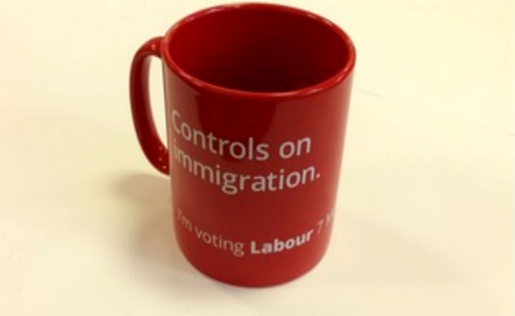
Labour’s immigration controls mug
None of this saved Miliband or his party, and the Tories won the 2015 election; the referendum vote in 2016 in favour of leaving the EU led to David Cameron’s resignation as Prime Minister; he was succeeded by Theresa May; Ed Miliband resigned as Labour leader; Jeremy Corbyn was elected in his place; the process of leaving the EU began. In 2017, Theresa May called another general election, hoping to increase her majority. In the event, the Tory party lost its small overall majority but won the election as the largest single party. But from then on it had to rely on Democratic Unionist Party (DUP) votes to get its business through the Commons.
These parliamentary changes meant nothing for the Windrush generation. The scandal began to come to light in 2017 but their suffering continued beyond the end of the decade, one of the main reasons being that the compensation scheme was seriously flawed. This remained a problem in April 2025, almost a year after the election of a Labour government. The Parliamentary and Health Service Ombudsman (PHSO), Rebecca Hilsenrath, had found that
further harm and injustice are still being caused by failings in the way the scheme is working. We found recurrent reasons for this, suggesting these were not one-off issues but systemic problems.[5]
In response, the Home Office sought to give some reassurance:
This government is committed to putting right the appalling injustices caused by the Windrush scandal and making sure those affected receive the compensation they rightly deserve.[6]
Nevertheless, given the Home Office’s record, we should hesitate before we are reassured. In 2020, the Williams review of the Windrush scandal had made 30 recommendations to the government, all of which were accepted by Priti Patel, Tory Home Secretary at the time. In January 2023, the Home Office unlawfully dropped three of them.[7] Moreover, the department prevented the publication of a report prepared in response to the Williams Review. Williams had said that Home Office staff needed to “learn about the history of the UK and its relationship with the rest of the world, including Britain’s colonial history, the history of inward and outward migration and the history of black Britons.” As a result, the Home Office commissioned an independent report: The Historical Roots of the Windrush Scandal. In the words of Jim Dunton, the report
lays much of the blame for the Windrush scandal on essentially racist measures introduced to restrict the ability of Commonwealth citizens to move to the UK in the years since the second world war.[8]
The report has been available internally since 2022 but, writes Dunton, “the department resisted attempts for it to be made publicly available, including rejecting repeated Freedom of Information Act requests and pressure from Labour MP Diane Abbott.” Then, in early September 2024, after a legal challenge was launched,
a First Tier Tribunal judge ordered the document’s publication, quoting George Orwell’s memorable lines from 1984: “Who controls the past controls the future. Who controls the present controls the past.”[9]
So the Home Office, reluctantly, made the report publicly available, and I will refer to its findings in future blogs. But it is not yet time to take Home Office reassurances at face value. Or Labour’s reassurances, come to that.
In future blogs: more on Labour’s record on immigration and race; and the necessary exposure of a long-standing myth.
[1] Goodfellow, M. (2019), Hostile Environment: How immigrants became Scapegoats, Verso Books, London, loc. 167.
[2] Jack Peat, “Just 6 Labour MPs voted against the 2014 Immigration Act”, The London Economic, 19/04/2018:
[3] Decca Aitkenhead, “Sarah Teather: ‘I’m angry there are no alternative voices on immigration’.”, The Guardian, 12 July 2013.
[4] Andrew Grice, “Ed Miliband attempts to take on Ukip – with toughened immigration policies”, The Guardian, 24 October 2014: Ed Miliband attempts to take on Ukip – with toughened immigration policies | The Independent | The Independent
[5] Adina Campbell, “Payments for Windrush victims denied compensation”, BBC News, 5 September 2024: Payments for Windrush victims denied Home Office compensation – BBC News
[6] Ibid.
[7] Ashith Nagesh & André Rhoden-Paul, “Home Office unlawfully axed Windrush measures”, BBC News, 19 June 2024: Windrush Scandal: Home office unlawfully axed recommendations, court rules – BBC News
[8] Jim Dunton, “Home Office publishes internal ‘roots of Windrush’ report after FoI battle”, Civil Service World, 27 September 2024: Home Office publishes internal ‘roots of Windrush’ report after FoI battle
[9] Ibid.
I will do no harm or injustice to them
There’s a thing called the Hippocratic oath, taken by medical students when they end their studies and set out on their careers. It’s 2,500 years old now, so it’s a bit out of date. For one thing, the medic declares, “I swear by Apollo the physician, and Asclepius, and Hygieia and Panacea and all the gods and goddesses” to keep the oath; for another, aspiring doctors say, “In purity and according to divine law will I carry out my life and my art.” Mind you, leaving aside the divine law, the purity promise may be less out of date when coupled with the promise to avoid “any voluntary act of impropriety or corruption, including the seduction of women or men, whether they are free men or slaves.” (We may once have thought slavery was out of date after Toussaint L’Ouverture and Wilberforce, but not any more.) It may also be encouraging to know that your GP has sworn, “I will not use the knife, even upon those suffering from stones, but I will leave this to those who are trained in this craft.” But much is out of date – the prohibition of abortion for example. But there is one promise that’s right up to date, even to today’s headlines, and it’s one we all need to be sure of. Speaking of their patients, doctors promise: “I will do no harm or injustice to them.”
Both those things were done to Esayas Welday, an Eritrean asylum seeker in the UK. He was diagnosed with leukaemia and started a course of chemotherapy. But suddenly the treatment was stopped and he was told that, because he couldn’t afford the £33,000 needed to pay for the treatment, that was it. He had already been homeless. Now he was homeless again, turfed out of Northwick Park Hospital in West London, with a few bits of medication in a plastic bag. Read his story below. The hospital trust apparently treated him in this way because they thought the government had instructed them to do so. They said: “Mr Welday is not eligible for NHS treatment … he is homeless with refugee status.” They were wrong. He was eligible although he was homeless. They were wrong again because with refugee status he would have been eligible. They were wrong yet again because he didn’t have refugee status, he was simply an asylum seeker asking for refugee status. And as such he was eligible because his treatment was urgent. How did they get all this wrong? I would guess it’s because these particular rules, part of the government’s hostile environment towards migrants since 2017, are complicated, strict and presented in such a way that the pressure is on staff to err on the side of refusal rather than follow their instinct to care.
Happily, another hospital interpreted the rules in a different way. Whittington Hospital in North London looked at their patient, looked at the rules, and refused to be panicked or pressured into doing “harm or injustice” to him. His treatment continued.
My point is this: capitalism corrupts everything, It has no respect for human decency. It even tricks people sworn to a duty of care into thinking that they now have no need to care. It demands what this article describes as payment “upfront for many forms of hospital-based medical care, even though such patients are usually penniless and often destitute, like Welday.” Complicated and hard-to-interpret government rules imposing a hostile environment seemed to lock the NHS bureaucracy and then its staff into a scenario that would have ended in Esayas’s death (at 29) if another solution had not been found by other staff.
We definitely need a general election. But we need more than that. We need to overturn a system of markets and money and profits and a culture of xenophobia and racism that insists that “they” are not equal to “us”. Are our alternative leaders up to the job? I hope so. But I don’t know.
The article:
Students set the example
We had the protests in Florida against American gun laws, during which the students showed themselves to be more adult than the adults. In the UK, students are supporting their lecturers on strike. And now, in France, it is students leading the way in taking action to protect migrants and refugees, and to protest against France’s policy towards them. Here is my translation of the introduction to an article in the French newspaper Libération:
Tonight, Hafez should be able to sleep in the warm. Unless, that is, the authorities at Jussieu University (in the 5th arrondissement of Paris) decide to evacuate the prefabricated building occupied since Wednesday by students, activists and migrants. The occupation movement, the aim of which is to provide accommodation for “people in exile”, [i.e. asylum seekers and refugees] was started in Lyon in the autumn, has continued during the winter in Nantes, and has inspired similar movements elsewhere. The University of Paris-VIII has joined in, so there is now a second Paris university being occupied. It has a twofold aim: to offer a roof to migrants, while the thermometer shows minus-freezing temperatures in the capital; and to create a platform for political demands, particularly against the migration policies of the [French] government.
Keep going – and keep warm.
Here’s the full article:
EU 2: You will be voting against migrants whichever way you vote
How to vote in the referendum if you support a humane response to the current migration crisis? Many in the No camp sound like they just want to “secure our borders” and keep the migrants out. But if we want a humane response what do we do?
In 2014, when rickety boats filled with people fleeing war and persecution began to sink, dragging their passengers to the bottom of the Mediterranean, or their bodies got washed up on the nearest shore, there were some who shouted, “Close the borders”. The Tory-led coalition (really the Tories dragging the pathetic so-called Liberal Democrats behind them) said, in effect, “Let them drown” and withdrew its support for the Italian-led rescue operations. Under pressure after this common Tory gut reaction Cameron said they would take in a tiny number of refugees – but not from the Mediterranean. They would take them from the refugee camps in Lebanon and elsewhere. Because, you see, people contemplating a journey across the Mediterranean had to learn a lesson: “Don’t set out in the first place.” So when, predictably, the drowning continued, presumably the Tories thought, “Don’t come whining to us – it’s your own fault.” By April 2015 there were fifteen times more deaths of migrants in the Mediterranean that year than in the whole of 2014.
More recently, during the crisis in Calais, in the camp called “the Jungle”, Cameron seems to have been forced (through actual or threatened legal action in the courts) to concede that at least some children there, with family in the UK, have the right to come here. But he’s done bugger all about it and most of them are still in Calais.
It’s arguable that if we vote to leave the EU we will be turning our backs on desperate people and putting their fate in the hands of a politician (whether Cameron or Boris Johnson) who would let migrants drown, let them rot in the garbage of Calais or send them packing back to where they came from.
So what would we be doing if we voted to stay in the EU? Other EU states seemed at first to be different. Germany took large numbers of refugees and there was talk of sharing responsibility across the EU states. But many were reluctant from the start, they couldn’t agree how this might be done and they began to squabble amongst themselves. So there was deadlock and some of them began to close their borders – those borders which, under the Schengen Convention, were the pride and joy of the EU, open borders within the Union. Another cry went up: “Schengen is finished.”
For those who don’t like the EU because they don’t like foreigners this is good news. For them the EU is finished, and good riddance. For those who hoped that the EU would provide a humanitarian solution it is bad news. So how to vote? Jeremy Corbyn is still optimistic as, on behalf of the Labour Party, he argues to vote Yes to the EU:
“‘There has to be an agreement all across Europe that [the EU states] all take a proportion of [the refugees],’ he said. ‘The problem is that the degree of inward-looking politics that’s going on has meant that Greece is making a huge effort, Italy is making a huge effort and Germany is making a huge effort. Every other country is putting barbed wire entanglements along their borders to keep desperate people out … Surely in the 21st century the least we can do is reach out and try to help these people in some way; by the political solution in Syria; by the support for what the Greek government is trying to do and take a proportion all across Europe.’”[1]
That, presumably, would be the policy if there was a Labour government. But yesterday the French began to bulldoze the people in Calais out of their makeshift homes. The French had originally said that the process of moving people would be done by gentle persuasion over many weeks, not with force or violence, not with bulldozers. The French Minister of the Interior spelt this out only last week: the government’s plan, he said, was not “to carry out a brutal evacuation of the camp by using bulldozers, this is not how we operate.” But yesterday the bulldozers appeared and the destruction began.
On Channel 4 News last night Krishnan Guru-Murthy asked Sylvie Bermann, the French ambassador to the UK: “Why did you say ‘no bulldozers’ and then use them?”
Bermann: I think we are using bulldozers to clear the camp, not to force all these migrants to go.
Guru-Murthy: But you said you wouldn’t.
Bermann: Well, our ministers said we wouldn’t force people to go, but at the same time what I cannot understand is – well, your reporter said it was filthy, stinking conditions. So how could you consider it better to live in these squalid conditions than to be relocated in accommodations [sic] where you have water, heating, electricity?
Guru-Murthy: But you don’t have enough space. There are thousands living there and there aren’t enough spaces in the shipping containers. They’re not flats, are they, they’re shipping containers, where you’re suggesting they go and live in?
Bermann: They are temporary accommodations, that’s true, but some of them will be relocated in other camps in France.
Guru-Murthy: Can you guarantee every one of them a comfortable roof over their heads?
Bermann: They will be relocated, but conditions will be far much better [sic] than it was in the Jungle.[2]
At the end of all this ducking and diving, there was no answer to the question, “Why use bulldozers when you said ‘no bulldozers’?” But then Sylvie is a diplomat.
So referendum voters who want a humanitarian solution to the migration crisis aren’t going to get one, in or out of the EU. The Tories will close the UK’s borders either way; the EU states will do the same; and France, our nearest neighbour, will bring out the bulldozers at the drop of a hat despite its much-vaunted pride in being the home of human rights.
How to vote? With some difficulty.
[1] The Guardian, 29 February 2016.
[2] Channel 4 News, 29 February 2016.
 Bob Mouncer's blog