Home » Posts tagged 'indefinite leave to remain'
Tag Archives: indefinite leave to remain
Immigration policy Mahmood-style: no one is safe
In an earlier blog,[1] I explained the first steps in the UK’s new asylum and immigration policy announced by Home Secretary Shabana Mahmood last November. Her hostility to asylum seekers is clear in these proposals: she sees them as abusers of the asylum system. She declares (wrongly) that if you are an asylum seeker off a small boat arriving in Dover you are “illegal”. But her hostility doesn’t stop at asylum seekers. It is extended to recognised refugees and, as we shall see, to a whole range of other migrants.
A quick reminder of the story so far: after you have been granted asylum, you will only be given temporary protection for 30 months instead of the permanent protection offered under the old system. If, before the end of that period, you apply for an extension and the government decides, without consulting you, that you no longer need protection, you will be deported back to your country. If the government does decide that you still need protection, you will get it for another 30 months. You can apply for an extension four times, at a cost of £3,908.50 a throw. If the government eventually agrees that you still need protection, you will nevertheless not be able to apply for indefinite leave to remain (ILR), which gives you permanent status, until you have been here for 10 years (under the previous system it was five years). If you are receiving social security benefits you will have to wait longer (15 or 20 years) before you can apply for ILR.
If you think all this delay and uncertainty is harmful and destabilising to people already traumatised by the experiences that forced them to leave their home countries in the first place, you are right.[2] But Mahmood claims to have provided a solution: the Protection Work and Study Visa scheme. When we last saw this scheme,[3] it was up for consultation. Now the consultation process has ended. The scheme is being rolled out. Against the background of the current changes, it may seem to have one advantage: if you’re on a work-and-study visa, you may get a shorter qualifying period to ILR.[4] This sounds consistent with Mahmood’s claim that migrants are welcome here if they are willing to work and contribute to society. However, we should not take that claim at face value. We should remember that the government’s overriding aim as it introduces the new policy is to discourage all but the most determined (or, indeed, desperate) people from applying, not just for ILR, but for asylum in the first place. It hopes that people seeking safety will see the obstacles being erected and rule out coming here at all. Mahmood says this ploy works, that other European countries have tried it and asylum applications have fallen. She believes that applications must be made to fall in the UK too, and this is the way to do it. She doesn’t say what the solution is for those who need to flee their countries. But then none of her favourite European countries, including Denmark, Belgium and the Netherlands,[5] seem to address that question either.
Mahmood’s policy contradicts her claim that migrants are welcome if they’re ready to knuckle down and work. For one thing, the policy reduces the number of people allowed to work, regardless of the need for labour in any sector of the economy. For example, jobs counted as medium-skilled can no longer be sponsored unless the Migration Advisory Committee[6] recommends an exemption from the new rules, and unless “the industry demonstrates efforts to recruit domestically”.[7] The fact that the policy operates regardless of the need for labour is most clearly seen in the case of social-care workers (generally counted as low-skilled). They were urgently recruited during the Covid pandemic on a promise that, after five years of work in the sector, they would be able to apply for permanent settlement and bring their families here. That promise has now been broken. Indeed, employers can no longer recruit social-care workers from abroad at all: together with the reduction in the number of skilled jobs eligible for visa sponsorship, “overseas recruitment of social care workers also ended on 22 July 2025.”[8]
The government says that to do otherwise would be too costly. A Reuters report notes that between 2022 and 2024,
around 616,000 workers and their dependants moved to Britain on a specific visa for care workers, nurses and doctors. Around 384,000 are expected to become eligible for ILR between 2027 and 2029.[9]
The Home Office claims that, as a result, around 350,000 low-skilled workers and their dependants would cost about £10 billion in public services and benefits, including pensions, during their lifetimes.[10] Is this claim tenable? Not according to Jonathan Portes, Professor of Economics and Public Policy at King’s College, London. He described the estimate as “at best deliberately misleading”. The rule change would only save that amount if “every single person” modelled in the projection left the country.[11]
On the need for workers, the same report notes that:
job vacancies in the sector already stand at nearly three times the national average – a problem that can affect the running of the National Health Service when it cannot discharge patients into care homes, and a major challenge for Britain’s ageing population.[12]
But the government insists that “restricting foreign labour would force care homes to pay higher wages to attract local staff”.[13] At the time of blogging, however, there is no sign that care homes are ready to fulfil this fantasy. Meanwhile, “Britain’s ageing population” will continue to suffer.
Mahmood claims that she wants refugees on temporary core protection to move to the Protection Work and Study Visa route to ILR:
We want to encourage refugees to integrate more fully into the communities providing them sanctuary. To address this, we will encourage refugees to switch out of the Core Protection route wherever possible. We will introduce a new, in-country Protection Work and Study route. A person granted protection will be eligible to apply to move into this route if they obtain employment or commence study at an appropriate level and pay a fee. Once on this route, they will become eligible to “earn” settlement sooner than they would under core protection alone.[14]
It is difficult to see how refugees counted as medium or low skilled will be able to do that under the new scheme, either through employment or through study. Not only are there now increased employment restrictions on medium- and low-skilled migrants, but there are also tougher rules for universities if they want to sponsor students.[15]
However, these restrictions do not apply to all migrants. In particular they do not apply to those the government sees as having more to contribute to the UK, and who are also likely to be more affluent, than your average small-boat traveller. Take, for example, those who are eligible to apply for the Global Talent Visa. This visa has been created “for talented and promising individuals in the fields of science, digital technology and arts and culture wishing to work in the UK”.[16] According to the Home Office,
we are making it easier for top design talent to use the Global Talent visa and come to the UK. To do this, we are expanding the route to include a design pathway, covering additional design roles which are not currently catered for.[17]
Such individuals will not have to spend time worrying about temporary status. The Home Office reassures them:
There’s no limit to how long you can stay in the UK in total, but you will need to renew (“extend”) your visa when it expires. Each extension can last from 1 to 5 years – you choose how long you want the extension to be.[18]
For most migrants, however, this is an impossible dream.
Resistance
Mahmood’s changes to asylum and immigration policy have not gone unchallenged, even from within the Labour Party. A joint letter opposing the asylum changes was sent to Mahmood in January. It was signed by Neil Duncan-Jordan, the Labour MP for Poole, Andrea Egan, the General Secretary of the Unison trade union, and Doctor Gloria-Olivia Vicol, CEO of the Work Rights Centre. It was signed by 53 MPs, 21 peers and 33 civil society organisations. Duncan-Jordan, highlighting the care workers, said:
A Labour Government has lost its way when it’s making policy designed to chase Nigel Farage’s tail instead of doing what’s best for the country. I worked with migrant care workers for years as a trade unionist – they’re decent, hardworking people who do a challenging job in difficult conditions, often for low pay.[19]
He said the policy “pushes a struggling sector closer to crisis” and argued that the government “must not apply these changes to people already here – we punish those who have already built their home and their work around promises our government made them.”
In the next blog: Vanishing rights of appeal.
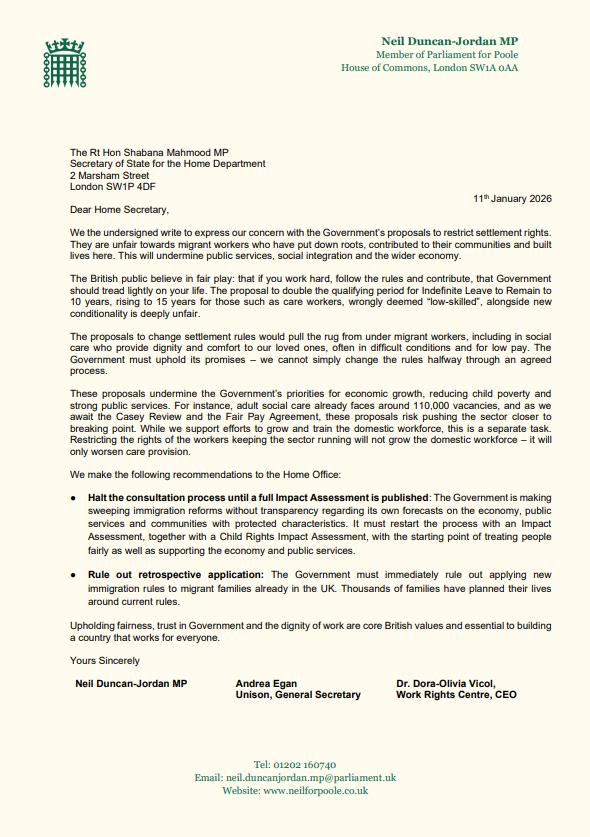
The first page of the letter to Mahmood.
[1]The new asylum regime: the first steps: https://bobmouncer.blog/2026/03/27/the-new-asylum-regime-the-first-steps/
[2] See my earlier blog for concerns expressed by others: The new asylum regime: the first steps, Concerns: The new asylum regime: the first steps « Bob Mouncer’s blog
[3]New and old hostilities: New and old hostilities « Bob Mouncer’s blog
[4] See New and old hostilities, Earn your keep: New and old hostilities « Bob Mouncer’s blog
[5] Restoring Order and Control: A statement on the government’s asylum and returns policy, Foreword from the Home Secretary, and para 2: Restoring Order and Control: A statement on the government’s asylum and returns policy (accessible) – GOV.UK
[6] The Migration Advisory Committee is a public body that advises the government on migration policy (see Migration Advisory Committee – GOV.UK).
[7] Changes to UK visa and settlement rules after the 2025 immigration white paper, House of Commons Library, 20 March 2026, section 1: Changes to UK visa and settlement rules after the 2025 immigration white paper – House of Commons Library
[8] Changes to UK visa and settlement rules after the 2025 immigration white paper, House of Commons Library, 20 March 2026, section 2: Changes to UK visa and settlement rules after the 2025 immigration white paper – House of Commons Library
[9] UK’s migration crackdown risks care home staffing crunch, 22 April 2026: UK’s migration crackdown risks care home staffing crunch | Reuters
[10] UK’s migration crackdown risks care home staffing crunch, 22 April 2026: UK’s migration crackdown risks care home staffing crunch | Reuters
[11] Cited, UK’s migration crackdown risks care home staffing crunch, 22 April 2026: UK’s migration crackdown risks care home staffing crunch | Reuters
[12] UK’s migration crackdown risks care home staffing crunch, 22 April 2026: UK’s migration crackdown risks care home staffing crunch | Reuters
[13]Cited, UK’s migration crackdown risks care home staffing crunch, 22 April 2026: UK’s migration crackdown risks care home staffing crunch | Reuters
[14] Restoring Order and Control: a statement on the government’s asylum and returns policy, 21 November 2025: Restoring Order and Control: A statement on the government’s asylum and returns policy (accessible) – GOV.UK
[15] Changes to UK visa and settlement rules after the 2025 immigration white paper, 20 March 2026: Changes to UK visa and settlement rules after the 2025 immigration white paper – House of Commons Library
[16] Explanatory memorandum to the statement of changes in the Immigration Rules:Explanatory memorandum to the statement of changes in the Immigration Rules: HC 1691, 5 March 2026 (accessible) – GOV.UK
[17] Explanatory memorandum to the statement of changes in the Immigration Rules, para. 5.67: Explanatory memorandum to the statement of changes in the Immigration Rules: HC 1691, 5 March 2026 (accessible) – GOV.UK
[18] Apply for the Global Talent Visa: Apply for the Global Talent visa : Overview – GOV.UK
[19] “Neil Duncan-Jordan MP opposes Home Office planned changes”, Bournemouth Echo: Neil Duncan-Jordan MP opposes Home Office planned changes | Bournemouth Echo
The new asylum regime: the first steps
The first steps towards the UK’s new asylum regime have now been taken. The Immigration Rules have been changed so that if you apply for asylum now and, after the Home Office has considered your application, you are recognised as a refugee, your protection will last only 30 months, after which you will have to apply to renew it. If at that point the Home Office decides that your country is safe for you to go back to, you will be sent back there.[1] If the Home Office decides that your country is still unsafe, your temporary leave will be extended for another 30 months, but you won’t be able to apply for Indefinite Leave to Remain (ILR) until you’ve been here for 10 years (previously it was five years). Under this scheme, you can apply to renew your 30-month visa four times, at a cost of £3,908.50 each time.[2] However, if you have been receiving benefits (including while in work) for up to 12 months you will have to wait 15 years before you can apply for ILR; if you have been receiving benefits for more than 12 months you will have to wait 20 years before applying for ILR.[3] Incidentally, if you are eligible to apply for ILR, the sooner you do it the better – from 8 April, the cost of an application will rise to £2,064, from the previous £1,938.[4] Maintaining the Home Office’s capacity to invent money-making schemes has been a consistent element in asylum policy for several decades.
Concerns
Critics have expressed their concerns about these changes. UNHCR commented on the original proposal to make protection temporary:
Providing refugees with only 30 months of leave at a time is likely to be detrimental to refugees’ sense of security, belonging and stability, factors critical to positive engagement and participation in society. Status of such a temporary nature may impact on a person’s ability to find housing, seek employment, learn English and develop skills, and risks undermining the Government’s intention to enhance refugees’ ability to contribute to their new communities.[5]
Mark Evans, president of the Law Society of England and Wales, gave this warning:
The rules announced today will create prolonged uncertainty for people who want to live free from danger and have been recognised by the government as needing protection. The changes stand in tension with Article 34 of the Refugee Convention, under which the UK has agreed to facilitate as far as possible the assimilation and naturalisation of refugees.[6]
Sophie McCann of Médecins sans Frontières, said:
Embedding prolonged uncertainty and fear within the asylum system will create further psychological harm and inhibit refugees’ – including our patients’ – ability to heal from their experiences and rebuild their lives with dignity.[7]
Nothing new under the sun?[8]
In one sense, these changes, and the rhetoric behind them, are part of a long-standing, and increasing, unwillingness of UK governments to accept refugees. In 1995, Tory Home Secretary Michael Howard declared that asylum applications were rising in the UK and falling in the rest of Europe because the UK gave easy access to jobs and benefits, claiming that “only a tiny proportion of them are genuine refugees”. Social Security Secretary Peter Lilley claimed that “genuine political refugees are few” and that Britain was “a soft touch”.[9] In 2002, Labour Home Secretary David Blunkett suggested that asylum-seeking children should be educated separately from other pupils so that they weren’t “swamping the local school”. Labour MP Diane Abbott responded, “For goodness’ sake, we’re talking about children here, not raw sewage!”[10] In 2003, Prime Minister Tony Blair’s chief of staff Jonathan Powell proposed withdrawing from Article 3 of the European Convention on Human Rights (ECHR) – which prohibits torture and inhuman or degrading treatment – so that more asylum seekers could then be deported back to their home countries.[11] Blair scribbled in the margin of one document that raised doubts about the legality of such a policy: “Just return them. This is precisely the point. We must not allow the ECHR to stop us dealing with it.”[12] Lord Irvine, the Lord Chancellor, gave such proposals short shrift, telling Blair and Home Secretary David Blunkett, with much irony, “I don’t know why you guys don’t just adopt the Zimbabwean constitution and have done with it.” Finally, the Attorney-General, Lord Goldsmith, told them that any attempt by the UK to avoid its responsibilities under the European Convention would put the UK in breach of its EU membership obligations.[13] The policy was not adopted. The current Labour government is lobbying in the European Commission for changes to the ECHR, but has not so far tampered with it. Indeed, in its Explanatory Memorandum justifying Mahmood’s new asylum policy, the Home Office carefully explains that the new regime “aims to provide entitlements for refugees that are entirely in accordance with our international obligations but do not exceed them” (my italics).[14] But the unashamed cruelty of Mahmood’s policies, and the deep hostility to asylum seekers she openly displays in her rhetoric, are unprecedented. We would be foolish to imagine that ECHR safeguards are safe in this government’s hands.
Visa brake
The government is refusing all study visas for people from Afghanistan, Myanmar, Sudan and Cameroon. It will also deny Afghans another visa: “Additionally,” says Mahmood, “we will refuse Skilled Worker visa applications from main applicants who are nationals of Afghanistan.”[15] The visa brake “will come into effect from 26 March but will not affect applications made before 26 March” – which is one bit of good news at least. Mahmood claims that the visa brake is “not intended to be permanent and will be regularly reviewed, with the aim that it can be released as soon as it is considered appropriate to do so”. We shouldn’t expect that promise to be fulfilled any time soon.
So what is the reason for applying the “visa brake”? It’s the usual one: asylum seekers are “taking advantage” of us. The Home Office says that high numbers of asylum claims are made by people from these countries after they have finished their study periods in the UK – and the Home Office sees this as abuse: “The government is clamping down on visa abuse so the UK can maintain its ability and proud tradition of helping those genuinely in need.” Mahmood, in typically strident mode, said she was “taking the unprecedented decision to refuse visas for those nationals seeking to exploit our generosity. I will restore order and control to our borders.”[16] There is, however, conflict, war and human rights abuse in all four of these countries: the Taliban are still the government in Afghanistan and the security situation is volatile. Moreover there have been increased tensions between Afghanistan and Pakistan, with violent clashes on the border. In Sudan there has been civil war since 2023, during which millions have fled their homes. The United Nations (UN) has called this the world’s largest humanitarian crisis. There is unrest in Cameroon, where militia are fighting for the independence of the country’s two English-speaking regions in what is mainly a French-speaking nation. There has been civil war in Myanmar since 2021, following a military coup.[17]
So “abuse” and “exploit” may not be the most appropriate words to describe the actions of students and skilled workers from those countries who need safe routes to protection. (You will notice there is no question of the government listening to their asylum claims, which is an obligation under the Refugee Convention. There is just a total ban on the visas. And if anyone from these four countries, in desperation, dares to arrive in a small boat, don’t worry – we’ve already declared that to be “illegal”.[18])
Nevertheless, there is a chance that the visa brake will put the Home Office in more trouble than it expected. Five students from Sudan and one from Afghanistan, with undergraduate degrees in medicine and other science-based subjects, have written an open letter to the Home Secretary saying that the decision to deny visas to students from only four countries is not only unlawful and irrational but also a violation of their human rights. They have launched legal action against the government.[19] Maybe others will join them. It is always possible to resist.
[1] For the notorious, and disastrous, record of governments in assessing whether a country is “safe”, see Mouncer, Bob (2009), Dealt with on their Merits? The Treatment of Asylum Seekers in the UK and France, University of Hull, Kingston-upon-Hull, paras 6.5.3-6.5.9: https://acrobat.adobe.com/id/urn:aaid:sc:EU:ecdd073f-c9b1-4905-859b-33bd62c23f47 For more recent inspections of the Home Office’s use of country reports, see An Inspection of the Production and use of Country of Origin Information, Independent Chief Inspector of Borders and Immigration, Chapter 6, January 2018: An_inspection_of_the_production_and_use_of_Country_of_Origin_Information.pdf
[2] “UK migrant families face giving up vital in-work benefits to avoid being ‘punished’, The Guardian, 20/2/2026: UK migrant families face giving up vital in-work benefits to avoid being ‘punished’ | Benefits | The Guardian
[3] “Some migrants to face 20 year wait for settled status”, BBC News, Some migrants to face 20-year wait for settled status – BBC News
[4] “Emergency Brake” Visa Pushback, Key Asylum Changes and More – UK March 2026 Updates, Immigration Advice Service: Emergency Visa Brakes, Asylum and More – March 2026 Updates
[5] UNHCR Observations on UK Asylum Statement “Restoring Order and Control”, UNHCR, 31 December 2025, para 5.9: UNHCR Observations On UK Asylum Statement ‘Restoring Order and Control’ | UNHCR UK
[6] Article 34 reads: “The contracting states shall as far as possible facilitate the assimilation and naturalisation of refugees. They shall in particular make every effort to expedite naturalisation proceedings and to reduce as far as possible the charges and costs of such proceedings.”
(“Mahmood’s move to make asylum temporary ‘may undermine refugee convention’”, The Guardian, 2 March 2026: Mahmood’s move to make asylum temporary ‘may undermine refugee convention’ | Refugees | The Guardian)
[7] “Mahmood’s move to make asylum temporary ‘may undermine refugee convention’”, The Guardian, 2 March 2026: Mahmood’s move to make asylum temporary ‘may undermine refugee convention’ | Refugees | The Guardian
[8] The biblical book of Ecclesiastes, chapter 1, verse 9: “What has been is what will be, and what has been done is what will be done; and there is nothing new under the sun.”
[9] Mouncer, Bob (2009). Dealt with on their Merits? The Treatment of Asylum Seekers in the UK and France, University of Hull, Kingston-upon-Hull, pp. 96-97: https://acrobat.adobe.com/id/urn:aaid:sc:EU:ecdd073f-c9b1-4905-859b-33bd62c23f47
[10] “Row erupts over Blunkett’s ‘swamped’ comment”, The Guardian, 24 April 2002: Row erupts over Blunkett’s ‘swamped’ comment | Politics | The Guardian
[11] Nicholas Watt & Patrick Wintour, “How immigration came to haunt Labour: the inside story”, The Guardian, 24 March 2015: How immigration came to haunt Labour: the inside story | Immigration and asylum | The Guardian
[12] “Tony Blair considered sending asylum seekers to a camp on the Isle of Mull, documents reveal”, the Independent, 29 December 2023: Tony Blair considered sending asylum seekers to a camp on the Isle of Mull, documents reveal | The Independent
[13] Nicholas Watt & Patrick Wintour, “How immigration came to haunt Labour: the inside story”, The Guardian, 24 March 2015: How immigration came to haunt Labour: the inside story | Immigration and asylum | The Guardian
[14] Explanatory memorandum to the statement of changes in the Immigration Rules, section 2.25, para. 5.7: Explanatory memorandum to the statement of changes in the Immigration Rules: HC 1691, 5 March 2026 (accessible) – GOV.UK
[15]Explanatory memorandum to the statement of changes in the Immigration Rules, section 2.25, para. 5.3: Explanatory memorandum to the statement of changes in the Immigration Rules: HC 1691, 5 March 2026 (accessible) – GOV.UK
[16]“Mahmood to stop study visas from four countries due to ‘abuse’” BBC News, 3 March 2026: Mahmood to stop study visas from four countries due to ‘abuse’ – BBC News
[17] “Mahmood to stop study visas from four countries due to ‘abuse’”, BBC News, 3 March 2026: Mahmood to stop study visas from four countries due to ‘abuse’ – BBC News
[18] See my earlier blog, New and Old Hostilities: New and old hostilities « Bob Mouncer’s blog
[19] “Six students challenge Home Office visa ban on four countries”, The Guardian, 23/3/2026: Six students challenge Home Office visa ban on four countries | Immigration and asylum | The Guardian
Hostile environment: the Windrush scandal II
The first blog in this series[1] showed how the announcement of a “hostile environment” for migrants by UK Home Secretary Theresa May in 2012 led to suffering and trauma for thousands of people, the Windrush generation. In this second blog, I tell the story of Hubert Howard, who was one of its victims.

Hubert Howard
We begin Hubert’s story in 1960, when his mother brought him to the UK from Jamaica when he was three years old. They were Citizens of the United Kingdom and Colonies (CUKCs), and Commonwealth citizens, and thus had the right to enter and reside in the UK. In his Court of Appeal hearing in 2019, Lord Justice Underhill made clear that Hubert’s residence, “was lawful from his first arrival in 1960.”[2] When Jamaica gained independence in 1962, Hubert automatically acquired Jamaican nationality (and thus ceased to be a CUKC). But he remained a Commonwealth citizen. This meant, Underhill explained, that “his right to reside in the United Kingdom was unaffected.”[3] Nevertheless, as we have seen,[4] the Acts of 1981 and 1988 did undermine that right. In particular, the British Nationality Act 1981 removed Hubert’s status as citizen and turned him into a foreigner. It imposed a limited transition period of five years during which individuals like Hubert would have to register themselves as British if they wanted to stay British. In her Windrush Lessons Learned Review, Wendy Williams noted that the transition period ended on 31 December 1987.[5] Once that period had expired the only way for Hubert to regain his legality and British status was through naturalisation.
Many of the Windrush generation, however, neither registered nor applied for naturalisation.[6] There were several reasons for this: the Home Office was afraid it would not be able to cope with the numbers that would apply and, the Williams Review found, it “wanted to develop advertising that was informative but didn’t ‘stimulate a flood of enquiries’.”[7] Moreover, officials managed the numbers by telling some applicants that “they didn’t have to register and wouldn’t face removal if they withdrew their applications.”[8] A leaflet issued in 1987 advised:
If you have the right to register but you don’t want to, you do not have to. Your other rights in the United Kingdom will not change in any way. You will not lose your entitlement to social benefits, such as health services, housing, welfare and pension rights, by not registering. Your position under immigration law is not changed.[9]
In the light of what happened later, when the Windrush victims lost all those entitlements, this piece of disinformation is startling. Regrettably, but not surprisingly, some people accepted the advice and did not register. Williams also highlighted another disincentive: applications “cost £60 (approximately £180 in today’s prices), with no dispensation for people on benefits.”[10] But not least among the reasons for not registering themselves as British or applying for naturalisation was that the Windrush generation took it for granted that they didn’t need to: they had come to the “mother country”, they were already British.[11] So, although around 130,000 people did apply for citizenship, many let the deadline pass.[12] One of them was Hubert Howard.
When Hubert’s mother retired, she decided to return to Jamaica. In 2005 she became ill with cancer and Hubert applied for a passport so he could visit her. His application was refused because, in the view of the Home Office, he had no documentary proof of his British citizenship. In 2006, his mother died, and he applied again so that he could go to her funeral. His application was again refused. In the end, he was never able to visit her grave. (This means, of course, that his legal rights as a member of the Windrush generation were being denied long before the hostile environment was announced in 2012, and we will return to this point in a later blog.) Hubert made several subsequent attempts to obtain confirmation of his status. After one of them, in 2011 (by which time Hubert had had 51 years of residence and a long work record), the Home Office wrote to him:
You confirmed that you entered the UK in the 1960s as a child and have lived in the UK since that time, but you are uncertain of your immigration status. In order to apply for British citizenship, you will first need to obtain confirmation of your immigration status in the UK based on your residence here.[13]
That was, of course, exactly what he was asking the Home Office to provide, since it was the government department responsible. As for his long work record, the Home Office brought it to an end in 2012: “My employers”, said Hubert,
were told by the Home Office that they had to get rid of me, otherwise they would get fined. All I needed was for the Home Office to say I was legal, but they said I was an overstayer and I didn’t have status. I tried to argue they were wrong. I left my job in 2012.[14]
In 2014, Hubert made another attempt, this time applying for a No Time Limit (NTL) confirmation of his status. The Home Office replied, once again shifting the responsibility and the burden of proof on to Hubert’s shoulders:
In order to qualify for this [you] must demonstrate that [you] are free from immigration time restrictions in the UK … [You are] unable to demonstrate that [you] have been continuously resident in the UK … the Secretary of State is not satisfied that [you are] entitled to an NTL endorsement and [your] application is therefore refused.[15]
Four years later, in February 2018, Hubert received this advice from another Home Office official:
Your case has recently been brought to my attention as you have been having certain issues due to not holding a document to confirm your status … Given your circumstances it would be advisable to make an NTL application.[16]
Huber did so. Eventually, after years of refusing to acknowledge the obvious, the Home Office finally relented and, on 10 May 2018, confirmed the knowledge it had possessed all along:
We’ve confirmed that you entered the UK before 1 January 1973. We consider that you have had indefinite leave to remain [ILR] from that date.[17]
Unfortunately, ILR was not enough. Hubert’s troubles were not yet over: he still had to apply for British citizenship. When he did so, his application was rejected on the grounds that he did not meet the “good character requirement” which had to be met for the naturalisation application to succeed. His failure to meet the requirement was the result of an argument with a receptionist at his GP surgery about a form he had filled in relating to his social security benefits. He was unable to work due to leukaemia, which he had suffered from since 2014. During the argument he had allegedly grabbed the receptionist’s finger while trying to take the form from her, and the police were called. Hubert was charged with common assault, found guilty and given a suspended prison sentence of 12 months.[18] The Home Office continued to reject his citizenship application in subsequent reviews but, finally, on 16 October 2019, an official wrote:
Mr Howard’s application has now been reviewed in the light of all the additional information and evidence provided, including that provided in Mr Howard’s current judicial review proceedings. The review has considered his immigration history and his current circumstances, in particular noting his long residence in the UK, the time that has now elapsed since his criminal conviction in June 2018, and his current ill health. I am pleased to say that, in view of the circumstances of his case, the Secretary of State is satisfied that discretion should now be exercised in his favour on an exceptional basis and Mr Howard’s application for British Citizenship has been approved.[19]
Hubert died from leukaemia three weeks later. In 2018, he had succinctly summed up his experience:
They basically messed up my life. I had a steady job. They took my job away, stating quite clearly I had no status in this country. It broke my heart losing my job with Peabody. It was the best job I was ever in. When my mum passed away, I wasn’t there, and I still have not been at her graveside.[20]
In the next blog:
Sabotage?
Smole and mirrors
A failed compensation scheme
[1] Hosrile Environment: the Windrush scandal I: Hostile Environment: the Windrush Scandal I « Bob Mouncer’s blog
[2] Case No: CA-2021-000601, Royal Courts of Justice Strand, London, WC2A 2LL (27/7/2022), para. 8: Microsoft Word – Howard for hand-down _2_.docx (dpglaw.co.uk)
[3] Ibid., para. 9.
[4] Hostile Environment: the Windrush scandal I: https://bobmouncerblog.wordpress.com/2025/03/22/hostile-environment-the-windrush-scandal-i/
[5] Wendy Williams (2020), Windrush Lessons Learned Review, p. 59: 6.5577_HO_Windrush_Lessons Learned Review (publishing.service.gov.uk)
[6] Ibid., and “Court of Appeal finds Windrush migrants’ experience of hardship irrelevant to British citizenship applications”, Deighton Pierce Glyn Solicitors (DPG), 27 July 2018: Court of Appeal finds Windrush migrants’ experience of hardship irrelevant to British citizenship applications – DPG Law
[7] Wendy Williams (2020), p. 59: 6.5577_HO_Windrush_Lessons Learned Review (publishing.service.gov.uk)
[8] Ibid.
[9] Ibid.
[10] Ibid.
[11] Ibid.
[12] Ibid.
[13] Cited, ibid.
[14] Gentleman, A., ”’I’ve been here for 50 years’: the scandal of the former Commonwealth citizens threatened with deportation”, The Guardian, 21 February 2018: ‘I’ve been here for 50 years’: the scandal of the former Commonwealth citizens threatened with deportation | Immigration and asylum | The Guardian
[15] Cited in “Court of Appeal finds Windrush Migrants’ experience of hardship irrelevant to British citizenship applications”, Deighton Pierce Glynn, Solicitors (DPG Partners): Court of Appeal finds Windrush migrants’ experience of hardship irrelevant to British citizenship applications – DPG Law (no date).
[16] Ibid.
[17] Ibid.
[18] Ibid.
[19] Case No: CA-2021-000601, Royal Courts of Justice Strand, London, WC2A 2LL (27/7/2022), para. 8: Microsoft Word – Howard for hand-down _2_.docx (dpglaw.co.uk), para 30.
[20] Gentleman, A., ”’I’ve been here for 50 years’: the scandal of the former Commonwealth citizens threatened with deportation”, The Guardian, 21 February 2018: ‘I’ve been here for 50 years’: the scandal of the former Commonwealth citizens threatened with deportation | Immigration and asylum | The Guardian
So you’re a Group 2 refugee, are you?
This is the third blog in the series on the UK’s Nationality and Borders Act 2022
The first thing to note if you are a Group 2 refugee is that you are a temporary person: “Temporary protection status will be for a temporary period, no longer than 30 months …” (Policy Statement, p. 20, see link below). Once that period is over, you will be protected from absolutely nothing. In Patel’s impersonal language, “individuals will be reassessed for return to their country of origin or removal to another safe country” (ibid.).
Three main problems arise immediately. The first is that it may not be safe to send you back to your own country. The UK government will argue that, since your claim of persecution has been rejected, returning you to your own country will not put you in danger. But, as we have seen, the Home Office’s decision-making is open to question and we will see in later blogs that in any case its knowledge of countries of origin is often inaccurate or out of date. So your safety is far from 100% certain. Moreover, there are plenty of examples where governments, especially if the Home Office has informed them of an asylum seeker’s return, punish them once they get back, and the UK government does not check on the welfare of the people it returns. Labour Immigration Minister Baroness Scotland told the House of Lords in 2006:
Where we refuse a claim and the Asylum and Immigration Tribunal dismisses any appeal we … consider that it is safe for that individual to return. This is one of the reasons why the Home Office does not routinely monitor the treatment of individuals once removed from the UK (cited Mouncer, B. (2010), Dealt with on their Merits?, p. 98).
The second problem is that so far Rwanda is the only country to agree to take asylum seekers passed on to them by the UK, and we don’t know if they will include the UK’s temporarily protected refugees, how they would be treated if they were included (settled there or removed somewhere else?), let alone whether there will be agreements in the future between the UK and other countries.
Thirdly, temporary protection status also means “family reunion rights will be restricted and there will be no recourse to public funds except in cases of destitution” (Policy Statement, p. 20). In practice this must mean that family reunion rights will be defunct in practice (for who would want to bring their family over for a maximum of 30 months, only to be deported to some unknown destination after that, possibly in a state of near-destitution?). But even “restricting” the right to family life surely breaches the spirit of the Refugee Convention, if not the letter. For although there is no specific reference to family reunification in the Refugee Convention, the Conference that adopted that Convention passed a strongly worded recommendation urging governments “to take the necessary measures for the protection of the refugee’s family, especially with a view to ensuring that the unity of the family is maintained” (The Right to Family Life and Family Unity of Refugees, etc., p. 9, para. 2.1.4: https://www.unhcr.org/5a8c40ba1.pdf). Jastram and Newland argue that “Recognition as a refugee gives rise to a prima facie reason to admit the refugee’s close family members to the country of asylum.” (Jastram, K. & Newland, K., Family Unity and Refugee Protection, p. 581: http://refworld.org). They give the same reason: “Reunification in a country of asylum is the only way to assure the right to family unity for refugees, who cannot by definition return to their country of origin.” This has been accepted by most signatories to the Refugee Convention ever since its inception.
The Home Office has described another scenario. In its Explanatory Notes it says that “individuals may be eligible to apply for long residency settlement after 10 years if the necessary requirements are met.” (Explanatory Notes, p.6, para 19). It doesn’t specify who these individuals might be or explain the contradiction between the 10-year period envisaged in this scheme and Patel’s firmly limited protection period of “no more than 30 months”. But with no basis in international law for the creation of Group 2 refugee status, the deportation of recognised refugees, whether after 30 months or 10 years, clearly breaches the Refugee Convention, Article 32: “The Contracting States shall not expel a refugee lawfully in their territory save on grounds of national security or public order.”
Finally, we have seen that if you are given Group 2 status, with its temporary protection, you will have “no recourse to public funds except in the case of destitution” (Policy Statement, p. 20). However, for UNHCR, a refugee is a refugee regardless of the notion of temporary protection or the allocation of any “Group 2” status. UNHCR is clear that a “Group 2 refugee” is entitled to “public relief and assistance on the same terms as nationals”, as laid down in Article 23 of the Refugee Convention (UNHCR Comments on the New Plan, para. 45; Refugee Convention, Art. 23). A ban on such benefits must surely be a breach of the Convention.
Policy Statement:
The Tory hostile environment continues – but Labour must face up to its past
No sympathy should be wasted on Amber Rudd. Her role in the Windrush scandal can be dealt with swiftly. According to the Home Office memo sent to Rudd and other ministers:
- The Home Office set a “target of achieving 12,800 enforced returns in 2017-18 … we have extended our target of assisted returns[1]
- This target set the government on a “path towards a 10% increased performance on enforced returns, which we promised the Home Secretary earlier this year.”[2]
- Rudd set the target “personally”.[3]
So her responsibility for what happened is established and her claim to know nothing about targets is rubbish.
However, this isn’t just about the Windrush generation or even their descendants. The injustice done to them is manifest and for many of them a tragedy. But this story of targets goes wider than this particular scandal. It is about a very real and ongoing hostility at the Home Office towards migrants in general and asylum seekers in particular.
The memo cited above speaks of “assisted returns”, a category which certainly does include asylum seekers. “Typically”, says the memo, “these will be our most vulnerable returnees.”[4] The use of the word “vulnerable” does not indicate sympathy any more than talk of “assisted returns” indicates a helpful approach. When Home Office officials use the word “assisted” it means the same as when they use the word “enforced”.[5] It means you’ve got to go, we don’t believe you, we don’t want you, didn’t you understand the message on Theresa’s big van? – GO HOME.
I described what happens when you are in the hands of the Home Office in earlier blogs.[6] As I said in these blogs, during my research as long ago as 2007 I found that what was called an “agenda of disbelief” had permeated the asylum process. This was encouraged by section 8 of the Asylum and Immigration (Treatment of Claimants) Act 2004, which obliged “a deciding authority” to “take account, as damaging the claimant’s credibility, of any behaviour” specified as such. I gave several examples of how, in the frantic rush to find “credibility issues”, Home Office officials forgot the UN Guidelines urging them to give, wherever possible, “the benefit of the doubt” to asylum seekers’ accounts of persecution or torture and instead set up what asylum support and human rights groups called an “agenda of disbelief” which enabled them to cast doubt on the stories told by large numbers of applicants who had indeed been persecuted or tortured.[7]
The focus today is not on section 8 of that Act but on paragraph 322(5) of the Immigration Rules. Caseworkers are using this paragraph to justify refusing indefinite leave to remain (ILR) to 1,000 highly skilled migrants by claiming they are guilty of lying in their applications, typically about their incomes or their tax records. Growing numbers are taking their cases to court – and winning. According to The Guardian, among the cases waiting to be resolved are
a former Ministry of Defence mechanical engineer who is now destitute, a former NHS manager currently £30,000 in debt, thanks to Home Office costs and legal fees, who spends her nights fully dressed, sitting in her front room with a suitcase in case enforcement teams arrive to deport her, and a scientist working on the development of anti-cancer drugs who is now unable to work, rent or access the NHS.[8]
Saleem Dadabhoy is unlikely to become destitute or fall into debt, since he is
a scion of one of the wealthiest families in Pakistan, [facing] deportation under [para.] 322(5) despite three different appeal courts having scrutinised his accounts and finding no evidence of any irregularities, and a court of appeal judge having ruled that he is trustworthy and credible.[9]
Others connected to him, however, might well face debt or destitution: if he were to be deported, 20 people employed by him would lose their jobs and the company (worth £1.5m) would close.
It has become clear that all this is the result not just of Amber Rudd’s time at the Home Office but of Theresa May’s creation of a “hostile environment” when she was in the same job. However, it goes back further than that. The examples I have given of the “agenda of disbelief” relate to Labour’s time in office. The hostile environment, in fact, goes back to Tony Blair, who set targets for asylum seeker deportations, and to Home Secretary David Blunkett, who had kids separated from their parents and put into local authority care in order to persuade their parents to go home when they were afraid to do so. Rod McLean, Head of Asylum Policy at the Home Office in 2006, told me this was because Blunkett was making policy “with an eye to the media”, who wanted tougher measures on removals. He then told me the policy would be abandoned “because it hasn’t worked”. I asked him, “When you say it hasn’t worked do you mean that, instead of waiting for you to take their children away, they just disappear?” “Yes,” he said. Unfortunately the policy wasn’t abandoned – it remained on the statute book.[10]
I believe that Labour not only has to blame the Tories for the “hostile environment” but own up to its own past, when it presided over an “agenda of disbelief”, in which asylum seekers were considered guilty until proved innocent. Because if Labour doesn’t recognise its past it will be in danger of repeating it. This is not to cast doubt on Corbyn’s best intentions – but the tabloids are still there, and so are the successors of Rod McLean.
Immigration Rules, para. 322: https://www.gov.uk/guidance/immigration-rules/immigration-rules-part-9-grounds-for-refusal
[1] “Amber Rudd was sent targets for migrant removal, leak reveals”, The Guardian¸ 28 April 2018: https://www.theguardian.com/politics/2018/apr/27/amber-rudd-was-told-about-migrant-removal-targets-leak-reveals
[2] Ibid.
[3] Ibid.
[4] Ibid.
[5] Ibid., see the “Q & A” box, “What are enforced departures?”
[6] https://bobmouncerblog.wordpress.com/2018/02/12/the-secretary-of-state-still-doesnt-believe-you-2/
https://bobmouncerblog.wordpress.com/2018/02/14/inappropriate-behaviour/
[7] See Dealt with on their Merits, pp.151-162: https://hydra.hull.ac.uk/assets/hull:2678a/content
[8] “At least 1,000 highly skilled migrants wrongly face deportation, experts reveal”, The Observer, 6 May 2018:
[9] Ibid.
[10] See Dealt with on their Merits, pp.220-221: https://hydra.hull.ac.uk/assets/hull:2678a/content
 Bob Mouncer's blog