Home » Posts tagged 'immigration'
Tag Archives: immigration
Labour, immigration and Enoch Powell
Introduction
In an earlier blog, we saw how working parties were set up after the Second World War whose task was to justify racist immigration controls.[1] They repeatedly failed to do so, but they continued their efforts for 17 years. Finally, employing a series of manifestly false arguments, the Tories passed the Commonwealth Immigrants Act 1962, complete with racist controls.
Hostility to black Commonwealth immigrants, however, was not confined to the Tories. It was, after all, the Labour government elected in 1945 that set up the working parties in the first place. Kieran Connell writes of “the relentless presence of racism in 1940s Britain, and the related influence of ideas about race.”[2] Labour was part of that pressure and influence. In 1946, Labour Home Secretary Chuter Ede told a cabinet committee that when it came to immigration he would be much happier if it “could be limited to entrants from the Western countries, whose traditions and social backgrounds were more nearly equal to our own.”[3] When the Empire Windrush arrived in 1948 with 492 Jamaicans ready to work to rebuild post-war Britain, 11 Labour MPs wrote to Prime Minister Clement Attlee, notifying him of “the fact that several hundred West Indians have arrived in this country trusting that our government will provide them with food, shelter and employment.” They feared that “their success might encourage other British subjects to follow their example.” This would turn Britain into
an open reception centre for immigration not selected in relation to health, education and training and above all regardless of whether assimilation was possible or not … An influx of coloured people domiciled here is likely to impair the harmony, strength and cohesion of our public and social life and cause discord and unhappiness among all concerned.[4]
Attlee replied to the letter, reassuring them that “if our policy [of unrestricted immigration] were to result in a great influx of undesirables we might, however unwillingly, have to consider modifying it.”[5] Kenan Malik notes that this exchange of letters contains many assumptions that shaped official and popular attitudes to post-war black immigration:
There are two kinds of British citizens: white people and “undesirables”. Britain is in danger of being swamped by immigrants taking advantage of the nation’s generosity. Immigrants’ standards of “health, education and training” are lower than those of British people. Black people are incapable of assimilating British culture. A large black presence in Britain would create social tensions.[6]
Such attitudes didn’t end with that decade but continued through the 17 years to 1962. At first, therefore, it seems puzzling that Labour opposed the 1962 Act throughout its passage through parliament. It did so, however, in the context of the ending of British rule in countries that were previously part of the British Empire and were now becoming independent nations. Britain’s post-war determination to justify immigration controls against black immigrants now came up against its need to build Commonwealth institutions and keep a political and economic foothold in the countries it once ruled. To that end, the Commonwealth was increasingly promoted as a “family of nations”. Any suggestion that the racism that had served British interests “out there” in the old Empire might now be applied to citizens of the new Commonwealth when they came here could threaten the whole project. This was a dilemma for both the main political parties. Lord Salisbury (Lord President of the Council and Tory Leader of the House of Lords) was a strong advocate of immigration controls. When a working party reported that there was no evidence that black immigrants were more inclined to criminality than white natives, he roundly declared in 1954: “It is not for me merely a question of whether criminal negroes should be allowed in … it is a question of whether great quantities of negroes, criminal or not, should be allowed to come.”[7] Lord Swinton (Secretary of State for Commonwealth Relations) agreed but warned Salisbury of the dangers ahead: “If we legislate on immigration, though we can draft it in non-discriminatory terms, we cannot conceal the obvious fact that the object is to keep out coloured people.”[8] Other Tories were more cautious. Henry Hopkinson, Minister of State at the Colonial Office, declared: “We still take pride in the fact that a man can say civis Britannicus sum [I am a British citizen] whatever his colour may be and we take pride in the fact that he wants to and can come to the mother country.”[9] In 1958, Arthur Bottomley, on Labour’s front bench, had also spoken up for the new Commonwealth and against immigration controls:
The central principle on which our status in the Commonwealth is largely dependent is the “open door” to all Commonwealth citizens. If we believe in the importance of our great Commonwealth, we should do nothing in the slightest degree to undermine that principle.[10]
It seemed for a while as if the battle between racist immigration controls, espoused by both parties, and the Commonwealth ideal of a “family of nations”, also espoused by both parties, might be won by the Commonwealth. But when Labour won the 1964 general election, the new government immediately refocused on immigration controls and increased the restrictions in the 1962 Act. In the years to come, Labour would introduce legislation and rules to reduce black immigration whenever it got the chance.
Facing both ways
Labour in government dealt with the embarrassing contradiction between racism and the “Commonwealth ideal” by facing both ways and hoping nobody would notice. It constantly sought to reassure voters that it “understood” their “genuine concerns” about immigration and enacted increasingly restrictive immigration laws. At the same time, it denied being racist and passed legislation aimed at creating “good race relations”. What often emerged from this process, however, were weak race-relations laws, suggesting that the government’s priority was to curb immigration. Thus, the Race Relations Acts of 1965 and 1968 were half-hearted affairs. While the 1965 Act did prohibit “incitement to racial hatred”, when it came to discrimination it didn’t include discrimination in housing and employment, and it didn’t apply to the police; and while the 1968 Act went further and included discrimination in housing and employment, the government decided that this would not apply to the police, who had exerted strong pressure on the cabinet not to include them. Home Secretary James Callaghan told the cabinet at the time:
The opposition of the Police Federation to amending the [police disciplinary] code has been intense and deep-seated. And the Police Advisory Board has been unanimous in advising me not to proceed.[11]
In 1968, the government introduced a new Commonwealth Immigrants Act which seemed set to undo the limited good the two Race Relations Acts had done. The Act refused all Commonwealth immigrants entry into the UK unless they could prove they were – or one of their parents or grandparents was – born, naturalised or adopted in the UK, or unless they were otherwise registered in specified circumstances as UK citizens.[12] This meant that citizens in the “white” Commonwealth (Canada, Australia, New Zealand) were not refused entry. The Act was Labour’s response to the Kenyan Asians crisis, when racism on the far right of the Tory Party was at its most virulent and dangerous. It was a decision to follow the Tory racists.
The Kenyan Asians: race, nation and the end of Empire
The Kenyan Asians were being forced out of Kenya by its government’s Africanisation policy, which excluded Kenya’s Asian population from employment and other rights. Many of them had British passports, which a British Conservative government had allowed them to retain following Kenya’s independence in 1963. Now, not surprisingly, they expected to be able to use them. The Labour government, however, decided otherwise. 80,000 of them, out of a total of about 200,000, had arrived in Britain by early 1968 and the government had been under pressure from several directions to keep them out. A campaign against allowing them to enter the country was launched by Tory MPs Duncan Sandys and Enoch Powell. Sandys had already told the Conservative Party Conference in 1967:
We are determined to preserve the British character of Britain. We welcome other races, in reasonable numbers. But we have already admitted more than we can absorb.[13]
Now Powell set about raising the temperature: he used deliberately provocative and racist language. He claimed a woman had written to him (anonymously, Powell alleged, out of fear of reprisals if her identity became known) claiming abuse by “Negroes”. She had, according to Powell’s story, paid off her mortgage and had started to let some of the rooms in her house to tenants; but she wouldn’t let to “Negroes”:
Then the immigrants moved in [to the neighbourhood]. With growing fear, she saw one house after another taken over. The quiet street became a place of noise and confusion. Regretfully, her white tenants moved out … She finds excreta pushed through her letter box. When she goes to the shops, she is followed by children, charming, wide-grinning piccaninnies.”[14]
Powell declared:
Those whom the gods wish to destroy, they first make mad. We must be mad, literally mad, as a nation to be permitting the annual inflow of some 50,000 dependants, who are for the most part the material of the future growth of the immigrant-descended population. It is like watching a nation busily engaged in heaping up its own funeral pyre.[15]
The British Empire, which Powell had supported, was no more. Its former subjects had fought for, and won, their independence. Satnam Virdee argues that, for Powell,
Black and Asian workers had now become the unintended reminder of peoples abroad who wanted nothing to do with the British Empire. And, in the mind of Powell, this invited the question, “What are they doing here in Britain?”[16]
For Powell, they “represented the living embodiment of the Empire that now was lost, a painful and daily reminder of [Britain’s] defeat on the world stage.”[17] For that reason, as well as his nightmare that the “immigrant-descended population” would lead to a “funeral pyre”, he was in favour of their repatriation (or, as he put it, their “re-emigration”) to the countries they or their parents had come from:
I turn to re-emigration. If all immigration ended tomorrow, the rate of growth of the immigrant and immigrant-descended population would be substantially reduced, but the prospective size of this element in the population would still leave the basic character of the national danger unaffected.[18]
The way to solve this problem was through “the encouragement of re-emigration”. Powell noted that no such policy had been tried, so there was no evidence from which to judge potential success or failure: “Nobody knows,” he said. So he once again called his constituents in aid to support him:
I can only say that, even at present, immigrants in my own constituency from time to time come to me, asking if I can find them assistance to return home. If such a policy were adopted and pursued with the determination which the gravity of the alternative justifies, the resultant outflow could appreciably alter the prospects.[19]
The leader of the Tory opposition, Edward Heath, sacked Powell from the shadow cabinet after the speech. But there were demonstrations in support of Powell in the immediate aftermath of the speech and his sacking. There were strikes by thousands of workers. They began in the West Midlands, where Powell’s constituency was located. Construction workers and power workers struck in Wolverhampton and Birmingham, there were strikes in Coventry and Gateshead. Then they spread to the London docks and the meat porters of Smithfield market. Strikers marched “from the East End to Westminster carrying placards reading ‘Don’t knock Enoch’ and ‘Back Britain, not Black Britain’.”[20]
But Powell remained sacked. His intervention was not welcomed by mainstream politicians in the Tory party, Labour or the Liberal Party. For one thing, his provocative racism seemed likely to threaten Britain’s social stability if unchecked. Moreover, good relations with the independent countries of the Commonwealth were still deemed vital to British interests: Powell’s racism not only threatened stability at home, it endangered good and profitable relations abroad. Nevertheless, there were some in official circles who seemed to believe that government promises to its citizens could be broken with impunity. Eric Norris, the British High Commissioner in Nairobi, was against allowing the Kenyan Asians in and he watched them as they queued outside his office demanding that the British government keep its promises and honour its commitments: “They all had a touching faith”, he later said scornfully, “that we’d honour the passports that they’d got.”[21] There had been still other pressures on the government: the far-right National Front – whose preoccupations were, like Powell’s, with white British identity and the repatriation of black and Asian immigrants – were stirring in the same pot. But the government could have resisted these pressures. The liberal press, churches, students and others opposed the campaign against the Kenyan Asians and could have been called in aid. Instead, it joined the Tory racists. Home Secretary James Callaghan wrote a memo to the cabinet:
We must bear in mind that the problem is potentially much wider than East Africa. There are another one and a quarter million people not subject to our immigration control … At some future time we may be faced with an influx from Aden or Malaysia.[22]
The Act was passed in 72 hours. It met Callaghan’s wider fears, and it rendered the Kenyan Asians’ passports worthless. No wonder that a year later The Economist declared that Labour had “pinched the Tories’ white trousers”.[23]
[1] By Hook or by Crook – Determined to be Hostile: https://bobmouncer.blog/2025/05/04/__trashed-2/
[2] Connell, Kieran (2024), Multicultural Britain: A People’s History, C. Hurst & Co. (Publishers) Ltd., London, p. 46.
[3] Cited, ibid., p. 20.
[4] Cited, Malik, Kenan (1996), The Meaning of Race: Race, History and Culture in Western Society, Macmillan, Basingstoke, p. 19.
[5] Cited, ibid.
[6] Ibid.
[7] Carter, B., Harris, C. & Joshi, S. (1993), “The 1951-55 Conservative Government and the Racialization of Black Immigration”, in James, W. & Harris, C. (eds), Inside Babylon: the Caribbean Diaspora in Britain, Verso, London, p. 65.
[8] Spencer, I. (1997), British Immigration Policy since 1939: the Making of Multi-Racial Britain, Routledge, London, p. 64.
[9] Hayter, T. (2000), Open Borders: the Case against Immigration Controls, Pluto Press, London, p. 44.
[10] Foot, P. (1968), The Politics of Harold Wilson, Penguin Books, Harmondsworth, p. 251.
[11] “Callaghan: I was wrong on police and race”, BBC News, 8 January 1999: BBC NEWS | Special Report | 1999 | 01/99 | 1968 Secret History | Callaghan: I was wrong on police and race
[12] Commonwealth Immigrants Act 1968, s. 1 (2A).
[13] Playing the Race Card, 24 October 1999, Channel Four Television, London.
[14] Palash Ghosh, ”Enoch Powell’s ’Rivers of Blood‘ Speech”, International Business Times, 14/6/2011: Enoch Powell’s “Rivers of Blood” Speech (FULL-TEXT) | IBTimes
[15] Ibid.
[16] Virdee, S. & McGeever, B. (2023). Britain in Fragments: Why things are falling apart, Manchester University Press, Manchester, p. 71.
[17] Ghosh, op cit.
[18] Ibid.
[19] Ibid.
[20] Virdee, S. & McGeever, B. (2023). Britain in Fragments: Why things are falling apart, Manchester University Press, Manchester, pp., 72-74.
[21] Playing the Race Card, 24 October 1999, Channel Four Television, London.
[22] Cited, Hayter, T. (2000), Open Borders: the case against immigration controls, Pluto Press, London, p. 53.
[23] Cited, ibid., p. 51.
Hostile Environment: the Windrush Scandal I
****************************
Dedication
To Nurse Thelma Rock, her mother, and her son Colin, who were our neighbours in the 1950s. Thelma’s mother slept at our house until she found a place of her own.
They were part of the Windrush generation
*****************************
Introduction
The creation of a “hostile environment” for migrants was announced by Theresa May, the UK’s Conservative (Tory) Home Secretary, in 2012. Although she said it was intended for “illegal” migrants, it turned out that, under this policy, almost anyone could be made “illegal” if they were either a migrant themselves or a descendant of one. This became clear as the Windrush scandal unfolded.
“Windrush scandal” is the name eventually given to the UK government’s cruel and unjust treatment of thousands of British citizens, notably in – though not confined to – the decade following 2012. The citizens in question were members of the “Windrush generation”, who had come perfectly legally from British colonies and ex-colonies in the Caribbean, to work in the UK, helping to rebuild the country after the Second World War. The first group came by boat, the SS Empire Windrush, in 1948. The scandal affected the original arrivals and their descendants, as well as subsequent arrivals and their descendants. Under Theresa May’s new legislation, they were told they were not British after all. They were sacked from their jobs and deprived of their citizenship rights. The policy was set up to fulfil the election promise of Prime Minister David Cameron in 2010 that he would reduce immigration to “less than tens of thousands” a year. In her turn, May undertook to ensure the removal of “illegal” migrants from the country. Some of the Windrush generation were indeed deported.
In this series of blogs, I will tell how the hostile environment was set up and how it was used against the Windrush generation, highlighting the case of one of its victims, Hubert Howard, to show in personal terms the devastating impact of the scandal on individuals. I will examine the response of the government after the scandal was revealed in 2017.
I will argue that what happened was not simply an accident. or the result of bureaucratic mismanagement, or due to poor judgment on the part of politicians and officials; it was the result of deliberate acts of government, having at their root the history of UK and European racism. I will show (contrary to the myth that post-war governments encouraged and welcomed these post-war immigrants) that, from the start, Labour and Conservative governments actively sought, by administrative means, to discourage and prevent them from coming to Britain. Later, they alleged that such immigration was harmful to British society in various ways. The allegations were proved embarrassingly groundless. These attempts continued throughout and beyond the 1950s, until parliament was finally provided with an excuse to pass the restrictive Commonwealth Immigration Act 1962.
I will show that in subsequent years the Conservative Party remained against large-scale immigration of black people into the UK and imposed strict legislative controls on them; I will also show that the Labour Party, though disguising its own hostility, introduced similar restrictive legislation. I will discuss the Labour Party’s approach to immigration and highlight events during the governments of Tony Blair and Gordon Brown between 1997 and 2010 suggesting that the hostile environment existed under Labour well before Theresa May’s announcement in 2012.
I will examine the failed compensation scheme set up by the Tory government and, finally, I will show that Windrush victims are still being targeted today, under a Labour government claiming to be committed to change.
But I begin with the announcement of the hostile environment policy and show how the Windrush scandal followed and how it became a catastrophe for so many people.
Creating hostility
During the UK general election campaign in 2010, David Cameron, leader of the Tory opposition, pledged to reduce the UK’s net immigration per year to “less than tens of thousands” if he became Prime Minister. After the election, he led a coalition government with the Liberal Democrats (LibDems). He appointed Tory MP Theresa May as Home Secretary, who seemed as determined as he was to get immigration numbers down. She announced her intention in an interview in The Telegraph in 2012, saying,“The aim is to create, here in Britain, a really hostile environment for illegal immigrants.”[1] The following year she introduced an Immigration Bill, which would become law in 2014, and explained its purpose in the following way:
Most people will say it can’t be fair for people who have no right to be here in the UK to continue to exist as everybody else does with bank accounts, with driving licences and with access to rented accommodation. We are going to be changing that because we don’t think that is fair … What we don’t want is a situation where people think that they can come here and overstay because they’re able to access everything they need.[2]
She was careful to say that her hostility was directed at people who were “illegal” and thus to imply that the hostility was “fair”. But we will see how easy it was for her to pin the “illegal” label on innocent people, make false accusations against them and turn their lives upside down.
At this stage, May’s legislation and her language could be seen as simply in line with a long-standing Tory approach to immigration. Her comments were reminiscent of remarks by a previous Home Secretary, referring specifically to asylum seekers: in 1995 Michael Howard had declared that the UK was seen as
a very attractive destination because of the ease with which people can get access to jobs and to benefits. And while, for instance, the number of asylum seekers for the rest of Europe are [sic] falling the number in this country are [sic] increasing [and] only a tiny proportion of them are genuine refugees.[3]
Likewise, Tory Social Security Secretary Peter Lilley told the Tory Party Conference in the same year:
Genuine political refugees are few. The trouble is our system almost invites people to claim asylum to gain British benefits. That can’t be right – and I’m going to stop it. Britain should be a safe haven, not a soft touch.[4]
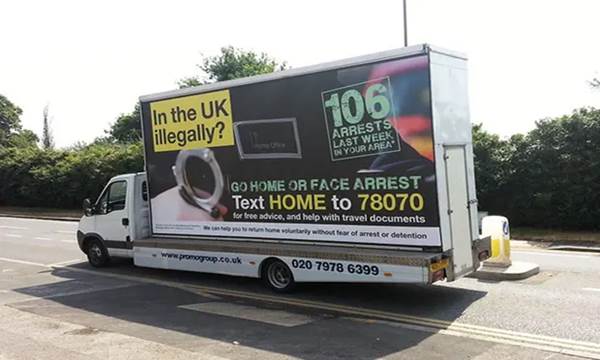
In 2013, however, May made clear that the environment would now become unmistakably hostile. The hostility would be expressed not only in legislation but also in government actions. This included a crude attempt to frighten migrants into leaving the country and to create hostility to them in local communities: in July 2013, the Home Office sent vans, displaying the message, “In the UK illegally? Go home or face arrest”, into six London boroughs. It was a pilot scheme, lasting one month, and the Home Office claimed that it resulted in 60 people “voluntarily” returning to their home countries and that it saved taxpayers’ money.[5] There was, however, a good deal of public disquiet and the vans were not used again.
But the legislation, too, was unmistakably hostile. As May’s Immigration Bill started its journey through parliament, it was obvious that many of its provisions would be particularly worrying for asylum seekers: grounds of appeal against refusal and deportation would be reduced from 17 to four and a “deport first, appeal later” policy would be introduced for people judged as being at no risk of “serious irreversible harm” if returned to their countries of origin, or indeed to other countries similarly approved by the government.[6] This was particularly dangerous since such judgments, made by caseworkers or secretaries of state, are notoriously unreliable.[7] So these legal changes were worrying enough. But it became clear that Home Office definitions of who was an “illegal immigrant” were equally unreliable, and dangerous, as the Windrush scandal unfolded.
What happened to the Windrush generation under the hostile environment policy was particularly scandalous because this whole cohort of people who had been citizens for decades were suddenly told they were not citizens at all. The House of Commons Home Affairs Select Committee, which investigated the scandal, summed up what happened to them in a few succinct sentences. Members of the Windrush generation were
denied access to employment, healthcare, housing and other services in the UK. In some cases, people who had every right to live in the UK were targeted for removal, held in immigration detention, deported or prevented from returning to the UK from visits abroad. Upon trying to resolve their status with the Home Office, they faced obstacles such as “often insurmountable” requirements for decades-worth of evidence to demonstrate their time in the UK and significant application fees.[8]
When it came to removal from the country, some decided, with their history erased, to leave before they could be forcibly removed and thus retain some dignity.[9] For others, the hostile environment ruined their health.
Persecution enforced by law
May’s Bill passed into law, becoming the Immigration Act 2014. It required employers to demand evidence of their employees’ immigration and citizenship status, NHS staff to demand the same of their patients, private landlords of their tenants and banks of their customers. Other public bodies were instructed to do likewise, and new powers were given to check the immigration status of driving licence applicants, refusing those who could not provide evidence and revoking licences already granted.[10] When such checks were made, it turned out that large numbers of people who had lived and worked in the country for decades had no documents to prove their citizenship (no passports, no naturalisation papers). They were declared “illegal”. Most of them were part of the Windrush generation and their descendants.
Rhetoric versus reality
When the Empire Windrush passengers arrived at the UK’s border, no questions were raised about their citizenship or their right to enter and live in the UK. Indeed, for more than a century citizens of the British Empire had enjoyed those rights. In their rhetoric, many UK politicians treated this as a principle to be proud of. In 1954 Henry Hopkinson, Tory Minister of State for Colonial Affairs, declared:
We still take pride in the fact that a man can say civis Britannicus sum [I am a British citizen] whatever his colour may be and we take pride in the fact that he wants to and can come to the mother country.[11]
Moreover, rhetoric apart, the decision to maintain these long-standing rights after the war was taken on hard political and economic grounds: as the countries that had formed the British Empire began to gain their independence, and the Empire became the Commonwealth, good relations with those countries were deemed vital if Britain was to maintain an economic foothold in the regions of the world it once ruled. So, in the very year the Empire Windrush sailed, the British Nationality Act 1948 confirmed those rights to British citizenship.[12] Later, the Immigration Act 1971 confirmed them yet again: although the Act granted only temporary residence to most new arrivals, crucially it still granted Commonwealth citizens protection from deportation.[13] However, by the beginning of the next decade, an erosion of their right to protection had begun. The British Nationality Act 1981 created a new status – that of “British citizen”. In doing so, in the words of Lord Justice Underhill in the Court of Appeal in 2019, it
assimilated the position of Commonwealth citizens to that of other foreign nationals, by requiring them to naturalise … in order to acquire British citizenship.[14]
Arguably, the protection given by the 1971 Act still existed, since it had not been repealed. But by the end of the decade the Immigration Act 1988 had removed it. Section 1(5) of the 1971 Act had ensured that Commonwealth citizens “settled in the United Kingdom at the coming into force of this Act” would retain their freedom “to come into and go from the United Kingdom”.[15] The 1988 Act, however, removed it in a single sentence: “Section 1(5) of the … Immigration Act 1971 … is hereby repealed.”[16] During the passage of the 1988 Act through parliament, concerns had been raised in the House of Lords by Lord Pitt.[17] “I wish that the Government would think through these matters,” he said:
We are talking about people who have been here for 15 years. During those 15 years they have been contributing to the state through taxes, rates, their work and their contributions to society. In 1971 the Government gave them a pledge. I ask them for Christ’s sake to keep it.[18]
Despite this urgent plea, the Bill received the Royal Assent and became the Immigration Act 1988, and the protection given in the 1971 Act was removed. Nevertheless, the confirmation of their rights in the 1948 Act remained and another Act, Labour’s Immigration and Asylum Act 1999, seemed to give similar protection.
“… a great deal of thought …”
Theresa May claimed in the House of Commons in 2014 that the government had “given a great deal of thought to the way in which our measures will operate.”[19] May and her officials certainly noticed a provision in the 1999 Act. It worried them – and they did something about it. The Guardian reported in 2018:
All longstanding Commonwealth residents were protected from enforced removal by a specific exemption in the 1999 Immigration and Asylum Act – a clause removed in the updated 2014 legislation.[20]
They removed it deliberately, without warning and without debate.[21] One attempted justification, once the removal of the clause had been discovered, didn’t wash at all: a later Home Secretary, Amber Rudd, told the House of Commons in 2018 that the clause had been removed because it was unnecessary – there was already protection in the 1971 Act.[22] It didn’t wash, first, because the 1971 protection had been repealed, as we have seen, by the Immigration Act 1988; secondly, if they believed at the time that the protection still existed, why did they inflict the threats and punishments that immediately followed the passing of the 2014 Act? The answer is that they were determined to implement the hostile environment and, after giving the matter a great deal of thought, they removed the protection in the 1999 Act and set about persecuting the Windrush generation.
The consequences were predictable and intended. As employers, NHS staff, landlords, bank staff and other authorities checked the status of their current and potential workers, patients, customers and clients, more and more people were told that their lack of documentary proof of citizenship meant that they were not citizens at all. They were illegal. They had, in the words of Theresa May, “no right to be here”. They had to go. In April 2018, journalist Gary Younge gave examples of the cruelty inflicted on the Windrush generation and their descendants in the name of the “hostile environment”:
There’s Renford McIntyre, 64, who came to Britain from Jamaica when he was 14 to join his mum, worked as a tool setter, and is now homeless and unemployed, after he was fired when he couldn’t produce papers to prove his citizenship. Or 61-year-old Paulette Wilson who used to cook for MPs in the House of Commons. She was put in Yarl’s Wood removal centre and then taken to Heathrow for deportation, before a last-minute reprieve prevented her from being sent to Jamaica, which she last visited when she was 10 and where she has no surviving relatives. Or Albert Thompson, a 63-year-old who came from Jamaica as a teenager and has lived in London for 44 years. He was evicted from his council house and has now been denied NHS treatment for his cancer unless he can stump up £54,000, all because they question his immigration status.[23]
In the next blog, I will tell the story of Hubert Howard, one of the saddest victims of the hostile environment and the Windrush scandal.
[1] James Kirkup, “Theresa May interview: ‘We’re going to give illegal migrants a really hostile reception’”, The Telegraph, 25 May 2012: Theresa May interview: ‘We’re going to give illegal migrants a really hostile reception’ (telegraph.co.uk)
[2] Cited The Guardian, 10 October 2013: Immigration bill: Theresa May defends plans to create ‘hostile environment’ | Theresa May | The Guardian (accessed 28/5/2023).
[3] Playing the Race Card, 7 November 1999, Channel Four Television, London.
[4] Ibid.
[5] Operation Vaken: evaluation report, Home Office and Immigration Enforcement, 31 October 2013: https://www.gov.uk/government/publications/operation-vaken-evaluation-report; Hattenstone, S., “Why was the scheme behind May’s ‘Go Home’ vans called Operation Vaken?”, The Guardian, 26 April 2018: Why was the scheme behind May’s ‘Go Home’ vans called Operation Vaken? | Simon Hattenstone | The Guardian
[6] Immigration Act 2014, s. 17(3), insertion 94B(3).
[7] Mouncer, Bob (2009), Dealt with on their Merits: the Treatment of Asylum Seekers in the UK and France, University of Hull, paras 6.5.9, 6.5.12, 6.6.1-6.6.4: file:///C:/Users/Bob/AppData/Local/Temp/b76ecf82-0f04-4115-975d-917a3a324502_Dealt%20with%20on%20their%20merits.zip.502/519233.pdf; Shaw, J. & Witkin, R. (2004), Get it Right: How Home Office Decision Making Fails Refugees, Amnesty International, London.
[8] The Windrush Compensation Scheme, House of Commons Home Affairs Committee Report (24 November 2021), para. 1: The Windrush Compensation Scheme – Home Affairs Committee (parliament.uk)
[9] “What is Windrush and who are the Windrush generation?”, BBC News 27 July 2023: What is Windrush and who are the Windrush generation? – BBC News
[10] Immigration Act 2014.
[11] Cited, Hayter, T. (2000), Open Borders: The Case against Immigration Controls, Pluto Press, London, p. 44.
[12] Ibid., p. 43.
[13] Immigration Act 1971, ss. 1(5) and 7 (1); Gentleman, A., “‘I’ve been here for 50 years’: the scandal of the former Commonwealth citizens threatened with deportation’”, The Guardian, 21 February 2018: ‘I’ve been here for 50 years’: the scandal of the former Commonwealth citizens threatened with deportation | Immigration and asylum | The Guardian
[14] Case No: CA-2021-000601, Royal Courts of Justice Strand, London, WC2A 2LL (27/7/2022), para. 11: Microsoft Word – Howard for hand-down _2_.docx (dpglaw.co.uk)
[15] Immigration Act 1971, s.1(5): “The rules [made by the Secretary of State relating to how the Act would work in practice] shall be so framed that Commonwealth citizens settled in the United Kingdom at the coming into force of this Act and their wives and children are not, by virtue of anything in the rules, any less free to come into and go from the United Kingdom than if this Act had not been passed.”
[16] Immigration Act 1988, s,1: Immigration Act 1988 (legislation.gov.uk)
[17] David Pitt was born on the Caribbean island of Grenada in 1913. He won the Island Scholarship to have further education abroad and studied medicine at the University of Edinburgh. He returned to the Caribbean, but settled in Britain in 1947. He was given a life peerage in 1975. He died in 1994.
[18] Cited, Williams, W. op. cit., p. 58: 6.5577_HO_Windrush_Lessons Learned Review (publishing.service.gov.uk).
[19] Hansard, House of Commons, 30 January 2014, cols 1124-25: Immigration Bill – Hansard – UK Parliament
[20] Taylor, D., ”UK removed legal protection for Windrush immigrants in 2014”, UK removed legal protection for Windrush immigrants in 2014 | Commonwealth immigration | The Guardian
[21] Ibid.
[22] Hansard, House of Commons, 23 April 2018, cols. 628-29).
[23] Younge, G., “Hounding Commonwealth citizens is no accident. It’s cruelty by design”, The Guardian, 13 April 2018: Hounding Commonwealth citizens is no accident. It’s cruelty by design | Gary Younge | The Guardian
So you’re a Group 2 refugee, are you?
This is the third blog in the series on the UK’s Nationality and Borders Act 2022
The first thing to note if you are a Group 2 refugee is that you are a temporary person: “Temporary protection status will be for a temporary period, no longer than 30 months …” (Policy Statement, p. 20, see link below). Once that period is over, you will be protected from absolutely nothing. In Patel’s impersonal language, “individuals will be reassessed for return to their country of origin or removal to another safe country” (ibid.).
Three main problems arise immediately. The first is that it may not be safe to send you back to your own country. The UK government will argue that, since your claim of persecution has been rejected, returning you to your own country will not put you in danger. But, as we have seen, the Home Office’s decision-making is open to question and we will see in later blogs that in any case its knowledge of countries of origin is often inaccurate or out of date. So your safety is far from 100% certain. Moreover, there are plenty of examples where governments, especially if the Home Office has informed them of an asylum seeker’s return, punish them once they get back, and the UK government does not check on the welfare of the people it returns. Labour Immigration Minister Baroness Scotland told the House of Lords in 2006:
Where we refuse a claim and the Asylum and Immigration Tribunal dismisses any appeal we … consider that it is safe for that individual to return. This is one of the reasons why the Home Office does not routinely monitor the treatment of individuals once removed from the UK (cited Mouncer, B. (2010), Dealt with on their Merits?, p. 98).
The second problem is that so far Rwanda is the only country to agree to take asylum seekers passed on to them by the UK, and we don’t know if they will include the UK’s temporarily protected refugees, how they would be treated if they were included (settled there or removed somewhere else?), let alone whether there will be agreements in the future between the UK and other countries.
Thirdly, temporary protection status also means “family reunion rights will be restricted and there will be no recourse to public funds except in cases of destitution” (Policy Statement, p. 20). In practice this must mean that family reunion rights will be defunct in practice (for who would want to bring their family over for a maximum of 30 months, only to be deported to some unknown destination after that, possibly in a state of near-destitution?). But even “restricting” the right to family life surely breaches the spirit of the Refugee Convention, if not the letter. For although there is no specific reference to family reunification in the Refugee Convention, the Conference that adopted that Convention passed a strongly worded recommendation urging governments “to take the necessary measures for the protection of the refugee’s family, especially with a view to ensuring that the unity of the family is maintained” (The Right to Family Life and Family Unity of Refugees, etc., p. 9, para. 2.1.4: https://www.unhcr.org/5a8c40ba1.pdf). Jastram and Newland argue that “Recognition as a refugee gives rise to a prima facie reason to admit the refugee’s close family members to the country of asylum.” (Jastram, K. & Newland, K., Family Unity and Refugee Protection, p. 581: http://refworld.org). They give the same reason: “Reunification in a country of asylum is the only way to assure the right to family unity for refugees, who cannot by definition return to their country of origin.” This has been accepted by most signatories to the Refugee Convention ever since its inception.
The Home Office has described another scenario. In its Explanatory Notes it says that “individuals may be eligible to apply for long residency settlement after 10 years if the necessary requirements are met.” (Explanatory Notes, p.6, para 19). It doesn’t specify who these individuals might be or explain the contradiction between the 10-year period envisaged in this scheme and Patel’s firmly limited protection period of “no more than 30 months”. But with no basis in international law for the creation of Group 2 refugee status, the deportation of recognised refugees, whether after 30 months or 10 years, clearly breaches the Refugee Convention, Article 32: “The Contracting States shall not expel a refugee lawfully in their territory save on grounds of national security or public order.”
Finally, we have seen that if you are given Group 2 status, with its temporary protection, you will have “no recourse to public funds except in the case of destitution” (Policy Statement, p. 20). However, for UNHCR, a refugee is a refugee regardless of the notion of temporary protection or the allocation of any “Group 2” status. UNHCR is clear that a “Group 2 refugee” is entitled to “public relief and assistance on the same terms as nationals”, as laid down in Article 23 of the Refugee Convention (UNHCR Comments on the New Plan, para. 45; Refugee Convention, Art. 23). A ban on such benefits must surely be a breach of the Convention.
Policy Statement:
EU citizens, present and future: what to do to prepare for Brexit
Here is a link to the government’s latest policy document on immigration arrangements after a no-deal Brexit on 31 October. I comment here on some aspects of these arrangements. The first point to make is that if you are an EU citizen who lives here now but you haven’t yet applied for Settled Status you need to do so now. The best way to do this is through a solicitor. You can do it without one, but I don’t advise it. The Home Office has always operated with a mixture of hostility and incompetence. Under Johnson and the new Home Secretary, Priti Patel, the incompetence levels remain the same but the hostility levels are higher. Don’t take any risks. This warning also applies to people coming here after Brexit. The following are my comments and quotes from the document:
- Anyone moving to the UK from the EU after Brexit “will be able to move to the UK and live, study, work and access benefits and services as they do now” – until 31 December 2020. If they want to stay longer they will have to apply for a new kind of status, called Temporary Leave to Remain (TLR). If they get TLR it will give them only 36 months.
- After January 2021, there will be “a new, Australian-style points-based immigration system”, which the government describes here as a “fairer immigration system that prioritises skills and what people can contribute to the UK, rather than where they came from.” That sounds fair at first, partly because it seems to include all migrants, but it actually limits your chances of staying because the skills you have, and get “points” for, are only the skills that will get you a salary of at least £30,000 a year (according to a government policy announced earlier). If you have skills that earn less than that, you won’t be able to stay.
- EU citizens with TLR “will only be required to apply to the new points-based immigration system when their 36 months’ Euro TLR leave expires”, although they can do it earlier. But if they do not “meet the … criteria under the new [points-based] immigration system or otherwise have a right to remain in the UK, they will be expected to leave the UK when their Euro TLR expires. Euro TLR will therefore only provide a temporary stay in the UK for some EU citizens.”
Make no mistake: “they will be expected to leave the UK” is not friendly advice: “EU citizens and their family members who move to the UK after 31 October 2019 will need to have applied for a UK immigration status (whether Euro TLR or under the new, points-based immigration system) by 31 December 2020. Otherwise, they will be here unlawfully and will be liable to enforcement action, detention and removal as an immigration offender.”
- “enforcement action” = they will take you from your home;
- “detention” = they will put you in prison;
- “removal” = they will force you onto a plane and fly you out
Here is the government document:
Freedom of Movement II
What will immigration policy be after Brexit?
The Tories were clear about their intentions from the beginning. In the Foreword to their White Paper on post-Brexit immigration policy May declared, “As we leave the European Union, free movement will end.”[1] But she also added: “For the first time in decades, it will be the democratically elected representatives of the British people who choose who comes into our country.” This promotes the claim that for the last few decades there was “uncontrolled immigration” – which, as we saw in the previous blog, was not true. Given this bad start, there should be no surprise at the criticisms that quickly emerged. May had said that the government would
introduce a new, skills-based immigration system. This will be a system where it is workers’ skills that matter, not which country they come from.
It will be a single system that welcomes talent, hard work, and the skills we need as a country. It will attract the brightest and best to a United Kingdom that is open for business.
Migrants have made a huge contribution to our country over our history – and they will continue to in the future. But it will also be an immigration system that is fair to working people here at home. It will mean we can reduce the number of people coming to this country, as we promised, and it will give British business an incentive to train our own young people.[2]
The White Paper also announced that skilled workers would have to be earning £30,000 if they were to qualify for entry. In this way, preference was to be given to high earners while low earners would be much less welcome. Sabrina Huck of Labour Against Racism and Fascism summarised much of this approach when she pointed out that
“low skilled” workers from “low risk” countries (countries whose citizens are deemed less likely to commit immigration offences such as overstaying or coming under false premises)[3] can apply to work in the UK for up to 12 months, with no ability to bring family members, access different visa schemes or extend their stay, and without access to public benefits during their time. When the 12 months are up, the person is not allowed to re-apply for this visa until a “cooling off” period of a year has passed, effectively banning them from re-entering for work purposes in this time.[4]
Problems with Labour’s response to the White Paper and the Immigration and Social Security Bill
In her response to the White Paper, Shadow Home Secretary Diane Abbott was right to point out that the £30,000 salary threshold for skilled workers does not reflect a skills-based immigration system, because skill levels don’t always reflect salary levels. But, as Sabrina Huck noted, “Abbott is not challenging the basic assumption that a person’s ability to enter the country, and to live a life with full citizen’s rights, is determined by their material contribution to the needs of British capital.”[5] She added:
This is a dangerous line for the left to take, as it concedes to the right’s political argument that immigration in itself is not a right, and that people’s worth is determined by their (narrowly defined) value for the economic system. This argument underpins much of the Conservative’s [sic] austerity agenda, the demonisation of the working class, poor and disabled, as undeserving, because they do not “contribute” their “fair share” to society.[6]
Abbott’s response to the Bill itself increased these worries: “The Labour [P]arty is clear”, she said,
that when Britain leaves the single market, freedom of movement ends, and we set this out in our 2017 manifesto. I am a slavish devotee of that magnificent document: so on that basis, the frontbench of the Labour [P]arty will not be opposing this bill this evening.[7]
In the event, the Labour front bench changed its mind and whipped MPs to vote against the Bill, rather than abstain, after protests by several MPs and an immediate on-line and email protest from Labour activists and others. But it took the front bench 90 minutes to do this, after MPs had originally been told they could go home as their votes were not required. Many of them did. Only 178 out of 256 Labour MPs were present to vote.[8]
It is, of course, true that the Labour manifesto appeared indistinguishable from the Tory White Paper and the Bill when it came to freedom of movement: “Freedom of movement will end when we leave the European Union. Britain’s immigration system will change …” it said.[9] It is also true that assurances were given that Labour would not “scapegoat migrants nor blame them for economic failures” and that Labour “will develop and implement fair immigration rules” and “not discriminate between people of different races or creeds.”[10] But how fragile are these assurances in the light of Labour’s incomprehensible original decision to abstain? Such a possibility should not even have crossed the leadership’s minds. For there were overwhelmingly more important reasons to vote against the Bill. In the words of David Lammy, MP for Tottenham:
It will force our NHS and other vital services into an even deeper staffing crisis. There are already 41,000 nursing vacancies in England. The salary threshold still under consideration would exclude many skilled medical staff, including nurses, paramedics and midwives.
It continues the inhumane practice of indefinite detention. We remain the only European country which does not set a time limit for detained migrants. This sullies our international reputation and undermines complaints we make about human rights abuses abroad.
The 1.2 million [UK citizens in Europe] will inevitably see their own rights eroded too. Overnight they could lose their ability to live and work freely in Europe. Young people who overwhelmingly want the chance to live across the continent are having their horizons permanently narrowed.[11]
The Labour Campaign for Free Movement couldn’t understand abstention either:
The Bill would end free movement for EU citizens and subject them to UK immigration control. Rather than having parliament specify what the new regime will be, it would hand over a blank cheque to Ministers who will be able to write and re-write the law themselves – so-called “Henry VIII powers”. The Government’s White Paper last month signalled some of their intentions – a brutal attack on the rights and security of migrants, especially working-class migrants.[12]
It was impossible not to be reminded of the fiasco of the Labour abstention during the Tories’ Welfare Bill debate in 2015, at the height of the first Labour leadership elections. The Bill was set to impose measures under which the most vulnerable in society would have to bear the heaviest burden: measures proposed in the Bill meant that, for the first time, tax credits and family benefits under Universal Credit would be limited to the first two children and that most working age benefits would be frozen for four years from 2016.[13] People claiming the working element of the Employment and Support Allowance (ESA) would have their payments reduced to match the Job Seeker’s Allowance (JSA),[14] and the benefit cap was to be reduced from £26,000 a year to £23,000 in London, and £20,000 in the rest of the country.[15] Moreover, many young people between the ages of 18 and 21 would no longer be able to claim Housing Benefit.[16] Most people expected Labour to vote against such measures, which impacted so negatively on the poor. But the party’s Acting Leader, Harriet Harman, decided otherwise. She told Andrew Neil on The Sunday Politics:
We won’t oppose the Welfare Bill, we won’t oppose the household benefit cap. [We won’t oppose] what they brought forward in relation to restricting benefits and tax credits for people with three or more children … We’ve got to recognise why the Tories are in government and not us, not because [voters] love the Tories but because they didn’t trust us on the economy and on benefits.[17]
Harman went on to instruct Labour MPs to abstain in the Commons vote on the Bill.[18] This caused much dissent among MPs, and Harman tried to defuse the crisis by tabling a “reasoned amendment” to the Bill, an amendment which changed nothing since it still supported controls on the overall costs of social security and backed proposals such as the lower benefits cap, the removal of tax credits from families with more than two children and the replacing of mortgage interest support with loans. Among the leadership candidates, only Corbyn voted against the Bill.
On that occasion, Corbyn was the hero, together with John McDonnell. They refused to pander to the prejudices and misperceptions about benefits that some voters entertained. Instead they tried to counter and dispel them. John McDonnell made a powerful speech:
I would swim through vomit to vote against the Bill, and listening to some of the nauseating speeches tonight, I think we might have to.
Poverty in my constituency is not a lifestyle choice; it is imposed on people. We hear lots about how high the welfare bill is, but let us understand why that is the case. The housing benefit bill is so high because for generations we have failed to build council houses, we have failed to control rents and we have done nothing about the 300,000 properties that stand empty in this country. Tax credits are so high because pay is so low. The reason pay is so low is that employers have exploited workers and we have removed the trade union rights that enabled people to be protected at work. Fewer than a third of our workers are now covered by collective bargaining agreements. Unemployment is so high because we have failed to invest in our economy, and we have allowed the deindustrialisation of the north, Scotland and elsewhere. That is why the welfare bill is so high, and the Bill does as all other welfare reform Bills in recent years have done and blames the poor for their own poverty, not the system … We need a proper debate about how we go forward investing in housing, lifting wages, restoring trade union rights and ensuring that we get people back to work and do not have high pockets of deprivation in areas such as mine and around the country … I say to Labour Members that people out there do not understand reasoned amendments; they want to know whether we voted for or against the Bill. Tonight I will vote against it.[19]
In the debate on the Immigration and Social Security Bill this week he could have stood ready to counter and dispel the current prejudices and misperceptions about immigration and migrants. Instead he, Corbyn, Abbott and the rest of the front bench stood ready to give in to them. It took a rebellion to stop that happening.
What fears do people have? One of them is the notion that immigrants take jobs from the native population and depress wages. Liberal leader Vince Cable has summarised some of the arguments on this:
At the heart of the politics of immigration is the belief, repeated by Theresa May as a fact, that immigrants, especially unskilled immigrants, depress wages. At first sight the argument seems plausible – and undeniably there is low-wage competition in some places. But there is no evidence that this is a general problem. [In 2013, during the coalition government] I commissioned a range of reviews and studies to establish the facts. They showed that the impact on wages was very small (and only in recession conditions). By and large, immigrants were doing jobs that British people didn’t want to do (or highly skilled jobs that helped to generate work for others). This research was inconvenient to the Home Office, which vetoed the publication of its results.[20]
In 2016, Paul Johnson of the Institute for Fiscal Studies produced a report and asked:
But aren’t all these foreigners taking our jobs? That’s true in the Premier League. The more foreign footballers there are playing for the top clubs, the fewer English players there will be. There’s only room for 11 players in a starting XI.
Yet there is not a fixed number of jobs in the economy. There are seven million more people in work in the UK than there were 40 years ago. Astonishingly, there are nearly two million more than immediately before the recession in 2008. Employment rates among the UK-born are close to record levels. More people means more jobs, not more unemployment. There is absolutely no evidence that higher levels of immigration have increased unemployment among native-born Brits.[21]
On wage levels he wrote:
Evidence on wage impacts is a bit less conclusive. While many studies do not find any evidence of immigration depressing wages, a recent Bank of England paper suggests that the impact of migration on UK-born lower-skilled workers might have been to reduce wages by 1 per cent over a period of eight years. Thus it may have played a part, though only a minor one, in recent experience of low or negative pay growth.[22]
So, just as Harriet Harman should have argued against benefit cuts and voted them down in 2015 instead of pressing the panic button, Corbyn and the Labour front bench should have argued against immigration myths and should never have tried to press the abstain button. They must never do this again.
Corbyn says that after Brexit we will have a new immigration policy. But for some of us our confidence has been shaken by this episode. We need to know what the new policy will be. It should be spelt out now. At a conference last year, the journalist Gary Younge argued that, while the promises and plans of the Labour leadership under Corbyn are welcome news, we still have to hold these politicians to account. In that context, Sabrina Huck has some good advice for us all:
Anti-racism campaigners have a duty to oppose the toxic hostile environment through engaging the public in a positive debate about immigration, challenge the arguments that a person’s value for society can be determined purely based on their economic contribution and by effectively lobbying parliamentarians to oppose legislation enforcing these immigration policies.[23]
[1] White Paper: “The UK’s future skills-based immigration system”: https://assets.publishing.service.gov.uk/government/uploads/system/uploads/attachment_data/file/766465/The-UKs-future-skills-based-immigration-system-print-ready.pdf, p. 3.
[2] Ibid.
[3] The White Paper counts, among others, Australia, the US, New Zealand, Japan, South Korea and Singapore as “low risk” countries. Poorer countries (e.g. African and Arab countries) are likely to be classified as “high risk”. Thus, for all the talk of more opportunities for people from outside the EU to come and work in Britain, workers from the global south will be virtually excluded.
[4] “The Immigration White Paper represents a massive attack on migrants’ rights”, Labour Against Racism and Fascism: https://laraflondon.wordpress.com/2019/01/04/the-immigration-white-paper-represents-a-massive-attack-on-migrants-rights/
[5] Ibid.
[6] Ibid.
[7] House of Commons debate, 28 January 2019: https://www.theguardian.com/politics/2019/jan/28/labour-in-embarrassing-u-turn-over-immigration-bill-vote
[8] By my calculation, since the government won the vote by 297 votes to 234 (a majority of 63), if the full quota of Labour MPs had turned up to vote against them (another 78), the government would have lost the vote on the Bill.
[9] Labour Manifesto 2017, p. 28: https://labour.org.uk/wp-content/uploads/2017/10/labour-manifesto-2017.pdf
[10] Ibid.
[11] In a series of three tweets on 28 January 2019, before the front bench change of mind, declaring his intention to vote against the Bill.
[12] Labour Campaign for Free Movement email, 29 January 2019.
[13] “Benefit changes: Who will be affected?”, BBC News, 8 July 2015: http://www.bbc.co.uk/news/business-33429390 (accessed 29/3/2017).
[14] Ibid.
[15] Ibid.
[16] Ibid.
[17] “Labour won’t oppose Welfare Bill”, BBC News, 12 July 2015: http://www.bbc.co.uk/news/av/uk-33498110/labour-won-t-oppose-welfare-bill (accessed 2/1/2018).
[19] Commons Hansard, 20/7/2015, House of Commons, London: https://hansard.parliament.uk/commons/2015-07-20/debates/1507206000001/WelfareReformAndWorkBill (accessed 29/3/2017).
[20] “The Tory fallacy: that migrants are taking British jobs and driving down wages”:
[21] Immigration limits won’t lift Britain: https://www.ifs.org.uk/publications/8317
[22] Ibid.
[23] “The Immigration White Paper represents a massive attack on migrants’ rights”, Labour Against Racism and Fascism: https://laraflondon.wordpress.com/2019/01/04/the-immigration-white-paper-represents-a-massive-attack-on-migrants-rights/
 Bob Mouncer's blog