Home » Posts tagged 'Home Office'
Tag Archives: Home Office
By hook or by crook — determined to be hostile
Introduction
In recent blogs, I examined the hostile environment policy introduced by UK Home Secretary Theresa May during the early 2010s and the political scandals and human tragedies that followed: the Windrush and Mediterranean scandals.[1] Although at first sight the hostile environment policy seemed to be the creation of Conservative (Tory) governments, first under David Cameron and then under Theresa May, a closer examination raised questions about the policies on immigration and race adopted by all the main political parties over a much longer period. I will show, in particular, that both Tory and Labour governments have long been enthusiasts for racist immigration controls. I begin in 1945 and the need for reconstruction of the country after the destruction wreaked during the Second World War. In doing so, I will need to destroy a myth that has comforted most of us for many years. It is the myth that a universal welcome was given by governments of the UK and its people to the mainly Caribbean immigrants who came to help reconstruct the country after the war. The reality, however, was different and more complex. Acknowledging this reality will be essential if we are to understand the decades that followed.
Reconstruction
The task of reconstruction in the UK after the Second World War was massive and daunting: many workers had been killed in the fighting and much of the country’s infrastructure and industry had been destroyed in the bombing. Workers were certainly needed and the government tried, first, to persuade workers at home to relocate to different parts of the country where the need was greatest. This had limited success, as did the government’s attempts to recruit workers from the devastated European continent. There was, however, a third source of labour that could be tapped: for at least a century no official distinction had been made between citizens of the British Empire when it came to their right to enter and live in Britain. However, contrary to the myth still propagated and almost universally accepted today, the post-war Labour government was reluctant to use this source if it meant recruiting non-white people from the Caribbean, Africa and the Indian subcontinent. Indeed, although many workers had been recruited urgently from those regions while the war was raging, the government’s intention now was to return them to their home countries. As early as April 1945, a Colonial Office official, referring to around a thousand Caribbean workers in Merseyside and Lancashire, wrote that, because they were British, “we cannot force them to return”, but it would be “undesirable” to encourage them to stay.[2] But by the middle of 1947, the government had managed to deport most of them by administrative means and, when it came to discouraging new migrants, one highly questionable means used was the distribution in the Caribbean of an official film that showed
the very worst aspects of life in Britain in deep mid-winter. Immigrants were portrayed as likely to be without work and comfortable accommodation against a background of weather that must have been filmed during the appallingly cold winter of 1947-8.[3]
At the same time, however, the government was busy trying to recruit Poles in camps throughout the UK, displaced persons in Germany, Austria and Italy, people from the Baltic states and the unemployed of Europe. Anybody was more welcome than the Caribbean workers.
But there were pressures which made this position increasingly uncomfortable for the government: it became increasingly clear after the war that the British Empire was coming to an end and Britain began to seek good political and economic relations with the newly independent former colonies, most of which were becoming part of the new British Commonwealth. The government sought to reassure Commonwealth leaders of its goodwill by maintaining the status quo on immigration: the British Nationality Act 1948 confirmed the already-existing right of Commonwealth citizens to come to the “mother country” to live and work. Behind the scenes, however, the government was still determined to travel in the opposite direction.
Working parties
In 1947, the governors of Barbados, Jamaica, Trinidad and British Guiana, countries which had high unemployment rates, tried to persuade the British government that allowing some of their workers into Britain would be beneficial both to them and to Britain. In 1948, the Colonial Office responded by setting up an interdepartmental working party, the first of many set up during these years: the “Working Party on the Employment in the UK of Surplus Colonial Labour”. Its first task was to determine whether there was a prima facie case for using colonial workers to help in reconstructing the country. The working party seemed willing to take the broad hint being offered: it concluded that there was no overall shortage of labour in the UK after all and that the only sector of the economy that might benefit from colonial labour was the health sector.[4] The government, however, remained worried.
In 1953, a confidential meeting of ministers at the Colonial Office agreed that, before legislation to restrict immigration could be introduced, empirical evidence would be needed to justify it. Police surveillance of black communities was used for this purpose and surveys were undertaken by a wide range of government departments and voluntary organisations.[5] A working party on “The Employment of Coloured People in the United Kingdom” was set up. It studied the information provided to it by the government and produced a report in 1954. The cabinet was disappointed. After considering issues related to the number of immigrants in the country, employment and unemployment, housing and criminality, it failed to provide evidence to justify legislation. For some cabinet ministers, the working party had totally missed the point. Lord Salisbury declared that the working party did not seem to recognise “the dangers of the increasing immigration of coloured people into this country.”[6] He later spelt out his views even more clearly, declaring that “for me it is not merely a question of whether criminal negroes should be allowed in; it is a question of whether great quantities of negroes, criminal or not, should be allowed to come.”[7]
Many similar working parties and departmental and interdepartmental committees were set up in this post-war period, many of them overlapping in the tasks they were set. There was the “Interdepartmental Committee on colonial people in the United Kingdom”, based in the Home Office; the “Cabinet Committee on colonial immigrants”; and the one that seemed to express its discriminatory intentions most clearly in its title: the “Interdepartmental Working Party on the Social and Economic Problems Arising from the Growing Influx into the United Kingdom of Coloured Workers from Other Commonwealth Countries”. Nevertheless, none of these committees and working parties managed to produce convincing evidence to justify legislation. On the latter committee’s reports between 1959 and 1961, Spencer writes:
Viewed objectively, the reports of the Working Party consistently failed to fulfil the purpose defined in its title …. In the areas of public order, crime, employment and health there was little noteworthy to report to their political masters.[8]
Moreover, there was uncertainty within government circles about whether there was sufficient public support for immigration controls. In November 1954, Lord Swinton, the Colonial Secretary, wrote a memorandum expressing the hope that “responsible public opinion is moving in the direction of favouring immigration control”. There was, however, “a good deal to be done before it is more solidly in favour of it”.[9] In June 1955, Cabinet Secretary Sir Norman Brook wrote to Prime Minister Anthony Eden expressing the view that, while controls were obviously necessary, the government needed “to enlist a sufficient body of public support for the legislation that would be needed”.[10] So Caribbean workers continued to arrive. Indeed, since 1949, the new National Health Service (NHS) had begun recruiting nurses from the Caribbean. In 1956, London Transport began recruiting Caribbean staff. They came because they were needed. They came because they could. But trouble was brewing which might, in the end, give Eden and Brook what they wanted.
Smoke and mirrors – mission accomplished
The trouble had its roots in the new post-war world order and Britain’s position in it as a declining colonial power. As we have seen, the British were having to face the end of their Empire as one by one its old colonies achieved independence. For supporters of the British Empire, the saddest loss was India – over which Queen Victoria had proudly declared herself Empress – which became independent in 1947. Others were to follow. As Satnam Virdee notes of this period, “the limitations of Britain’s declining imperial reach were badly exposed by its seeming inability to repress movements for national independence in Kenya, Malaya and elsewhere.”[11] This process steadily changed Britain’s view of itself, and the consequences were given clear focus during the Suez crisis of 1956. Egypt, under President Nasser, had nationalised the Suez Canal. Britain had control over the canal at that time and regarded it as crucial to maintaining its pre-eminence in the Middle East. So Britain, together with France and Israel, invaded Egypt to take the canal back. The US refused to support the invasion, the UN intervened, and the invaders withdrew. “This episode”, writes Virdee, “had a devastating effect on British national confidence.”[12] As former US Secretary of State Dean Acheson would later express it poignantly: “Britain has lost an empire and not yet found a role.”[13] The consequences unfolded gradually. Two years after Suez, in the summer of 1958, there were riots in Nottingham (in the East Midlands) and in Notting Hill (in West London): “On successive nights, thousands of white people gathered in the streets of St Ann’s in Nottingham looking for black people to attack.”[14] In Notting Hill, “young white men attacked black residents and attempted to drive them off the streets …”[15] They were armed with “iron bars, butcher’s knives and weighted leather belts”[16] The black community armed themselves and responded.
The police downplayed any racist element in the attacks. DS Walters, in his official report, said the press was wrong to call the disturbances “racial riots”. He put most of the blame on “ruffians, with coloured and white” who engaged in “hooliganism”.[17] However, the reality was otherwise, as crowds of “300-400 white people in Bramley Road shouting, ‘We will kill all black bastards’ [told one police officer] ‘Mind your own business, copper. Keep out of it. We will settle these niggers our way. We’ll murder the bastards.’”[18] Likewise, the Foreign Office – in line with the government’s fears of offending Commonwealth governments – immediately played the riots down, telling its overseas diplomats to say that “by foreign standards” the disturbances would not even count as riots.[19] Nevertheless, “[i]n cases committed for trial, there were three white defendants for every black one.”[20] The racist attacks were encouraged and provoked by neofascist groups such as the Union Movement (led by Oswald Mosley, who had been leader of the British Union of Fascists in the 1930s), the White Defence League and the League of Empire Loyalists.[21] The problem for the government was that, however much it wanted to stop “coloured” immigration, if it was seen to do so in response to racist violence this would be equally offensive to Commonwealth governments and undermine Britain’s position as leader of the multicultural Commonwealth.
The government’s dilemma: how to conceal the racism behind its intended immigration controls? As we have seen, the working party with the clearest mandate to focus on “social and economic problems” consistently failed to construct an argument for controls which would do the job. So, in the end, working party officials concocted a solution: they compensated for their failure to find existing problems by predicting that they would arise in the future. They were, writes Spencer, “prepared to admit that the case for restriction could not ‘at present’ rest on health, crime, public order or employment grounds”,[22] but
[i]n the end, the official mind made recommendations based on predictions about … future difficulties which were founded on prejudice rather than on evidence derived from the history of the Asian and black presence in Britain.[23]
In 1961, Home Secretary R. A. Butler claimed, in a TV interview, that a decision on immigration controls would be made “on a basis absolutely regardless of colour and without prejudice.”[24] But he told the cabinet a very different story: when describing the work-voucher scheme at the heart of the government’s proposed Bill, he reassured them that “the great merit” of the scheme was
that it can be presented as making no distinction on grounds of race or colour … Although the scheme purports to relate solely to employment and to be non-discriminatory, the aim is primarily social and its restrictive effect is intended to, and would in fact, operate on coloured people almost exclusively.[25]
The Bill passed into law and became the Commonwealth Immigrants Act 1962, the first piece of legislation to control Commonwealth immigration after the war. The myth of a universal welcome should have died at that point.
[1] Hostile Environment: the Windrush Scandal: https://bobmouncer.blog/2025/03/22/hostile-environment-the-windrush-scandal-i/; https://bobmouncer.blog/2025/03/26/hostile-environment-the-windrush-scandal-ii/; https://bobmouncer.blog/2025/03/30/hostile-environment-the-windrush-scandal-iii/; https://bobmouncer.blog/2025/04/02/hostile-environment-the-mediterranean-scandal/;
[2] Spencer, I. (1997), British Immigration Policy since 1939: the Making of Multi-Racial Britain, Routledge, London, p. 39.
[3] Ibid., p. 32.
[4] Ibid., p. 40. Spencer cites National Archives, CO 1006/1, but this now seems to be unavailable.
[5] Carter, B., Harris, C. & Joshi, S. (1993), “The 1951-55 Conservative Government and the Racialization of Black Immigration”, in James, W. & Harris, C. (eds), Inside Babylon: The Caribbean Diaspora in Britain, Verso, London, pp. 58-59.
[6] National Archives, CAB 124/1191, Marquis of Salisbury, Minute, 8 August 1954.
[7] National Archives, CAB 124/1191, Marquis of Salisbury to Viscount Swinton, 19 November 1954.
[8] Spencer, I. (1997), British Immigration Policy since 1939: the Making of Multi-Racial Britain, Routledge, London, p. 119.
[9] Cited, ibid., p. 66.
[10] National Archives, PREM 11/824, briefing note, Norman Brook (Cabinet Secretary) to Prime Minister, 14 June 1955.]
[11] Virdee, S. (2014), Racism, Class and the Racialised Outsider, Palgrave Macmillan, Basingstoke, p. 107.
[12] Ibid.
[13] Cited, James Barber, “Britain’s place in the world”, British Journal of International Studies 6 (1980), Cambridge University Press, Cambridge, p. 93: Britain’s Place in the World on JSTOR
[14] Virdee, S. (2014), Racism, Class and the Racialised Outsider, Palgrave Macmillan, Basingstoke, p. 108.
[15] Hilliard, C., “Mapping the Notting Hill riots”, History Workshop Journal, Vol. 93, \issue 1, Spring 2022, Oxford University Press, Oxford, pp. 47-68.
[16] Travis, A. “After 44 years secret papers reveal truth about five nights of violence in Notting Hill”, The Guardian, 24 August 2002.
[17] Ibid.
[18] Virdee, S. (2014), Racism, Class and the Racialised Outsider, Palgrave Macmillan, Basingstoke, p. 108.
[19] Hilliard, C., “Mapping the Notting Hill riots”, History Workshop Journal, Vol. 93, \issue 1, Spring 2022, pp. 47-68: Mapping the Notting Hill Riots: Racism and the Streets of Post-war Britain | History Workshop Journal | Oxford Academic (oup.com)
[20] Ibid.
[21] Virdee, S. (2014), Racism, Class and the Racialised Outsider, Palgrave Macmillan, Basingstoke, p. 108.
[22] Spencer, op. cit., p. 120.
[23] Ibid.
[24] Playing the Race Card, BBC2 TV documentary, 24 October 1999.
[25] Hayter, T. (2000), Open Borders: The Case Against Immigration Controls, Pluto Press, London, p. 47.
The hostile environment: Labour’s response
In the first blog in this series (https://bobmouncer.blog/2025/03/22/hostile-environment-the-windrush-scandal-i/), I showed how the announcement of a “hostile environment” for migrants by UK Home Secretary Theresa May in 2012 led to suffering and trauma for thousands of people, the Windrush generation. In the second blog (https://bobmouncer.blog/2025/03/26/hostile-environment-the-windrush-scandal-ii/), I told the story of Hubert Howard, who was one of its victims. In the third blog (https://bobmouncer.blog/2025/03/30/hostile-environment-the-windrush-scandal-iii/), I showed how documents that could have prevented the disaster to Hubert and thousands of others were deliberately destroyed; I described how the scandal slowly emerged and the government’s obstinate refusal to roll back on the policy; and I showed how a compensation scheme was finally devised and how it failed so many Windrush victims. In the last blog (https://bobmouncer.blog/2025/04/02/hostile-environment-the-mediterranean-scandal/) I described the Mediterranean scandal, in which the EU, including the UK, stopped rescue operations in the Mediterranean and how a UK government tried to deny its responsibility for the ensuing tragedy.
In this blog, I examine Labour’s response to the hostile environment.
Labour’s response
The two major scandals examined in my previous blogs in this series unfolded, first, under a Tory/LibDem coalition government and then under the subsequent Tory government. But what was Labour’s response to May’s hostile environment? Maya Goodfellow describes it as “the most minimal resistance”.[1] Labour, the official opposition, abstained in the final Commons vote on the Immigration Bill. Sixteen MPs voted against it, but only six of them were Labour MPs: Diane Abbott, Kelvin Hopkins, John McDonnell, Fiona Mactaggart, Dennis Skinner and Jeremy Corbyn. Corbyn said the Bill was
dog-whistle politics, the mantras being that every immigrant is an illegal immigrant who must somehow be condemned, and that immigration is the cause of all the problems in our society … If we descend into a UKIP-generated xenophobic campaign, it weakens and demeans all of us and our society, and we are all the losers for that.[2]
One of the other MPs was Sarah Teather, a LibDem MP and former minister, who had told The Guardian in 2013 that the proposals in the Bill were “hewn from the same rock” as earlier welfare cuts, much of which were “about setting up political dividing lines, and trying to create and define an enemy”.[3] But apart from the six rebels, Labour MPs obeyed their leader, Ed Miliband, and the Labour whips, and abstained in the Commons vote.
By October, Miliband had moved further right. In a by-election campaign in the Rochester and Strood constituency, which UKIP was hoping to win, Miliband declared he would toughen immigration policy if Labour won the general election in May the following year.[4] Echoing Theresa May, he raised familiar spectres and fears about immigration, ignoring its advantages. The UK, he said, “needs stronger controls on people coming here” and promised a new immigration reform Act if he became Prime Minister. His message was:
- If your fear is uncontrolled numbers of illegal migrants entering the country, Labour will crack down on illegal immigration by electronically recording and checking every migrant arrive in or depart from Britain
- If your fear is of widespread migrant benefit fraud, Labour will make sure that benefits are linked more closely to workers’ contributions
- If the spectre that haunts you is, as Margaret Thatcher had put it, that immigrants were bringing an “alien culture” to Britain, Labour understands, and will ensure that migrants integrate “more fully” into society
- Miliband turned his attention to the EU. Arguments about Britain’s EU membership were coming to a head at this time, with both the Tory right and UKIP agitating for the UK to leave. In 2013, Prime Minister David Cameron had agreed to renegotiate Britain’s terms of membership. The renegotiation would be followed by an in/out referendum to take place after the 2015 general election. Miliband, in his by-election speech in 2014, included migration from the EU in his new immigration promises. He claimed that Labour under Tony Blair had wrongly opened the UK to Eastern Europeans when their countries had joined the EU in 2004. He would not let that happen again. If he won the 2015 election, there would be longer “transitional controls” for new EU members before they could move to Britain.
He even told the voters of Rochester and Strood that they didn’t need to vote for UKIP to get these policies: Labour would do the job.
One pledge seemed at first sight to be protective of migrants. Miliband said he wanted to ensure that migrants were not exploited by employers. However, this was, in fact, a reference to another fear – that migrant workers undercut native workers’ wages because bosses often pay lower wages to migrants (often below the minimum wage). However, where this problem exists, its solution lies not in immigration law but in employment law and its enforcement. It also lies in union recognition and legally binding agreements.
As promise followed promise and pledge followed pledge, Miliband began to sound like Theresa May. A few months later, as the 2015 election approached, Labour’s campaign included the issuing of mugs with “Controls on immigration” printed on them.
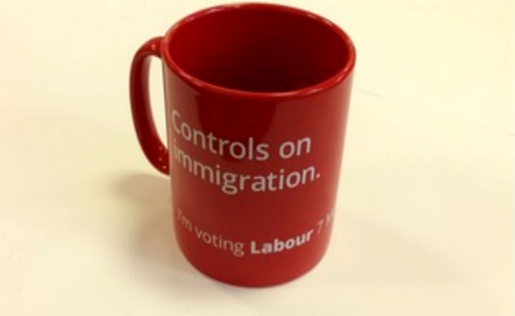
Labour’s immigration controls mug
None of this saved Miliband or his party, and the Tories won the 2015 election; the referendum vote in 2016 in favour of leaving the EU led to David Cameron’s resignation as Prime Minister; he was succeeded by Theresa May; Ed Miliband resigned as Labour leader; Jeremy Corbyn was elected in his place; the process of leaving the EU began. In 2017, Theresa May called another general election, hoping to increase her majority. In the event, the Tory party lost its small overall majority but won the election as the largest single party. But from then on it had to rely on Democratic Unionist Party (DUP) votes to get its business through the Commons.
These parliamentary changes meant nothing for the Windrush generation. The scandal began to come to light in 2017 but their suffering continued beyond the end of the decade, one of the main reasons being that the compensation scheme was seriously flawed. This remained a problem in April 2025, almost a year after the election of a Labour government. The Parliamentary and Health Service Ombudsman (PHSO), Rebecca Hilsenrath, had found that
further harm and injustice are still being caused by failings in the way the scheme is working. We found recurrent reasons for this, suggesting these were not one-off issues but systemic problems.[5]
In response, the Home Office sought to give some reassurance:
This government is committed to putting right the appalling injustices caused by the Windrush scandal and making sure those affected receive the compensation they rightly deserve.[6]
Nevertheless, given the Home Office’s record, we should hesitate before we are reassured. In 2020, the Williams review of the Windrush scandal had made 30 recommendations to the government, all of which were accepted by Priti Patel, Tory Home Secretary at the time. In January 2023, the Home Office unlawfully dropped three of them.[7] Moreover, the department prevented the publication of a report prepared in response to the Williams Review. Williams had said that Home Office staff needed to “learn about the history of the UK and its relationship with the rest of the world, including Britain’s colonial history, the history of inward and outward migration and the history of black Britons.” As a result, the Home Office commissioned an independent report: The Historical Roots of the Windrush Scandal. In the words of Jim Dunton, the report
lays much of the blame for the Windrush scandal on essentially racist measures introduced to restrict the ability of Commonwealth citizens to move to the UK in the years since the second world war.[8]
The report has been available internally since 2022 but, writes Dunton, “the department resisted attempts for it to be made publicly available, including rejecting repeated Freedom of Information Act requests and pressure from Labour MP Diane Abbott.” Then, in early September 2024, after a legal challenge was launched,
a First Tier Tribunal judge ordered the document’s publication, quoting George Orwell’s memorable lines from 1984: “Who controls the past controls the future. Who controls the present controls the past.”[9]
So the Home Office, reluctantly, made the report publicly available, and I will refer to its findings in future blogs. But it is not yet time to take Home Office reassurances at face value. Or Labour’s reassurances, come to that.
In future blogs: more on Labour’s record on immigration and race; and the necessary exposure of a long-standing myth.
[1] Goodfellow, M. (2019), Hostile Environment: How immigrants became Scapegoats, Verso Books, London, loc. 167.
[2] Jack Peat, “Just 6 Labour MPs voted against the 2014 Immigration Act”, The London Economic, 19/04/2018:
[3] Decca Aitkenhead, “Sarah Teather: ‘I’m angry there are no alternative voices on immigration’.”, The Guardian, 12 July 2013.
[4] Andrew Grice, “Ed Miliband attempts to take on Ukip – with toughened immigration policies”, The Guardian, 24 October 2014: Ed Miliband attempts to take on Ukip – with toughened immigration policies | The Independent | The Independent
[5] Adina Campbell, “Payments for Windrush victims denied compensation”, BBC News, 5 September 2024: Payments for Windrush victims denied Home Office compensation – BBC News
[6] Ibid.
[7] Ashith Nagesh & André Rhoden-Paul, “Home Office unlawfully axed Windrush measures”, BBC News, 19 June 2024: Windrush Scandal: Home office unlawfully axed recommendations, court rules – BBC News
[8] Jim Dunton, “Home Office publishes internal ‘roots of Windrush’ report after FoI battle”, Civil Service World, 27 September 2024: Home Office publishes internal ‘roots of Windrush’ report after FoI battle
[9] Ibid.
Hostile environment: the Mediterranean scandal
In the first blog in this series (https://bobmouncer.blog/2025/03/22/hostile-environment-the-windrush-scandal-i/), I showed how the announcement of a “hostile environment” for migrants by UK Home Secretary Theresa May in 2012 led to suffering and trauma for thousands of people, the Windrush generation. In the second blog (https://bobmouncer.blog/2025/03/26/hostile-environment-the-windrush-scandal-ii/), I told the story of Hubert Howard, who was one of its victims. In the third blog, I showed how documents that could have prevented the disaster to Hubert and thousands of others were deliberately destroyed; I described how the scandal slowly emerged and the government’s obstinate refusal to roll back on the policy; and I show how a compensation scheme was finally devised and how it failed so many Windrush victims. In this blog, I tell how another scandal erupted involving the UK government, though this time it was an EU-wide scandal. It was, however, perfectly in line with the UK’s hostile environment policy toward migrants. It should be counted as part of it.
The Mediterranean scandal
David Cameron and Theresa May were part of another immigration scandal, though they were not the only ones involved. In October 2014, Italy brought its routine search-and-rescue operations (called Mare Nostrum) to an end. The scheme rescued migrants crossing the Mediterranean Sea from Libya, most of them in unseaworthy boats. In the 12 months between October 2013 and October 2014, according to the Commons Home Affairs Select Committee, “Mare Nostrum saved 100,000 lives, but the Italian Government could not afford to maintain the operation at the cost of €9 million a month”[1] and had, for some time, been pressing the EU (which still included the UK as a member-state) to play a larger role in the operation. When Mare Nostrum came to an end, the EU’s response was to replace the Italian scheme with its own much more limited scheme, Triton. The difference between the two schemes was that Mare Nostrum undertook “a proactive search and rescue operation across 27,000 square miles of sea”[2] whereas, under Triton, the EU simply operated a coastguard patrol that reached out no further than 12 miles from the coast. Routine search-and-rescue operations were over. The EU argued that the search-and-rescue operations represented a “pull factor” for migrants: they attempted the dangerous crossing because they thought they would be rescued if they got into difficulties.
The Home Office carefully sheltered under the EU roof as officials sought to justify the removal of search and rescue: “Ministers across the EU”, the Home Office said,
have expressed concerns that search-and-rescue operations in the Mediterranean … [are] encouraging people to make dangerous crossings in the expectation of rescue. This has led to more deaths as traffickers have exploited the situation using boats that are unfit to make the crossing.[3]
One year later, Cameron and his Deputy Prime Minister Nick Clegg (leader of the Liberal Democrats), admitted that Triton was flawed. As the EU had scaled back the search-and-rescue operations to no more than coastguard patrols, hundreds more people had died. Then, after two disasters in quick succession in which a total of 1,200 people had died, Cameron declared that the plan to reduce crossings and deaths was “not successful”. He then sought to distance himself from it as much as possible by stressing the EU’s role as if it had nothing to do with him: the decision to stop search and rescue, he said,
was made by the EU and Italy as well. They found at some stage it did look like more people were taking to boats. So they, the EU, decided to end that policy and have a coastguard policy. That hasn’t worked either.[4]
It is worth noting that the decision to stop search and rescue was not a joint decision between Italy and the EU: the decision was at first made, as we have seen, by Italy alone on grounds of cost.[5] Nevertheless, the EU’s earlier unwillingness to play a larger role contributed to Italy’s decision.
Like Cameron, Nick Clegg also managed to distance himself from the policy in an attempt to avoid blame being attached to him or his party: he too claimed the decision to stop search and rescue was taken by “the EU”. He also claimed credit for the Liberal Democrats, who had, he said, called for an urgent review of “the EU’s policy”:
The EU’s decision to end routine search-and-rescue operations in the Mediterranean last year was taken with good intentions. No one expected the number of deaths to fall to zero, but there was a view that the presence of rescue ships encouraged people to risk the crossing. That judgment now looks to have been wrong. That’s why the Liberal Democrats have called for an urgent review of the EU’s policy …[6]
Once the consequences of the removal of search and rescue had become clear and public, the EU rolled back on the disastrous “coastguard patrols only” policy: it introduced a new search-and-rescue policy and Cameron pledged ships and helicopters and ordered the Royal Navy flagship HMS Bulwark to Malta to join the operations. This was a U-turn and it involved a significant change in the government’s language: its policy in the Mediterranean was now about “rescuing these poor people” rather than depicting them as reckless and foolish migrants.[7] But by June that year it was announced that the deployment of HMS Bulwark was being reviewed, which raised the question that, if it was to be withdrawn, would it be replaced? On 17 June, Labour MP Hilary Benn asked Chancellor George Osborne, who was standing in for Cameron at Prime Minister’s Questions in the Commons:
… we learned yesterday that [HMS Bulwark’s] deployment is under active review. Having made a grave error last October in withdrawing support from the Mare Nostrum search and rescue operations, will the right hon. Gentleman assure the House that the Government will continue to save the lives of those in peril on that sea?[8]
Osborne replied that “no one should in any way doubt Britain’s determination to play its role in helping with this situation”:
Taking people out of the water and rescuing them is essential – we are a humanitarian nation and we need to deal with those issues – but, in the end, we must break the link that enables someone to get on a boat and then claim asylum in Europe and spend the rest of their lives on the European continent.[9]
The government’s priorities became clearer on 22 June when Defence Secretary Michael Fallon announced that HMS Bulwark (19,000 tonnes, 176 metres long; 3,000 lives saved, according to government figures[10]) was to be replaced by HMS Enterprise (3,700 tonnes, 90.6 metres long, able to hold up to 120 people; part of the government’s “intelligence-led effort” to solve the crisis).[11] Despite this obvious reduction in search-and-rescue capacity and the priority it was given, Downing Street said that HMS Enterprise would be gathering intelligence “while continuing to rescue people as necessary”. However, one month later Enterprise had “not rescued any migrants since deploying to the Mediterranean to support the common security defence policy operation”.[12] So “rescuing these poor people” had apparently ceased to be “absolutely essential” and had given way to intelligence gathering. From now on, intelligence would be gathered while search-and-rescue operations vanished entirely.
[1] Migration Crisis (2015), Report by the Commons Home Affairs Select Committee, paras. 79-81: House of Commons – Migration Crisis – Home Affairs Committee (parliament.uk)
[2] Home Affairs Committee, House of Commons, Migration Crisis:
[3] Alan Travis, “Home Office defends decision for UK to halt migrant rescues”, The Guardian, 28 October 2014.
[4] Rowena Mason, “Cameron and Clegg admit axing search and rescue in Mediterranean has failed”, The Guardian, 22 April 2015: Cameron and Clegg admit axing search and rescue in Mediterranean has failed | Immigration and asylum | The Guardian
[5] Home Office minister James Brokenshire confirmed this in an answer during an urgent question in the House of Commons, when a Tory MP had suggested that the EU had withdrawn support from Mare Nostrum: ”To be clear, the EU is not withdrawing anything. Mare Nostrum is an Italian initiative. It is supported by the Italian navy, and ultimately decisions will be taken by the Italian Government.” (Refugees and Migrants (Search and Rescue Operation) (Urgent Question), col. 404, 30 October 2014: Refugees and Migrants (Search and Rescue Operation) – Hansard – UK Parliament
[6] Nick Clegg, “The solution to the deaths in the Mediterranean lies on land, not at sea”, The Guardian, 22 April 2015: The solution to the deaths in the Mediterranean lies on land, not at sea | Nick Clegg | The Guardian
[7] Ian Traynor, “European leaders pledge to send ships to Mediterranean to pick up migrants”, The Guardian, 23 April 2015: European leaders pledge to send ships to Mediterranean to pick up migrants | European Union | The Guardian
[8] Commons Hansard, “Prime Minister’s Questions”, 17 June 2015, col. 312: House of Commons Hansard Debates for 17 Jun 2015 (pt 0001) (parliament.uk)
[9] Ibid.
[10] HMS Enterprise to replace HMS Bulwark in the Mediterranean, Ministry of Defence: HMS Enterprise to replace HMS Bulwark in the Mediterranean – GOV.UK (www.gov.uk)
[11] Ibid.
[12] Alan Travis, “HMS Bulwark’s replacement yet to rescue any migrants in Mediterranean”, The Guardian, 27 July 2015HMS Bulwark’s replacement yet to rescue any migrants in Mediterranean | Migration | The Guardian:
Hostile environment: the Windrush scandal II
The first blog in this series[1] showed how the announcement of a “hostile environment” for migrants by UK Home Secretary Theresa May in 2012 led to suffering and trauma for thousands of people, the Windrush generation. In this second blog, I tell the story of Hubert Howard, who was one of its victims.

Hubert Howard
We begin Hubert’s story in 1960, when his mother brought him to the UK from Jamaica when he was three years old. They were Citizens of the United Kingdom and Colonies (CUKCs), and Commonwealth citizens, and thus had the right to enter and reside in the UK. In his Court of Appeal hearing in 2019, Lord Justice Underhill made clear that Hubert’s residence, “was lawful from his first arrival in 1960.”[2] When Jamaica gained independence in 1962, Hubert automatically acquired Jamaican nationality (and thus ceased to be a CUKC). But he remained a Commonwealth citizen. This meant, Underhill explained, that “his right to reside in the United Kingdom was unaffected.”[3] Nevertheless, as we have seen,[4] the Acts of 1981 and 1988 did undermine that right. In particular, the British Nationality Act 1981 removed Hubert’s status as citizen and turned him into a foreigner. It imposed a limited transition period of five years during which individuals like Hubert would have to register themselves as British if they wanted to stay British. In her Windrush Lessons Learned Review, Wendy Williams noted that the transition period ended on 31 December 1987.[5] Once that period had expired the only way for Hubert to regain his legality and British status was through naturalisation.
Many of the Windrush generation, however, neither registered nor applied for naturalisation.[6] There were several reasons for this: the Home Office was afraid it would not be able to cope with the numbers that would apply and, the Williams Review found, it “wanted to develop advertising that was informative but didn’t ‘stimulate a flood of enquiries’.”[7] Moreover, officials managed the numbers by telling some applicants that “they didn’t have to register and wouldn’t face removal if they withdrew their applications.”[8] A leaflet issued in 1987 advised:
If you have the right to register but you don’t want to, you do not have to. Your other rights in the United Kingdom will not change in any way. You will not lose your entitlement to social benefits, such as health services, housing, welfare and pension rights, by not registering. Your position under immigration law is not changed.[9]
In the light of what happened later, when the Windrush victims lost all those entitlements, this piece of disinformation is startling. Regrettably, but not surprisingly, some people accepted the advice and did not register. Williams also highlighted another disincentive: applications “cost £60 (approximately £180 in today’s prices), with no dispensation for people on benefits.”[10] But not least among the reasons for not registering themselves as British or applying for naturalisation was that the Windrush generation took it for granted that they didn’t need to: they had come to the “mother country”, they were already British.[11] So, although around 130,000 people did apply for citizenship, many let the deadline pass.[12] One of them was Hubert Howard.
When Hubert’s mother retired, she decided to return to Jamaica. In 2005 she became ill with cancer and Hubert applied for a passport so he could visit her. His application was refused because, in the view of the Home Office, he had no documentary proof of his British citizenship. In 2006, his mother died, and he applied again so that he could go to her funeral. His application was again refused. In the end, he was never able to visit her grave. (This means, of course, that his legal rights as a member of the Windrush generation were being denied long before the hostile environment was announced in 2012, and we will return to this point in a later blog.) Hubert made several subsequent attempts to obtain confirmation of his status. After one of them, in 2011 (by which time Hubert had had 51 years of residence and a long work record), the Home Office wrote to him:
You confirmed that you entered the UK in the 1960s as a child and have lived in the UK since that time, but you are uncertain of your immigration status. In order to apply for British citizenship, you will first need to obtain confirmation of your immigration status in the UK based on your residence here.[13]
That was, of course, exactly what he was asking the Home Office to provide, since it was the government department responsible. As for his long work record, the Home Office brought it to an end in 2012: “My employers”, said Hubert,
were told by the Home Office that they had to get rid of me, otherwise they would get fined. All I needed was for the Home Office to say I was legal, but they said I was an overstayer and I didn’t have status. I tried to argue they were wrong. I left my job in 2012.[14]
In 2014, Hubert made another attempt, this time applying for a No Time Limit (NTL) confirmation of his status. The Home Office replied, once again shifting the responsibility and the burden of proof on to Hubert’s shoulders:
In order to qualify for this [you] must demonstrate that [you] are free from immigration time restrictions in the UK … [You are] unable to demonstrate that [you] have been continuously resident in the UK … the Secretary of State is not satisfied that [you are] entitled to an NTL endorsement and [your] application is therefore refused.[15]
Four years later, in February 2018, Hubert received this advice from another Home Office official:
Your case has recently been brought to my attention as you have been having certain issues due to not holding a document to confirm your status … Given your circumstances it would be advisable to make an NTL application.[16]
Huber did so. Eventually, after years of refusing to acknowledge the obvious, the Home Office finally relented and, on 10 May 2018, confirmed the knowledge it had possessed all along:
We’ve confirmed that you entered the UK before 1 January 1973. We consider that you have had indefinite leave to remain [ILR] from that date.[17]
Unfortunately, ILR was not enough. Hubert’s troubles were not yet over: he still had to apply for British citizenship. When he did so, his application was rejected on the grounds that he did not meet the “good character requirement” which had to be met for the naturalisation application to succeed. His failure to meet the requirement was the result of an argument with a receptionist at his GP surgery about a form he had filled in relating to his social security benefits. He was unable to work due to leukaemia, which he had suffered from since 2014. During the argument he had allegedly grabbed the receptionist’s finger while trying to take the form from her, and the police were called. Hubert was charged with common assault, found guilty and given a suspended prison sentence of 12 months.[18] The Home Office continued to reject his citizenship application in subsequent reviews but, finally, on 16 October 2019, an official wrote:
Mr Howard’s application has now been reviewed in the light of all the additional information and evidence provided, including that provided in Mr Howard’s current judicial review proceedings. The review has considered his immigration history and his current circumstances, in particular noting his long residence in the UK, the time that has now elapsed since his criminal conviction in June 2018, and his current ill health. I am pleased to say that, in view of the circumstances of his case, the Secretary of State is satisfied that discretion should now be exercised in his favour on an exceptional basis and Mr Howard’s application for British Citizenship has been approved.[19]
Hubert died from leukaemia three weeks later. In 2018, he had succinctly summed up his experience:
They basically messed up my life. I had a steady job. They took my job away, stating quite clearly I had no status in this country. It broke my heart losing my job with Peabody. It was the best job I was ever in. When my mum passed away, I wasn’t there, and I still have not been at her graveside.[20]
In the next blog:
Sabotage?
Smole and mirrors
A failed compensation scheme
[1] Hosrile Environment: the Windrush scandal I: Hostile Environment: the Windrush Scandal I « Bob Mouncer’s blog
[2] Case No: CA-2021-000601, Royal Courts of Justice Strand, London, WC2A 2LL (27/7/2022), para. 8: Microsoft Word – Howard for hand-down _2_.docx (dpglaw.co.uk)
[3] Ibid., para. 9.
[4] Hostile Environment: the Windrush scandal I: https://bobmouncerblog.wordpress.com/2025/03/22/hostile-environment-the-windrush-scandal-i/
[5] Wendy Williams (2020), Windrush Lessons Learned Review, p. 59: 6.5577_HO_Windrush_Lessons Learned Review (publishing.service.gov.uk)
[6] Ibid., and “Court of Appeal finds Windrush migrants’ experience of hardship irrelevant to British citizenship applications”, Deighton Pierce Glyn Solicitors (DPG), 27 July 2018: Court of Appeal finds Windrush migrants’ experience of hardship irrelevant to British citizenship applications – DPG Law
[7] Wendy Williams (2020), p. 59: 6.5577_HO_Windrush_Lessons Learned Review (publishing.service.gov.uk)
[8] Ibid.
[9] Ibid.
[10] Ibid.
[11] Ibid.
[12] Ibid.
[13] Cited, ibid.
[14] Gentleman, A., ”’I’ve been here for 50 years’: the scandal of the former Commonwealth citizens threatened with deportation”, The Guardian, 21 February 2018: ‘I’ve been here for 50 years’: the scandal of the former Commonwealth citizens threatened with deportation | Immigration and asylum | The Guardian
[15] Cited in “Court of Appeal finds Windrush Migrants’ experience of hardship irrelevant to British citizenship applications”, Deighton Pierce Glynn, Solicitors (DPG Partners): Court of Appeal finds Windrush migrants’ experience of hardship irrelevant to British citizenship applications – DPG Law (no date).
[16] Ibid.
[17] Ibid.
[18] Ibid.
[19] Case No: CA-2021-000601, Royal Courts of Justice Strand, London, WC2A 2LL (27/7/2022), para. 8: Microsoft Word – Howard for hand-down _2_.docx (dpglaw.co.uk), para 30.
[20] Gentleman, A., ”’I’ve been here for 50 years’: the scandal of the former Commonwealth citizens threatened with deportation”, The Guardian, 21 February 2018: ‘I’ve been here for 50 years’: the scandal of the former Commonwealth citizens threatened with deportation | Immigration and asylum | The Guardian
Theresa May’s victims are now Labour’s victims
In 2012, home secretary Theresa May launched the hostile environment. What was it?
During the UK’s general election campaign in 2010, David Cameron, leader of the Tory opposition, pledged to reduce the UK’s net immigration per year to “less than tens of thousands” if he became prime minister. After the election, he led a coalition government with the Liberal Democrats. He appointed Tory MP Theresa May as home secretary, who seemed as determined as he was to get immigration numbers down. She announced her intention in an interview in The Telegraph in 2012, saying, “The aim is to create, here in Britain, a really hostile environment for illegal immigrants.” She later introduced an Immigration Bill, which would become law in 2014, and explained its purpose in the following way:
Most people will say it can’t be fair for people who have no right to be here in the UK to continue to exist as everybody else does with bank accounts, with driving licences and with access to rented accommodation. We are going to be changing that because we don’t think that is fair … What we don’t want is a situation where people think that they can come here and overstay because they’re able to access everything they need.
The hostile environment policy led to two major scandals, the Windrush scandal and the Mediterranean scandal. I am concerned here with the Windrush scandal.
The name refers to the “Windrush generation”, British citizens from British colonies and ex-colonies in the Caribbean who had come to the UK to work and help rebuild the country after the Second World War. The first group came by boat, the SS Empire Windrush, in 1948. What happened during the hostile environment was particularly scandalous because this whole cohort of people who had been citizens for decades were told they were not. The House of Commons Home Affairs Select Committee, which later investigated the scandal, summed up what happened to them in a few succinct sentences. Members of the Windrush generation were
denied access to employment, healthcare, housing and other services in the UK. In some cases, people who had every right to live in the UK were targeted for removal, held in immigration detention, deported or prevented from returning to the UK from visits abroad. Upon trying to resolve their status with the Home Office, they faced obstacles such as “often insurmountable” requirements for decades-worth of evidence to demonstrate their time in the UK and significant application fees.
The Guardian story shows that the hostile environment has not disappeared. Samuel Jarrett-Coker is the latest of its victims to be revealed. There were half-hearted apologies, despite court cases won, and a failed compensation scheme set up. Yet many people have probably concluded that the scandal is over and the ill-treatment of its innocent victims a thing of the past.
Not any more.
Samuel Jarrett-Coker, 13 years after Cameron and May spawned the hostile environment, is in danger of losing his home and is threatened with deportation, after a lifetime in the UK, all because he hasn’t got a passport and, says the Home Office, must prove his British citizenship or be thrown out of the country.
I have written to my MP in Hull, Diana Johnson, about Samuel. I have explained to her that there is
absolutely no justification for Mr Jarrett-Coker’s treatment. The arguments put by the Home Office in his case were dismissed and settled in court in the Hubert Howard case in 2019, when Lord Justice Underhill declared that Hubert Howard’s residence in the UK “was lawful from his first arrival in 1960”.
The Home Office has been consistently abusive for decades. There’s not much we can do about the distant past. But we can bring the Windrush scandal to its end. I have suggested to Diana Johnson that as
we now have a Labour government, of which you are a member, it must surely be possible, now, to bring such Home Office abuse and the Windrush injustice, to an end. Three things should surely be done: stop the Home Office’s abuse; give Mr Jarrett-Coker his citizenship rights; and give all the surviving Windrush victims the compensation they deserve. If these actions are not taken, and fast, and if the Home Office is allowed to continue its abusive ways unchecked by politicians, not one of our ethnic communities (in Hull or anywhere else) is safe.
Read about Samuel Jarrett-Coker and then write to your MP. They all need to know, or be reminded of, what is still being done in our name to the innocent victims of what Theresa May called the “really hostile environment”.
So you’re a Group 2 refugee, are you?
This is the third blog in the series on the UK’s Nationality and Borders Act 2022
The first thing to note if you are a Group 2 refugee is that you are a temporary person: “Temporary protection status will be for a temporary period, no longer than 30 months …” (Policy Statement, p. 20, see link below). Once that period is over, you will be protected from absolutely nothing. In Patel’s impersonal language, “individuals will be reassessed for return to their country of origin or removal to another safe country” (ibid.).
Three main problems arise immediately. The first is that it may not be safe to send you back to your own country. The UK government will argue that, since your claim of persecution has been rejected, returning you to your own country will not put you in danger. But, as we have seen, the Home Office’s decision-making is open to question and we will see in later blogs that in any case its knowledge of countries of origin is often inaccurate or out of date. So your safety is far from 100% certain. Moreover, there are plenty of examples where governments, especially if the Home Office has informed them of an asylum seeker’s return, punish them once they get back, and the UK government does not check on the welfare of the people it returns. Labour Immigration Minister Baroness Scotland told the House of Lords in 2006:
Where we refuse a claim and the Asylum and Immigration Tribunal dismisses any appeal we … consider that it is safe for that individual to return. This is one of the reasons why the Home Office does not routinely monitor the treatment of individuals once removed from the UK (cited Mouncer, B. (2010), Dealt with on their Merits?, p. 98).
The second problem is that so far Rwanda is the only country to agree to take asylum seekers passed on to them by the UK, and we don’t know if they will include the UK’s temporarily protected refugees, how they would be treated if they were included (settled there or removed somewhere else?), let alone whether there will be agreements in the future between the UK and other countries.
Thirdly, temporary protection status also means “family reunion rights will be restricted and there will be no recourse to public funds except in cases of destitution” (Policy Statement, p. 20). In practice this must mean that family reunion rights will be defunct in practice (for who would want to bring their family over for a maximum of 30 months, only to be deported to some unknown destination after that, possibly in a state of near-destitution?). But even “restricting” the right to family life surely breaches the spirit of the Refugee Convention, if not the letter. For although there is no specific reference to family reunification in the Refugee Convention, the Conference that adopted that Convention passed a strongly worded recommendation urging governments “to take the necessary measures for the protection of the refugee’s family, especially with a view to ensuring that the unity of the family is maintained” (The Right to Family Life and Family Unity of Refugees, etc., p. 9, para. 2.1.4: https://www.unhcr.org/5a8c40ba1.pdf). Jastram and Newland argue that “Recognition as a refugee gives rise to a prima facie reason to admit the refugee’s close family members to the country of asylum.” (Jastram, K. & Newland, K., Family Unity and Refugee Protection, p. 581: http://refworld.org). They give the same reason: “Reunification in a country of asylum is the only way to assure the right to family unity for refugees, who cannot by definition return to their country of origin.” This has been accepted by most signatories to the Refugee Convention ever since its inception.
The Home Office has described another scenario. In its Explanatory Notes it says that “individuals may be eligible to apply for long residency settlement after 10 years if the necessary requirements are met.” (Explanatory Notes, p.6, para 19). It doesn’t specify who these individuals might be or explain the contradiction between the 10-year period envisaged in this scheme and Patel’s firmly limited protection period of “no more than 30 months”. But with no basis in international law for the creation of Group 2 refugee status, the deportation of recognised refugees, whether after 30 months or 10 years, clearly breaches the Refugee Convention, Article 32: “The Contracting States shall not expel a refugee lawfully in their territory save on grounds of national security or public order.”
Finally, we have seen that if you are given Group 2 status, with its temporary protection, you will have “no recourse to public funds except in the case of destitution” (Policy Statement, p. 20). However, for UNHCR, a refugee is a refugee regardless of the notion of temporary protection or the allocation of any “Group 2” status. UNHCR is clear that a “Group 2 refugee” is entitled to “public relief and assistance on the same terms as nationals”, as laid down in Article 23 of the Refugee Convention (UNHCR Comments on the New Plan, para. 45; Refugee Convention, Art. 23). A ban on such benefits must surely be a breach of the Convention.
Policy Statement:
Out of sight, out of mind: the fate planned for refugees
Discreet talks with the government in Tirana to establish an asylum centre are under way. After a series of frustrations in talks with other countries to host migrants, cabinet hopes of a deal with Albania are growing (The Times, “Migrants to be held in Albania”, 18 November 2021).
Abstaining is not an option – Labour must reject Patel’s Bill
I’ve written to Labour’s Shadow Home Secretary, Nick Thomas-Symonds, and my local MP, Emma Hardy, asking them to make sure that Labour votes against Priti Patel’s new asylum Bill.
Scrutiny of the Nationality and Borders Bill begins tomorrow (19 July). It is of particular interest to me because of my earlier research at Hull University on the treatment of asylum seekers. My particular concern today is that Labour should give no credibility to the Bill. In particular Labour shouldn’t abstain at any point on the grounds that “we understand voters’ concerns”. Labour did this on the Welfare Bill in 2015 and the front bench tried to do it on the Immigration and Social Security Bill in, I think, 2017. But it is time to stand up for a few principles now and not just run scared. The current Bill is the worst Bill of its kind that I can remember and it will do untold harm to people from the moment it becomes law. Labour should have no truck with it from day 1.
I’ve looked at the Bill itself now, so I thought I’d make some preliminary comments. I will focus on Part 2, which is about asylum, but for now I will only mention a couple of points.
Section 10 is unacceptable from the outset: it immediately creates two groups of refugees. Group 1 refugees are legal; Group 2 refugees are not. They are “unlawful”. What makes them unlawful is, according to s.10 (4), because “a person’s entry into or presence in the United Kingdom is unlawful if they require leave to enter or remain and do not have it.” This new definition of “unlawful” makes the vast majority of asylum seekers illegal. The Bill achieves this end, in part, because it creates an entirely new offence. According to s.37(2), (C1), a person who
“(a) requires entry clearance under the immigration rules, and
(b) knowingly arrives in the United Kingdom without a valid entry
clearance,
commits an offence.”
Plus, according to s. 37 (3):
“In proceedings for an offence under subsection (C1) above of
arriving in the United Kingdom without a valid entry
clearance … (b) proof that a person had a valid entry clearance is to lie on the defence.”
This offence of “arriving in the UK” is a new offence, created by this Bill. According to criminal defence barrister Aneurin Brewer, the current situation is that
“those who merely arrive, immediately claim asylum and are as a result admitted to the UK while their asylum claim is processed have not entered the UK illegally.” https://www.freemovement.org.uk/prosecutions-for-assisting-unlawful-immigration-in-small-boats-cases-the-key-to-acquittal/
If this Bill is passed, they will have done so and thus, although the Bill doesn’t breach Convention Article 31 (1) according to Patel’s narrow and restrictive interpretation, it certainly ignores the spirit of UNHCR recommendations on applying a “flexible and liberal” approach and on giving “the benefit of the doubt”.
Patel is legally entitled to do this. It may be worth bearing in mind that the Refugee Convention is not a perfect instrument for protecting refugees. Its final form was the result of a deal. Every state wanted to limit its obligations to give protection to refugees. So the Convention and UNHCR’s Guidelines, despite talk of liberality and benefit of doubt, provided them with caveats and ways of avoiding their responsibilities. One example of this is Article 31(1). While it is generally interpreted as prohibiting governments from imposing any penalties on asylum seekers who arrive without passports or other travel documents, governments generally do impose penalties because the article talks of asylum seekers who come “directly” from the country of their persecution and refers to illegal entry. The word “directly” can be interpreted to mean that penalties can be imposed if the asylum seeker comes to the UK and passes through another “safe” country where, it is always assumed, they could have claimed asylum. This interpretation of the word “directly” was probably the reason why the Dublin Convention, now not applicable after Brexit, was not regarded as a contravention of the Refugee Convention. one of the things Patel is proud of doing in this Bill is making this requirement part of UK law now, thus dealing with the “problem” of the disappearance of the Dublin Convention after Brexit.
So what I’m saying is that, in principle, the Convention seems to establish the primacy of refugee protection, but in its detail and in practice it has proved to be ambiguous and open to a variety of interpretations. UNHCR “advocates that governments adopt a rapid, flexible and liberal process” when dealing with asylum applicants because it recognises “how difficult it often is to document persecution”. However, its interpretation of the Convention contradicts this stance. In its definition of a refugee, the Convention’s reference to persecution “for reasons of race, religion, nationality, membership of a particular social group or political opinion” suggests the possibility of group persecution and a collective refugee experience. But, when interpreted by UNHCR, the definition turns out to be based on a concept of persecution in which the burden of proof falls on the individual asylum seeker. Thus people “who apply for refugee status normally need to establish individually that their fear of persecution is well-founded”, i.e. they must provide evidence that it is not just their social group, members of their political party or people who share their religion or ethnicity who are in danger but themselves as individuals. I have sat in a good few solicitors’ offices listening to them explaining to their clients how their letters, newspaper reports, and their photographs are absolutely not proof. A “flexible and liberal process” becomes less likely as governments demand this rigorous standard of proof. To put the burden of proof on refugees is to consider them guilty until proved innocent.
But Patel is clearly entitled to do what she’s trying to do here. She can invent laws and move the goalposts, she can choose only to follow the UNHCR advice that suits her and ignore the rest. But I think Labour should do its best to stop her. It should, if it can’t eliminate all her hostile purposes from the Bill, vote against the whole shebang and campaign loudly against it from the start. It should never abstain. Not just because of the Refugee Convention, important though that is. But because of the principle of refugee protection and the defence of human rights.
 Bob Mouncer's blog