Home » Posts tagged 'Gloria-Olivia Vicol'
Tag Archives: Gloria-Olivia Vicol
Immigration policy Mahmood-style: no one is safe
In an earlier blog,[1] I explained the first steps in the UK’s new asylum and immigration policy announced by Home Secretary Shabana Mahmood last November. Her hostility to asylum seekers is clear in these proposals: she sees them as abusers of the asylum system. She declares (wrongly) that if you are an asylum seeker off a small boat arriving in Dover you are “illegal”. But her hostility doesn’t stop at asylum seekers. It is extended to recognised refugees and, as we shall see, to a whole range of other migrants.
A quick reminder of the story so far: after you have been granted asylum, you will only be given temporary protection for 30 months instead of the permanent protection offered under the old system. If, before the end of that period, you apply for an extension and the government decides, without consulting you, that you no longer need protection, you will be deported back to your country. If the government does decide that you still need protection, you will get it for another 30 months. You can apply for an extension four times, at a cost of £3,908.50 a throw. If the government eventually agrees that you still need protection, you will nevertheless not be able to apply for indefinite leave to remain (ILR), which gives you permanent status, until you have been here for 10 years (under the previous system it was five years). If you are receiving social security benefits you will have to wait longer (15 or 20 years) before you can apply for ILR.
If you think all this delay and uncertainty is harmful and destabilising to people already traumatised by the experiences that forced them to leave their home countries in the first place, you are right.[2] But Mahmood claims to have provided a solution: the Protection Work and Study Visa scheme. When we last saw this scheme,[3] it was up for consultation. Now the consultation process has ended. The scheme is being rolled out. Against the background of the current changes, it may seem to have one advantage: if you’re on a work-and-study visa, you may get a shorter qualifying period to ILR.[4] This sounds consistent with Mahmood’s claim that migrants are welcome here if they are willing to work and contribute to society. However, we should not take that claim at face value. We should remember that the government’s overriding aim as it introduces the new policy is to discourage all but the most determined (or, indeed, desperate) people from applying, not just for ILR, but for asylum in the first place. It hopes that people seeking safety will see the obstacles being erected and rule out coming here at all. Mahmood says this ploy works, that other European countries have tried it and asylum applications have fallen. She believes that applications must be made to fall in the UK too, and this is the way to do it. She doesn’t say what the solution is for those who need to flee their countries. But then none of her favourite European countries, including Denmark, Belgium and the Netherlands,[5] seem to address that question either.
Mahmood’s policy contradicts her claim that migrants are welcome if they’re ready to knuckle down and work. For one thing, the policy reduces the number of people allowed to work, regardless of the need for labour in any sector of the economy. For example, jobs counted as medium-skilled can no longer be sponsored unless the Migration Advisory Committee[6] recommends an exemption from the new rules, and unless “the industry demonstrates efforts to recruit domestically”.[7] The fact that the policy operates regardless of the need for labour is most clearly seen in the case of social-care workers (generally counted as low-skilled). They were urgently recruited during the Covid pandemic on a promise that, after five years of work in the sector, they would be able to apply for permanent settlement and bring their families here. That promise has now been broken. Indeed, employers can no longer recruit social-care workers from abroad at all: together with the reduction in the number of skilled jobs eligible for visa sponsorship, “overseas recruitment of social care workers also ended on 22 July 2025.”[8]
The government says that to do otherwise would be too costly. A Reuters report notes that between 2022 and 2024,
around 616,000 workers and their dependants moved to Britain on a specific visa for care workers, nurses and doctors. Around 384,000 are expected to become eligible for ILR between 2027 and 2029.[9]
The Home Office claims that, as a result, around 350,000 low-skilled workers and their dependants would cost about £10 billion in public services and benefits, including pensions, during their lifetimes.[10] Is this claim tenable? Not according to Jonathan Portes, Professor of Economics and Public Policy at King’s College, London. He described the estimate as “at best deliberately misleading”. The rule change would only save that amount if “every single person” modelled in the projection left the country.[11]
On the need for workers, the same report notes that:
job vacancies in the sector already stand at nearly three times the national average – a problem that can affect the running of the National Health Service when it cannot discharge patients into care homes, and a major challenge for Britain’s ageing population.[12]
But the government insists that “restricting foreign labour would force care homes to pay higher wages to attract local staff”.[13] At the time of blogging, however, there is no sign that care homes are ready to fulfil this fantasy. Meanwhile, “Britain’s ageing population” will continue to suffer.
Mahmood claims that she wants refugees on temporary core protection to move to the Protection Work and Study Visa route to ILR:
We want to encourage refugees to integrate more fully into the communities providing them sanctuary. To address this, we will encourage refugees to switch out of the Core Protection route wherever possible. We will introduce a new, in-country Protection Work and Study route. A person granted protection will be eligible to apply to move into this route if they obtain employment or commence study at an appropriate level and pay a fee. Once on this route, they will become eligible to “earn” settlement sooner than they would under core protection alone.[14]
It is difficult to see how refugees counted as medium or low skilled will be able to do that under the new scheme, either through employment or through study. Not only are there now increased employment restrictions on medium- and low-skilled migrants, but there are also tougher rules for universities if they want to sponsor students.[15]
However, these restrictions do not apply to all migrants. In particular they do not apply to those the government sees as having more to contribute to the UK, and who are also likely to be more affluent, than your average small-boat traveller. Take, for example, those who are eligible to apply for the Global Talent Visa. This visa has been created “for talented and promising individuals in the fields of science, digital technology and arts and culture wishing to work in the UK”.[16] According to the Home Office,
we are making it easier for top design talent to use the Global Talent visa and come to the UK. To do this, we are expanding the route to include a design pathway, covering additional design roles which are not currently catered for.[17]
Such individuals will not have to spend time worrying about temporary status. The Home Office reassures them:
There’s no limit to how long you can stay in the UK in total, but you will need to renew (“extend”) your visa when it expires. Each extension can last from 1 to 5 years – you choose how long you want the extension to be.[18]
For most migrants, however, this is an impossible dream.
Resistance
Mahmood’s changes to asylum and immigration policy have not gone unchallenged, even from within the Labour Party. A joint letter opposing the asylum changes was sent to Mahmood in January. It was signed by Neil Duncan-Jordan, the Labour MP for Poole, Andrea Egan, the General Secretary of the Unison trade union, and Doctor Gloria-Olivia Vicol, CEO of the Work Rights Centre. It was signed by 53 MPs, 21 peers and 33 civil society organisations. Duncan-Jordan, highlighting the care workers, said:
A Labour Government has lost its way when it’s making policy designed to chase Nigel Farage’s tail instead of doing what’s best for the country. I worked with migrant care workers for years as a trade unionist – they’re decent, hardworking people who do a challenging job in difficult conditions, often for low pay.[19]
He said the policy “pushes a struggling sector closer to crisis” and argued that the government “must not apply these changes to people already here – we punish those who have already built their home and their work around promises our government made them.”
In the next blog: Vanishing rights of appeal.
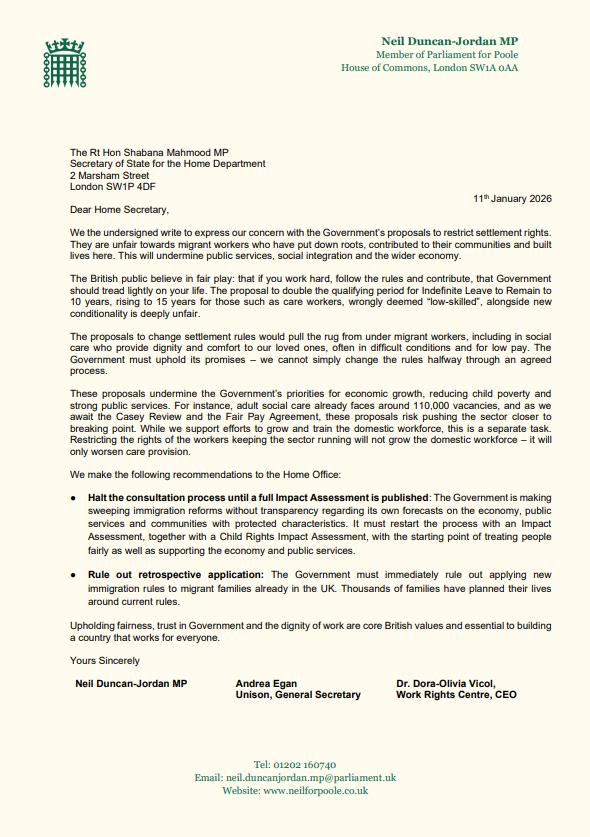
The first page of the letter to Mahmood.
[1]The new asylum regime: the first steps: https://bobmouncer.blog/2026/03/27/the-new-asylum-regime-the-first-steps/
[2] See my earlier blog for concerns expressed by others: The new asylum regime: the first steps, Concerns: The new asylum regime: the first steps « Bob Mouncer’s blog
[3]New and old hostilities: New and old hostilities « Bob Mouncer’s blog
[4] See New and old hostilities, Earn your keep: New and old hostilities « Bob Mouncer’s blog
[5] Restoring Order and Control: A statement on the government’s asylum and returns policy, Foreword from the Home Secretary, and para 2: Restoring Order and Control: A statement on the government’s asylum and returns policy (accessible) – GOV.UK
[6] The Migration Advisory Committee is a public body that advises the government on migration policy (see Migration Advisory Committee – GOV.UK).
[7] Changes to UK visa and settlement rules after the 2025 immigration white paper, House of Commons Library, 20 March 2026, section 1: Changes to UK visa and settlement rules after the 2025 immigration white paper – House of Commons Library
[8] Changes to UK visa and settlement rules after the 2025 immigration white paper, House of Commons Library, 20 March 2026, section 2: Changes to UK visa and settlement rules after the 2025 immigration white paper – House of Commons Library
[9] UK’s migration crackdown risks care home staffing crunch, 22 April 2026: UK’s migration crackdown risks care home staffing crunch | Reuters
[10] UK’s migration crackdown risks care home staffing crunch, 22 April 2026: UK’s migration crackdown risks care home staffing crunch | Reuters
[11] Cited, UK’s migration crackdown risks care home staffing crunch, 22 April 2026: UK’s migration crackdown risks care home staffing crunch | Reuters
[12] UK’s migration crackdown risks care home staffing crunch, 22 April 2026: UK’s migration crackdown risks care home staffing crunch | Reuters
[13]Cited, UK’s migration crackdown risks care home staffing crunch, 22 April 2026: UK’s migration crackdown risks care home staffing crunch | Reuters
[14] Restoring Order and Control: a statement on the government’s asylum and returns policy, 21 November 2025: Restoring Order and Control: A statement on the government’s asylum and returns policy (accessible) – GOV.UK
[15] Changes to UK visa and settlement rules after the 2025 immigration white paper, 20 March 2026: Changes to UK visa and settlement rules after the 2025 immigration white paper – House of Commons Library
[16] Explanatory memorandum to the statement of changes in the Immigration Rules:Explanatory memorandum to the statement of changes in the Immigration Rules: HC 1691, 5 March 2026 (accessible) – GOV.UK
[17] Explanatory memorandum to the statement of changes in the Immigration Rules, para. 5.67: Explanatory memorandum to the statement of changes in the Immigration Rules: HC 1691, 5 March 2026 (accessible) – GOV.UK
[18] Apply for the Global Talent Visa: Apply for the Global Talent visa : Overview – GOV.UK
[19] “Neil Duncan-Jordan MP opposes Home Office planned changes”, Bournemouth Echo: Neil Duncan-Jordan MP opposes Home Office planned changes | Bournemouth Echo

