Home » Posts tagged 'Diane Abbott'
Tag Archives: Diane Abbott
The hostile environment: Labour’s response
In the first blog in this series (https://bobmouncer.blog/2025/03/22/hostile-environment-the-windrush-scandal-i/), I showed how the announcement of a “hostile environment” for migrants by UK Home Secretary Theresa May in 2012 led to suffering and trauma for thousands of people, the Windrush generation. In the second blog (https://bobmouncer.blog/2025/03/26/hostile-environment-the-windrush-scandal-ii/), I told the story of Hubert Howard, who was one of its victims. In the third blog (https://bobmouncer.blog/2025/03/30/hostile-environment-the-windrush-scandal-iii/), I showed how documents that could have prevented the disaster to Hubert and thousands of others were deliberately destroyed; I described how the scandal slowly emerged and the government’s obstinate refusal to roll back on the policy; and I showed how a compensation scheme was finally devised and how it failed so many Windrush victims. In the last blog (https://bobmouncer.blog/2025/04/02/hostile-environment-the-mediterranean-scandal/) I described the Mediterranean scandal, in which the EU, including the UK, stopped rescue operations in the Mediterranean and how a UK government tried to deny its responsibility for the ensuing tragedy.
In this blog, I examine Labour’s response to the hostile environment.
Labour’s response
The two major scandals examined in my previous blogs in this series unfolded, first, under a Tory/LibDem coalition government and then under the subsequent Tory government. But what was Labour’s response to May’s hostile environment? Maya Goodfellow describes it as “the most minimal resistance”.[1] Labour, the official opposition, abstained in the final Commons vote on the Immigration Bill. Sixteen MPs voted against it, but only six of them were Labour MPs: Diane Abbott, Kelvin Hopkins, John McDonnell, Fiona Mactaggart, Dennis Skinner and Jeremy Corbyn. Corbyn said the Bill was
dog-whistle politics, the mantras being that every immigrant is an illegal immigrant who must somehow be condemned, and that immigration is the cause of all the problems in our society … If we descend into a UKIP-generated xenophobic campaign, it weakens and demeans all of us and our society, and we are all the losers for that.[2]
One of the other MPs was Sarah Teather, a LibDem MP and former minister, who had told The Guardian in 2013 that the proposals in the Bill were “hewn from the same rock” as earlier welfare cuts, much of which were “about setting up political dividing lines, and trying to create and define an enemy”.[3] But apart from the six rebels, Labour MPs obeyed their leader, Ed Miliband, and the Labour whips, and abstained in the Commons vote.
By October, Miliband had moved further right. In a by-election campaign in the Rochester and Strood constituency, which UKIP was hoping to win, Miliband declared he would toughen immigration policy if Labour won the general election in May the following year.[4] Echoing Theresa May, he raised familiar spectres and fears about immigration, ignoring its advantages. The UK, he said, “needs stronger controls on people coming here” and promised a new immigration reform Act if he became Prime Minister. His message was:
- If your fear is uncontrolled numbers of illegal migrants entering the country, Labour will crack down on illegal immigration by electronically recording and checking every migrant arrive in or depart from Britain
- If your fear is of widespread migrant benefit fraud, Labour will make sure that benefits are linked more closely to workers’ contributions
- If the spectre that haunts you is, as Margaret Thatcher had put it, that immigrants were bringing an “alien culture” to Britain, Labour understands, and will ensure that migrants integrate “more fully” into society
- Miliband turned his attention to the EU. Arguments about Britain’s EU membership were coming to a head at this time, with both the Tory right and UKIP agitating for the UK to leave. In 2013, Prime Minister David Cameron had agreed to renegotiate Britain’s terms of membership. The renegotiation would be followed by an in/out referendum to take place after the 2015 general election. Miliband, in his by-election speech in 2014, included migration from the EU in his new immigration promises. He claimed that Labour under Tony Blair had wrongly opened the UK to Eastern Europeans when their countries had joined the EU in 2004. He would not let that happen again. If he won the 2015 election, there would be longer “transitional controls” for new EU members before they could move to Britain.
He even told the voters of Rochester and Strood that they didn’t need to vote for UKIP to get these policies: Labour would do the job.
One pledge seemed at first sight to be protective of migrants. Miliband said he wanted to ensure that migrants were not exploited by employers. However, this was, in fact, a reference to another fear – that migrant workers undercut native workers’ wages because bosses often pay lower wages to migrants (often below the minimum wage). However, where this problem exists, its solution lies not in immigration law but in employment law and its enforcement. It also lies in union recognition and legally binding agreements.
As promise followed promise and pledge followed pledge, Miliband began to sound like Theresa May. A few months later, as the 2015 election approached, Labour’s campaign included the issuing of mugs with “Controls on immigration” printed on them.
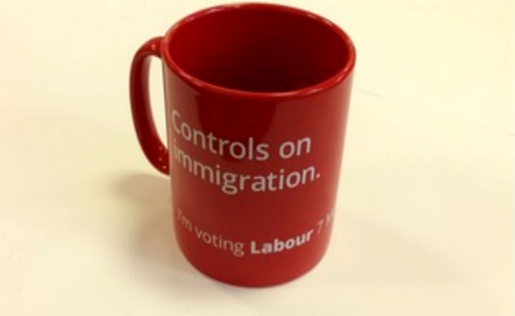
Labour’s immigration controls mug
None of this saved Miliband or his party, and the Tories won the 2015 election; the referendum vote in 2016 in favour of leaving the EU led to David Cameron’s resignation as Prime Minister; he was succeeded by Theresa May; Ed Miliband resigned as Labour leader; Jeremy Corbyn was elected in his place; the process of leaving the EU began. In 2017, Theresa May called another general election, hoping to increase her majority. In the event, the Tory party lost its small overall majority but won the election as the largest single party. But from then on it had to rely on Democratic Unionist Party (DUP) votes to get its business through the Commons.
These parliamentary changes meant nothing for the Windrush generation. The scandal began to come to light in 2017 but their suffering continued beyond the end of the decade, one of the main reasons being that the compensation scheme was seriously flawed. This remained a problem in April 2025, almost a year after the election of a Labour government. The Parliamentary and Health Service Ombudsman (PHSO), Rebecca Hilsenrath, had found that
further harm and injustice are still being caused by failings in the way the scheme is working. We found recurrent reasons for this, suggesting these were not one-off issues but systemic problems.[5]
In response, the Home Office sought to give some reassurance:
This government is committed to putting right the appalling injustices caused by the Windrush scandal and making sure those affected receive the compensation they rightly deserve.[6]
Nevertheless, given the Home Office’s record, we should hesitate before we are reassured. In 2020, the Williams review of the Windrush scandal had made 30 recommendations to the government, all of which were accepted by Priti Patel, Tory Home Secretary at the time. In January 2023, the Home Office unlawfully dropped three of them.[7] Moreover, the department prevented the publication of a report prepared in response to the Williams Review. Williams had said that Home Office staff needed to “learn about the history of the UK and its relationship with the rest of the world, including Britain’s colonial history, the history of inward and outward migration and the history of black Britons.” As a result, the Home Office commissioned an independent report: The Historical Roots of the Windrush Scandal. In the words of Jim Dunton, the report
lays much of the blame for the Windrush scandal on essentially racist measures introduced to restrict the ability of Commonwealth citizens to move to the UK in the years since the second world war.[8]
The report has been available internally since 2022 but, writes Dunton, “the department resisted attempts for it to be made publicly available, including rejecting repeated Freedom of Information Act requests and pressure from Labour MP Diane Abbott.” Then, in early September 2024, after a legal challenge was launched,
a First Tier Tribunal judge ordered the document’s publication, quoting George Orwell’s memorable lines from 1984: “Who controls the past controls the future. Who controls the present controls the past.”[9]
So the Home Office, reluctantly, made the report publicly available, and I will refer to its findings in future blogs. But it is not yet time to take Home Office reassurances at face value. Or Labour’s reassurances, come to that.
In future blogs: more on Labour’s record on immigration and race; and the necessary exposure of a long-standing myth.
[1] Goodfellow, M. (2019), Hostile Environment: How immigrants became Scapegoats, Verso Books, London, loc. 167.
[2] Jack Peat, “Just 6 Labour MPs voted against the 2014 Immigration Act”, The London Economic, 19/04/2018:
[3] Decca Aitkenhead, “Sarah Teather: ‘I’m angry there are no alternative voices on immigration’.”, The Guardian, 12 July 2013.
[4] Andrew Grice, “Ed Miliband attempts to take on Ukip – with toughened immigration policies”, The Guardian, 24 October 2014: Ed Miliband attempts to take on Ukip – with toughened immigration policies | The Independent | The Independent
[5] Adina Campbell, “Payments for Windrush victims denied compensation”, BBC News, 5 September 2024: Payments for Windrush victims denied Home Office compensation – BBC News
[6] Ibid.
[7] Ashith Nagesh & André Rhoden-Paul, “Home Office unlawfully axed Windrush measures”, BBC News, 19 June 2024: Windrush Scandal: Home office unlawfully axed recommendations, court rules – BBC News
[8] Jim Dunton, “Home Office publishes internal ‘roots of Windrush’ report after FoI battle”, Civil Service World, 27 September 2024: Home Office publishes internal ‘roots of Windrush’ report after FoI battle
[9] Ibid.
No ifs, no buts – Labour must support free movement
At a jamboree of the G7 interior ministers this week, the French minister, Christophe Castaner, took his chance to attack the non-governmental organisations (NGOs) saving migrants from their sinking vessels in the Mediterranean. The NGOs, said M. Castaner, were “complicit” with the people traffickers.[1] This was in line with his president’s view of the matter: last summer Macron declared that the NGOs were “playing the game of the smugglers”. In saying what he did at the end of this week’s conference, Castaner joined forces with his far-right Italian counterpart, Matteo Salvini, who had also said, during the conference, that there was “collusion” between the NGOs and the traffickers. Salvini’s contribution seemed to be a reassertion of the Italian far right’s earlier campaign against the rescue ships, calling them “the taxis of the sea”.
There is no mention here of our own home secretary, Savid Javid, who has just been forced to apologise for the Home Office’s treatment of the Windrush generation, an affair which also resulted in death for some of its victims. Javid said it was all a terrible mistake, and that it will never happen again. He then popped back to the office where his officials are continuing to steal, and keep, the UK passports of up to 6,000 British-Iraqi citizens on the spurious ground of finding discrepancies in their dates of birth. The Home Office knows full well that many Iraqi Kurds (and most of these people are Kurdish) are uncertain about their dates of birth. Historically, records were not kept in the same way as in the West. The Home Office knows this, yet, cruelly, it persists. The hostile environment continues.
But back to Christophe and Matteo. The “let them drown” brigade in Europe began its campaign some time ago. The UK was complicit.[2] The far right is getting its act together across the world. Will we continue to be complicit? Nothing suggests that the Tory Party will suddenly become migrant-friendly. Its leadership after May will become more right-wing, its home secretary (Javid or otherwise) will become more migrant-hostile.
That’s not where the Labour Party wants to go. Its 2017 election manifesto made this clear:
Labour will not scapegoat migrants nor blame them for economic failures … We will not discriminate between people of different races or creeds. We will end indefinite detentions … Labour will protect those already working here, whatever their ethnicity … Labour values the economic and social contributions of immigrants. Both public and private sector employers depend on immigrants. We will not denigrate those workers. We value their contributions, including their tax contributions … Labour will restore the rights of migrant domestic workers, and end this form of modern slavery … Refugees are not migrants. They have been forced from their homes, by war, famine or other disasters. Unlike the Tories, we will uphold the proud British tradition of honouring the spirit of international law and our moral obligations by taking our fair share of refugees. The current arrangements for housing and dispersing refugees are not fit for purpose. They are not fair to refugees or to our communities. We will review these arrangements.[3]
But if Labour doesn’t want to go down the same road as the Tories, it now has to change its stance on freedom of movement – for its current position, also set out in the manifesto, undermines these commitments. “Freedom of movement will end”, says the manifesto, “when we leave the European Union.” The reason for this was suggested by Emily Thornberry in an interview, apparently citing voters’ concerns about immigration:
As for the single market, you know and I know that it’s very difficult for us to remain in the single market as it currently is because nobody can pretend that the referendum didn’t include a debate on immigration and we want to have fair rules and managed migration when it comes to immigration so we need to negotiate something.[4]
But we are on dangerous ground here. Conceding to voters’ concerns and fears is no substitute for facing them honestly and allaying them. So what are the concerns that voters have about immigration? One of them is the idea that immigrants take jobs from the native population and depress wages. Liberal leader Vince Cable has summarised some of the arguments on this:
At the heart of the politics of immigration is the belief, repeated by Theresa May as a fact, that immigrants, especially unskilled immigrants, depress wages. At first sight the argument seems plausible – and undeniably there is low-wage competition in some places. But there is no evidence that this is a general problem. [In 2013, during the coalition government] I commissioned a range of reviews and studies to establish the facts. They showed that the impact on wages was very small (and only in recession conditions). By and large, immigrants were doing jobs that British people didn’t want to do (or highly skilled jobs that helped to generate work for others). This research was inconvenient to the Home Office, which vetoed the publication of its results.[5]
In 2016, Paul Johnson of the Institute for Fiscal Studies produced a report and asked:
But aren’t all these foreigners taking our jobs? That’s true in the Premier League. The more foreign footballers there are playing for the top clubs, the fewer English players there will be. There’s only room for 11 players in a starting XI.
Yet there is not a fixed number of jobs in the economy. There are seven million more people in work in the UK than there were 40 years ago. Astonishingly, there are nearly two million more than immediately before the recession in 2008. Employment rates among the UK-born are close to record levels. More people means more jobs, not more unemployment. There is absolutely no evidence that higher levels of immigration have increased unemployment among native-born Brits.[6]
On wage levels he wrote:
Evidence on wage impacts is a bit less conclusive. While many studies do not find any evidence of immigration depressing wages, a recent Bank of England paper suggests that the impact of migration on UK-born lower-skilled workers might have been to reduce wages by 1 per cent over a period of eight years. Thus it may have played a part, though only a minor one, in recent experience of low or negative pay growth.[7]
In fact, instead of seeing the fears and concerns of people as a reason for declaring an end to free movement, Thornberry could have argued those points and others in order to allay them and embrace free movement. Labour’s failure to do this had its impact on the Labour manifesto itself. First, the Tory White Paper on immigration post-Brexit included an income threshold of £30,000 p.a. which migrants would have to meet before they could have the right to work.[8] This would keep the poor out, and because of the way poverty is structured it would discriminate by race and ethnicity too. Labour’s response was:
We will replace income thresholds with a prohibition on recourse to public funds. New rules will be equally informed by negotiations with the EU and other partners, including the Commonwealth.[9]
This suggests that the “no recourse to public funds” rule would apply to EU and Commonwealth citizens alike, and it has the same effect as the Tory proposal: it discriminates against the poor and in the end it also discriminates by race and ethnicity.
Secondly, Tory policy matches this exclusion of the poor with “a new, skills-based immigration system”. Such a system “will mean we can reduce the number of people coming to this country, as we promised”.[10] On this, Labour’s manifesto (p. 28) says a Labour government would work
with businesses, trade unions, devolved governments and others to identify specific labour and skill shortages. Working together we will institute a new system which is based on our economic needs, balancing controls and existing entitlements.
This sounds no different to a Tory skills-based system.
The failure to defend immigration also led to the fiasco of Labour’s front bench at first whipping to abstain on the government’s Immigration and Social Security Bill a few weeks ago. There were many reasons to vote against the Bill. As David Lammy MP described it:
It will force our NHS and other vital services into an even deeper staffing crisis. There are already 41,000 nursing vacancies in England. The salary threshold still under consideration would exclude many skilled medical staff, including nurses, paramedics and midwives.
It continues the inhumane practice of indefinite detention. We remain the only European country which does not set a time limit for detained migrants. This sullies our international reputation and undermines complaints we make about human rights abuses abroad.
The 1.2 million [UK citizens in Europe] will inevitably see their own rights eroded too. Overnight they could lose their ability to live and work freely in Europe. Young people who overwhelmingly want the chance to live across the continent are having their horizons permanently narrowed.[11]
But Diane Abbott argued at the time:
The Labour [P]arty is clear that when Britain leaves the single market, freedom of movement ends, and we set this out in our 2017 manifesto. I am a slavish devotee of that magnificent document: so on that basis, the frontbench of the Labour [P]arty will not be opposing this bill this evening.[12]
In the event, the Labour front bench changed its mind and whipped MPs to vote against the Bill, rather than abstain, after protests by several MPs and an immediate on-line and email protest from Labour activists and others. But it took the front bench 90 minutes to do this, after MPs had originally been told they could go home as their votes were not required. Many of them did. Only 178 out of 256 Labour MPs were present to vote.[13]
Labour, under its present leadership, and with its expanded membership, is better than this. At a time when far-right forces are getting their act together, Labour should do so too, giving not an inch of ground to racism and xenophobia, whether it comes from politicians in France, Italy, Brazil, or the United States, or whether it is home-grown. In the Brexit arguments we should be fully in favour of the right to travel, to move from anywhere to anywhere, and for whatever reason: we should be in favour of the right to free movement.
[1]« Castaner accuse les ONG d’être complices des passeurs » Le Monde, 6 April 2019: https://www.lemonde.fr/international/article/2019/04/06/castaner-accuse-les-ong-d-etre-complices-des-passeurs_5446576_3210.html
[2] “Mediterranean Massacre”: https://bobmouncerblog.wordpress.com/2015/04/22/mediterranean-massacre-job-done/
[3] For The Many Not The Few: The Labour Party Manifesto 2017, pp. 28-29: https://labour.org.uk/wp-content/uploads/2017/10/labour-manifesto-2017.pdf
[4] “Labour signals that Britain should remain in customs union”, Irish Times, 18 February 2018: https://www.irishtimes.com/news/world/uk/labour-signals-that-britain-should-remain-in-customs-union-1.3396757
[5] “The Tory fallacy: that migrants are taking British jobs and driving down wages”:
[6] Immigration limits won’t lift Britain: https://www.ifs.org.uk/publications/8317
[7] Ibid.
[8] White Paper: “The UK’s future skills-based immigration system”: https://assets.publishing.service.gov.uk/government/uploads/system/uploads/attachment_data/file/766465/The-UKs-future-skills-based-immigration-system-print-ready.pdf, p. 3.
[9]For The Many Not The Few: The Labour Party Manifesto 2017, p. 28: https://labour.org.uk/wp-content/uploads/2017/10/labour-manifesto-2017.pdf
[10] White Paper: “The UK’s future skills-based immigration system”: https://assets.publishing.service.gov.uk/government/uploads/system/uploads/attachment_data/file/766465/The-UKs-future-skills-based-immigration-system-print-ready.pdf, p. 3.
[11] In a series of three tweets on 28 January 2019, before the front bench change of mind, declaring his intention to vote against the Bill.
[12] House of Commons debate, 28 January 2019: https://www.theguardian.com/politics/2019/jan/28/labour-in-embarrassing-u-turn-over-immigration-bill-vote
[13] By my calculation, since the government won the vote by 297 votes to 234 (a majority of 63), if the full quota of Labour MPs had turned up to vote against them (another 78), the government would have lost the vote on the Bill.
Freedom of Movement II
What will immigration policy be after Brexit?
The Tories were clear about their intentions from the beginning. In the Foreword to their White Paper on post-Brexit immigration policy May declared, “As we leave the European Union, free movement will end.”[1] But she also added: “For the first time in decades, it will be the democratically elected representatives of the British people who choose who comes into our country.” This promotes the claim that for the last few decades there was “uncontrolled immigration” – which, as we saw in the previous blog, was not true. Given this bad start, there should be no surprise at the criticisms that quickly emerged. May had said that the government would
introduce a new, skills-based immigration system. This will be a system where it is workers’ skills that matter, not which country they come from.
It will be a single system that welcomes talent, hard work, and the skills we need as a country. It will attract the brightest and best to a United Kingdom that is open for business.
Migrants have made a huge contribution to our country over our history – and they will continue to in the future. But it will also be an immigration system that is fair to working people here at home. It will mean we can reduce the number of people coming to this country, as we promised, and it will give British business an incentive to train our own young people.[2]
The White Paper also announced that skilled workers would have to be earning £30,000 if they were to qualify for entry. In this way, preference was to be given to high earners while low earners would be much less welcome. Sabrina Huck of Labour Against Racism and Fascism summarised much of this approach when she pointed out that
“low skilled” workers from “low risk” countries (countries whose citizens are deemed less likely to commit immigration offences such as overstaying or coming under false premises)[3] can apply to work in the UK for up to 12 months, with no ability to bring family members, access different visa schemes or extend their stay, and without access to public benefits during their time. When the 12 months are up, the person is not allowed to re-apply for this visa until a “cooling off” period of a year has passed, effectively banning them from re-entering for work purposes in this time.[4]
Problems with Labour’s response to the White Paper and the Immigration and Social Security Bill
In her response to the White Paper, Shadow Home Secretary Diane Abbott was right to point out that the £30,000 salary threshold for skilled workers does not reflect a skills-based immigration system, because skill levels don’t always reflect salary levels. But, as Sabrina Huck noted, “Abbott is not challenging the basic assumption that a person’s ability to enter the country, and to live a life with full citizen’s rights, is determined by their material contribution to the needs of British capital.”[5] She added:
This is a dangerous line for the left to take, as it concedes to the right’s political argument that immigration in itself is not a right, and that people’s worth is determined by their (narrowly defined) value for the economic system. This argument underpins much of the Conservative’s [sic] austerity agenda, the demonisation of the working class, poor and disabled, as undeserving, because they do not “contribute” their “fair share” to society.[6]
Abbott’s response to the Bill itself increased these worries: “The Labour [P]arty is clear”, she said,
that when Britain leaves the single market, freedom of movement ends, and we set this out in our 2017 manifesto. I am a slavish devotee of that magnificent document: so on that basis, the frontbench of the Labour [P]arty will not be opposing this bill this evening.[7]
In the event, the Labour front bench changed its mind and whipped MPs to vote against the Bill, rather than abstain, after protests by several MPs and an immediate on-line and email protest from Labour activists and others. But it took the front bench 90 minutes to do this, after MPs had originally been told they could go home as their votes were not required. Many of them did. Only 178 out of 256 Labour MPs were present to vote.[8]
It is, of course, true that the Labour manifesto appeared indistinguishable from the Tory White Paper and the Bill when it came to freedom of movement: “Freedom of movement will end when we leave the European Union. Britain’s immigration system will change …” it said.[9] It is also true that assurances were given that Labour would not “scapegoat migrants nor blame them for economic failures” and that Labour “will develop and implement fair immigration rules” and “not discriminate between people of different races or creeds.”[10] But how fragile are these assurances in the light of Labour’s incomprehensible original decision to abstain? Such a possibility should not even have crossed the leadership’s minds. For there were overwhelmingly more important reasons to vote against the Bill. In the words of David Lammy, MP for Tottenham:
It will force our NHS and other vital services into an even deeper staffing crisis. There are already 41,000 nursing vacancies in England. The salary threshold still under consideration would exclude many skilled medical staff, including nurses, paramedics and midwives.
It continues the inhumane practice of indefinite detention. We remain the only European country which does not set a time limit for detained migrants. This sullies our international reputation and undermines complaints we make about human rights abuses abroad.
The 1.2 million [UK citizens in Europe] will inevitably see their own rights eroded too. Overnight they could lose their ability to live and work freely in Europe. Young people who overwhelmingly want the chance to live across the continent are having their horizons permanently narrowed.[11]
The Labour Campaign for Free Movement couldn’t understand abstention either:
The Bill would end free movement for EU citizens and subject them to UK immigration control. Rather than having parliament specify what the new regime will be, it would hand over a blank cheque to Ministers who will be able to write and re-write the law themselves – so-called “Henry VIII powers”. The Government’s White Paper last month signalled some of their intentions – a brutal attack on the rights and security of migrants, especially working-class migrants.[12]
It was impossible not to be reminded of the fiasco of the Labour abstention during the Tories’ Welfare Bill debate in 2015, at the height of the first Labour leadership elections. The Bill was set to impose measures under which the most vulnerable in society would have to bear the heaviest burden: measures proposed in the Bill meant that, for the first time, tax credits and family benefits under Universal Credit would be limited to the first two children and that most working age benefits would be frozen for four years from 2016.[13] People claiming the working element of the Employment and Support Allowance (ESA) would have their payments reduced to match the Job Seeker’s Allowance (JSA),[14] and the benefit cap was to be reduced from £26,000 a year to £23,000 in London, and £20,000 in the rest of the country.[15] Moreover, many young people between the ages of 18 and 21 would no longer be able to claim Housing Benefit.[16] Most people expected Labour to vote against such measures, which impacted so negatively on the poor. But the party’s Acting Leader, Harriet Harman, decided otherwise. She told Andrew Neil on The Sunday Politics:
We won’t oppose the Welfare Bill, we won’t oppose the household benefit cap. [We won’t oppose] what they brought forward in relation to restricting benefits and tax credits for people with three or more children … We’ve got to recognise why the Tories are in government and not us, not because [voters] love the Tories but because they didn’t trust us on the economy and on benefits.[17]
Harman went on to instruct Labour MPs to abstain in the Commons vote on the Bill.[18] This caused much dissent among MPs, and Harman tried to defuse the crisis by tabling a “reasoned amendment” to the Bill, an amendment which changed nothing since it still supported controls on the overall costs of social security and backed proposals such as the lower benefits cap, the removal of tax credits from families with more than two children and the replacing of mortgage interest support with loans. Among the leadership candidates, only Corbyn voted against the Bill.
On that occasion, Corbyn was the hero, together with John McDonnell. They refused to pander to the prejudices and misperceptions about benefits that some voters entertained. Instead they tried to counter and dispel them. John McDonnell made a powerful speech:
I would swim through vomit to vote against the Bill, and listening to some of the nauseating speeches tonight, I think we might have to.
Poverty in my constituency is not a lifestyle choice; it is imposed on people. We hear lots about how high the welfare bill is, but let us understand why that is the case. The housing benefit bill is so high because for generations we have failed to build council houses, we have failed to control rents and we have done nothing about the 300,000 properties that stand empty in this country. Tax credits are so high because pay is so low. The reason pay is so low is that employers have exploited workers and we have removed the trade union rights that enabled people to be protected at work. Fewer than a third of our workers are now covered by collective bargaining agreements. Unemployment is so high because we have failed to invest in our economy, and we have allowed the deindustrialisation of the north, Scotland and elsewhere. That is why the welfare bill is so high, and the Bill does as all other welfare reform Bills in recent years have done and blames the poor for their own poverty, not the system … We need a proper debate about how we go forward investing in housing, lifting wages, restoring trade union rights and ensuring that we get people back to work and do not have high pockets of deprivation in areas such as mine and around the country … I say to Labour Members that people out there do not understand reasoned amendments; they want to know whether we voted for or against the Bill. Tonight I will vote against it.[19]
In the debate on the Immigration and Social Security Bill this week he could have stood ready to counter and dispel the current prejudices and misperceptions about immigration and migrants. Instead he, Corbyn, Abbott and the rest of the front bench stood ready to give in to them. It took a rebellion to stop that happening.
What fears do people have? One of them is the notion that immigrants take jobs from the native population and depress wages. Liberal leader Vince Cable has summarised some of the arguments on this:
At the heart of the politics of immigration is the belief, repeated by Theresa May as a fact, that immigrants, especially unskilled immigrants, depress wages. At first sight the argument seems plausible – and undeniably there is low-wage competition in some places. But there is no evidence that this is a general problem. [In 2013, during the coalition government] I commissioned a range of reviews and studies to establish the facts. They showed that the impact on wages was very small (and only in recession conditions). By and large, immigrants were doing jobs that British people didn’t want to do (or highly skilled jobs that helped to generate work for others). This research was inconvenient to the Home Office, which vetoed the publication of its results.[20]
In 2016, Paul Johnson of the Institute for Fiscal Studies produced a report and asked:
But aren’t all these foreigners taking our jobs? That’s true in the Premier League. The more foreign footballers there are playing for the top clubs, the fewer English players there will be. There’s only room for 11 players in a starting XI.
Yet there is not a fixed number of jobs in the economy. There are seven million more people in work in the UK than there were 40 years ago. Astonishingly, there are nearly two million more than immediately before the recession in 2008. Employment rates among the UK-born are close to record levels. More people means more jobs, not more unemployment. There is absolutely no evidence that higher levels of immigration have increased unemployment among native-born Brits.[21]
On wage levels he wrote:
Evidence on wage impacts is a bit less conclusive. While many studies do not find any evidence of immigration depressing wages, a recent Bank of England paper suggests that the impact of migration on UK-born lower-skilled workers might have been to reduce wages by 1 per cent over a period of eight years. Thus it may have played a part, though only a minor one, in recent experience of low or negative pay growth.[22]
So, just as Harriet Harman should have argued against benefit cuts and voted them down in 2015 instead of pressing the panic button, Corbyn and the Labour front bench should have argued against immigration myths and should never have tried to press the abstain button. They must never do this again.
Corbyn says that after Brexit we will have a new immigration policy. But for some of us our confidence has been shaken by this episode. We need to know what the new policy will be. It should be spelt out now. At a conference last year, the journalist Gary Younge argued that, while the promises and plans of the Labour leadership under Corbyn are welcome news, we still have to hold these politicians to account. In that context, Sabrina Huck has some good advice for us all:
Anti-racism campaigners have a duty to oppose the toxic hostile environment through engaging the public in a positive debate about immigration, challenge the arguments that a person’s value for society can be determined purely based on their economic contribution and by effectively lobbying parliamentarians to oppose legislation enforcing these immigration policies.[23]
[1] White Paper: “The UK’s future skills-based immigration system”: https://assets.publishing.service.gov.uk/government/uploads/system/uploads/attachment_data/file/766465/The-UKs-future-skills-based-immigration-system-print-ready.pdf, p. 3.
[2] Ibid.
[3] The White Paper counts, among others, Australia, the US, New Zealand, Japan, South Korea and Singapore as “low risk” countries. Poorer countries (e.g. African and Arab countries) are likely to be classified as “high risk”. Thus, for all the talk of more opportunities for people from outside the EU to come and work in Britain, workers from the global south will be virtually excluded.
[4] “The Immigration White Paper represents a massive attack on migrants’ rights”, Labour Against Racism and Fascism: https://laraflondon.wordpress.com/2019/01/04/the-immigration-white-paper-represents-a-massive-attack-on-migrants-rights/
[5] Ibid.
[6] Ibid.
[7] House of Commons debate, 28 January 2019: https://www.theguardian.com/politics/2019/jan/28/labour-in-embarrassing-u-turn-over-immigration-bill-vote
[8] By my calculation, since the government won the vote by 297 votes to 234 (a majority of 63), if the full quota of Labour MPs had turned up to vote against them (another 78), the government would have lost the vote on the Bill.
[9] Labour Manifesto 2017, p. 28: https://labour.org.uk/wp-content/uploads/2017/10/labour-manifesto-2017.pdf
[10] Ibid.
[11] In a series of three tweets on 28 January 2019, before the front bench change of mind, declaring his intention to vote against the Bill.
[12] Labour Campaign for Free Movement email, 29 January 2019.
[13] “Benefit changes: Who will be affected?”, BBC News, 8 July 2015: http://www.bbc.co.uk/news/business-33429390 (accessed 29/3/2017).
[14] Ibid.
[15] Ibid.
[16] Ibid.
[17] “Labour won’t oppose Welfare Bill”, BBC News, 12 July 2015: http://www.bbc.co.uk/news/av/uk-33498110/labour-won-t-oppose-welfare-bill (accessed 2/1/2018).
[19] Commons Hansard, 20/7/2015, House of Commons, London: https://hansard.parliament.uk/commons/2015-07-20/debates/1507206000001/WelfareReformAndWorkBill (accessed 29/3/2017).
[20] “The Tory fallacy: that migrants are taking British jobs and driving down wages”:
[21] Immigration limits won’t lift Britain: https://www.ifs.org.uk/publications/8317
[22] Ibid.
[23] “The Immigration White Paper represents a massive attack on migrants’ rights”, Labour Against Racism and Fascism: https://laraflondon.wordpress.com/2019/01/04/the-immigration-white-paper-represents-a-massive-attack-on-migrants-rights/
We must ensure that nobody will ever again be afraid to ask for medical treatment
We really do have to get rid of this Tory government and replace it with a Labour government different from any other. This story (see link below) about asylum seekers being afraid to get NHS treatment is just one of many reasons. Asylum seekers are afraid of being presented with a bill they have no means of paying, and they are afraid of the Home Office. The groundwork was laid for such fears a good number of years ago by governments of all stripes. A Labour Health Secretary was one who helped. At the end of my research into the treatment of asylum seekers, which I finished in 2010,[1] I wrote this in the wake of the news that an asylum seeker had been refused cancer treatment:
On 30 March 2009 the UK Court of Appeal ruled that failed asylum seekers were not entitled to free National Health Service treatment in England, overruling an earlier High Court ruling that they were. One exception was allowed: if an asylum seeker cannot return home and cannot pay in advance hospitals must consider treatment, but they were at the mercy of the discretion of the hospital. Lord Justice Ward expressed his views on failed asylum seekers clearly: they should not be here and should never have come in the first place. Health Secretary Alan Johnson was “pleased with the Court of Appeal’s judgment that asylum seekers cannot acquire ordinary resident status which would entitle them to treatment and a range of other services.”
When Jeremy Corbyn protests about a Tory statement or policy, the reply often comes back “Labour did the same thing.” Those of us in the Labour Party should always acknowledge the fact when it’s true and we will all have to make sure things are different next time by constantly holding Labour ministers to account. Shadow Home Secretary Diane Abbott has said clearly, when speaking of the Windrush scandal, “This will not happen when I am Home Secretary.” She will face strong opposition from Home Office officials who are currently enjoying the implementation of the “hostile environment”. We will have to support her, and support asylum seekers, in every way possible, against the pressures, not only of the Home Office establishment, but also of the Tories and their media. And it must never be the case again that vulnerable people are bullied so that they are afraid to ask for medical help. That, among many other reasons, is why I and thousands of other people joined or rejoined the Labour Party when Jeremy Corbyn was elected leader in 2015. We saw a different future.
Asylum seekers ‘too afraid’ to seek NHS care, report says
https://www.theguardian.com/uk-news/2018/nov/28/asylum-seekers-too-afraid-to-seek-nhs-care-report-says?CMP=Share_iOSApp_Other
[1] Dealt with on their Merits: https://hydra.hull.ac.uk/resources/hull:2678
 Bob Mouncer's blog