Home » Posts tagged 'David Cameron'
Tag Archives: David Cameron
The hostile environment: Labour’s response
In the first blog in this series (https://bobmouncer.blog/2025/03/22/hostile-environment-the-windrush-scandal-i/), I showed how the announcement of a “hostile environment” for migrants by UK Home Secretary Theresa May in 2012 led to suffering and trauma for thousands of people, the Windrush generation. In the second blog (https://bobmouncer.blog/2025/03/26/hostile-environment-the-windrush-scandal-ii/), I told the story of Hubert Howard, who was one of its victims. In the third blog (https://bobmouncer.blog/2025/03/30/hostile-environment-the-windrush-scandal-iii/), I showed how documents that could have prevented the disaster to Hubert and thousands of others were deliberately destroyed; I described how the scandal slowly emerged and the government’s obstinate refusal to roll back on the policy; and I showed how a compensation scheme was finally devised and how it failed so many Windrush victims. In the last blog (https://bobmouncer.blog/2025/04/02/hostile-environment-the-mediterranean-scandal/) I described the Mediterranean scandal, in which the EU, including the UK, stopped rescue operations in the Mediterranean and how a UK government tried to deny its responsibility for the ensuing tragedy.
In this blog, I examine Labour’s response to the hostile environment.
Labour’s response
The two major scandals examined in my previous blogs in this series unfolded, first, under a Tory/LibDem coalition government and then under the subsequent Tory government. But what was Labour’s response to May’s hostile environment? Maya Goodfellow describes it as “the most minimal resistance”.[1] Labour, the official opposition, abstained in the final Commons vote on the Immigration Bill. Sixteen MPs voted against it, but only six of them were Labour MPs: Diane Abbott, Kelvin Hopkins, John McDonnell, Fiona Mactaggart, Dennis Skinner and Jeremy Corbyn. Corbyn said the Bill was
dog-whistle politics, the mantras being that every immigrant is an illegal immigrant who must somehow be condemned, and that immigration is the cause of all the problems in our society … If we descend into a UKIP-generated xenophobic campaign, it weakens and demeans all of us and our society, and we are all the losers for that.[2]
One of the other MPs was Sarah Teather, a LibDem MP and former minister, who had told The Guardian in 2013 that the proposals in the Bill were “hewn from the same rock” as earlier welfare cuts, much of which were “about setting up political dividing lines, and trying to create and define an enemy”.[3] But apart from the six rebels, Labour MPs obeyed their leader, Ed Miliband, and the Labour whips, and abstained in the Commons vote.
By October, Miliband had moved further right. In a by-election campaign in the Rochester and Strood constituency, which UKIP was hoping to win, Miliband declared he would toughen immigration policy if Labour won the general election in May the following year.[4] Echoing Theresa May, he raised familiar spectres and fears about immigration, ignoring its advantages. The UK, he said, “needs stronger controls on people coming here” and promised a new immigration reform Act if he became Prime Minister. His message was:
- If your fear is uncontrolled numbers of illegal migrants entering the country, Labour will crack down on illegal immigration by electronically recording and checking every migrant arrive in or depart from Britain
- If your fear is of widespread migrant benefit fraud, Labour will make sure that benefits are linked more closely to workers’ contributions
- If the spectre that haunts you is, as Margaret Thatcher had put it, that immigrants were bringing an “alien culture” to Britain, Labour understands, and will ensure that migrants integrate “more fully” into society
- Miliband turned his attention to the EU. Arguments about Britain’s EU membership were coming to a head at this time, with both the Tory right and UKIP agitating for the UK to leave. In 2013, Prime Minister David Cameron had agreed to renegotiate Britain’s terms of membership. The renegotiation would be followed by an in/out referendum to take place after the 2015 general election. Miliband, in his by-election speech in 2014, included migration from the EU in his new immigration promises. He claimed that Labour under Tony Blair had wrongly opened the UK to Eastern Europeans when their countries had joined the EU in 2004. He would not let that happen again. If he won the 2015 election, there would be longer “transitional controls” for new EU members before they could move to Britain.
He even told the voters of Rochester and Strood that they didn’t need to vote for UKIP to get these policies: Labour would do the job.
One pledge seemed at first sight to be protective of migrants. Miliband said he wanted to ensure that migrants were not exploited by employers. However, this was, in fact, a reference to another fear – that migrant workers undercut native workers’ wages because bosses often pay lower wages to migrants (often below the minimum wage). However, where this problem exists, its solution lies not in immigration law but in employment law and its enforcement. It also lies in union recognition and legally binding agreements.
As promise followed promise and pledge followed pledge, Miliband began to sound like Theresa May. A few months later, as the 2015 election approached, Labour’s campaign included the issuing of mugs with “Controls on immigration” printed on them.
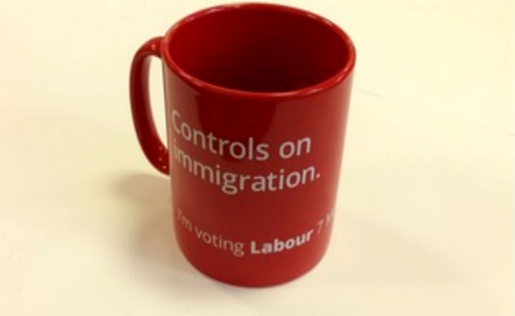
Labour’s immigration controls mug
None of this saved Miliband or his party, and the Tories won the 2015 election; the referendum vote in 2016 in favour of leaving the EU led to David Cameron’s resignation as Prime Minister; he was succeeded by Theresa May; Ed Miliband resigned as Labour leader; Jeremy Corbyn was elected in his place; the process of leaving the EU began. In 2017, Theresa May called another general election, hoping to increase her majority. In the event, the Tory party lost its small overall majority but won the election as the largest single party. But from then on it had to rely on Democratic Unionist Party (DUP) votes to get its business through the Commons.
These parliamentary changes meant nothing for the Windrush generation. The scandal began to come to light in 2017 but their suffering continued beyond the end of the decade, one of the main reasons being that the compensation scheme was seriously flawed. This remained a problem in April 2025, almost a year after the election of a Labour government. The Parliamentary and Health Service Ombudsman (PHSO), Rebecca Hilsenrath, had found that
further harm and injustice are still being caused by failings in the way the scheme is working. We found recurrent reasons for this, suggesting these were not one-off issues but systemic problems.[5]
In response, the Home Office sought to give some reassurance:
This government is committed to putting right the appalling injustices caused by the Windrush scandal and making sure those affected receive the compensation they rightly deserve.[6]
Nevertheless, given the Home Office’s record, we should hesitate before we are reassured. In 2020, the Williams review of the Windrush scandal had made 30 recommendations to the government, all of which were accepted by Priti Patel, Tory Home Secretary at the time. In January 2023, the Home Office unlawfully dropped three of them.[7] Moreover, the department prevented the publication of a report prepared in response to the Williams Review. Williams had said that Home Office staff needed to “learn about the history of the UK and its relationship with the rest of the world, including Britain’s colonial history, the history of inward and outward migration and the history of black Britons.” As a result, the Home Office commissioned an independent report: The Historical Roots of the Windrush Scandal. In the words of Jim Dunton, the report
lays much of the blame for the Windrush scandal on essentially racist measures introduced to restrict the ability of Commonwealth citizens to move to the UK in the years since the second world war.[8]
The report has been available internally since 2022 but, writes Dunton, “the department resisted attempts for it to be made publicly available, including rejecting repeated Freedom of Information Act requests and pressure from Labour MP Diane Abbott.” Then, in early September 2024, after a legal challenge was launched,
a First Tier Tribunal judge ordered the document’s publication, quoting George Orwell’s memorable lines from 1984: “Who controls the past controls the future. Who controls the present controls the past.”[9]
So the Home Office, reluctantly, made the report publicly available, and I will refer to its findings in future blogs. But it is not yet time to take Home Office reassurances at face value. Or Labour’s reassurances, come to that.
In future blogs: more on Labour’s record on immigration and race; and the necessary exposure of a long-standing myth.
[1] Goodfellow, M. (2019), Hostile Environment: How immigrants became Scapegoats, Verso Books, London, loc. 167.
[2] Jack Peat, “Just 6 Labour MPs voted against the 2014 Immigration Act”, The London Economic, 19/04/2018:
[3] Decca Aitkenhead, “Sarah Teather: ‘I’m angry there are no alternative voices on immigration’.”, The Guardian, 12 July 2013.
[4] Andrew Grice, “Ed Miliband attempts to take on Ukip – with toughened immigration policies”, The Guardian, 24 October 2014: Ed Miliband attempts to take on Ukip – with toughened immigration policies | The Independent | The Independent
[5] Adina Campbell, “Payments for Windrush victims denied compensation”, BBC News, 5 September 2024: Payments for Windrush victims denied Home Office compensation – BBC News
[6] Ibid.
[7] Ashith Nagesh & André Rhoden-Paul, “Home Office unlawfully axed Windrush measures”, BBC News, 19 June 2024: Windrush Scandal: Home office unlawfully axed recommendations, court rules – BBC News
[8] Jim Dunton, “Home Office publishes internal ‘roots of Windrush’ report after FoI battle”, Civil Service World, 27 September 2024: Home Office publishes internal ‘roots of Windrush’ report after FoI battle
[9] Ibid.
Hostile environment: the Mediterranean scandal
In the first blog in this series (https://bobmouncer.blog/2025/03/22/hostile-environment-the-windrush-scandal-i/), I showed how the announcement of a “hostile environment” for migrants by UK Home Secretary Theresa May in 2012 led to suffering and trauma for thousands of people, the Windrush generation. In the second blog (https://bobmouncer.blog/2025/03/26/hostile-environment-the-windrush-scandal-ii/), I told the story of Hubert Howard, who was one of its victims. In the third blog, I showed how documents that could have prevented the disaster to Hubert and thousands of others were deliberately destroyed; I described how the scandal slowly emerged and the government’s obstinate refusal to roll back on the policy; and I show how a compensation scheme was finally devised and how it failed so many Windrush victims. In this blog, I tell how another scandal erupted involving the UK government, though this time it was an EU-wide scandal. It was, however, perfectly in line with the UK’s hostile environment policy toward migrants. It should be counted as part of it.
The Mediterranean scandal
David Cameron and Theresa May were part of another immigration scandal, though they were not the only ones involved. In October 2014, Italy brought its routine search-and-rescue operations (called Mare Nostrum) to an end. The scheme rescued migrants crossing the Mediterranean Sea from Libya, most of them in unseaworthy boats. In the 12 months between October 2013 and October 2014, according to the Commons Home Affairs Select Committee, “Mare Nostrum saved 100,000 lives, but the Italian Government could not afford to maintain the operation at the cost of €9 million a month”[1] and had, for some time, been pressing the EU (which still included the UK as a member-state) to play a larger role in the operation. When Mare Nostrum came to an end, the EU’s response was to replace the Italian scheme with its own much more limited scheme, Triton. The difference between the two schemes was that Mare Nostrum undertook “a proactive search and rescue operation across 27,000 square miles of sea”[2] whereas, under Triton, the EU simply operated a coastguard patrol that reached out no further than 12 miles from the coast. Routine search-and-rescue operations were over. The EU argued that the search-and-rescue operations represented a “pull factor” for migrants: they attempted the dangerous crossing because they thought they would be rescued if they got into difficulties.
The Home Office carefully sheltered under the EU roof as officials sought to justify the removal of search and rescue: “Ministers across the EU”, the Home Office said,
have expressed concerns that search-and-rescue operations in the Mediterranean … [are] encouraging people to make dangerous crossings in the expectation of rescue. This has led to more deaths as traffickers have exploited the situation using boats that are unfit to make the crossing.[3]
One year later, Cameron and his Deputy Prime Minister Nick Clegg (leader of the Liberal Democrats), admitted that Triton was flawed. As the EU had scaled back the search-and-rescue operations to no more than coastguard patrols, hundreds more people had died. Then, after two disasters in quick succession in which a total of 1,200 people had died, Cameron declared that the plan to reduce crossings and deaths was “not successful”. He then sought to distance himself from it as much as possible by stressing the EU’s role as if it had nothing to do with him: the decision to stop search and rescue, he said,
was made by the EU and Italy as well. They found at some stage it did look like more people were taking to boats. So they, the EU, decided to end that policy and have a coastguard policy. That hasn’t worked either.[4]
It is worth noting that the decision to stop search and rescue was not a joint decision between Italy and the EU: the decision was at first made, as we have seen, by Italy alone on grounds of cost.[5] Nevertheless, the EU’s earlier unwillingness to play a larger role contributed to Italy’s decision.
Like Cameron, Nick Clegg also managed to distance himself from the policy in an attempt to avoid blame being attached to him or his party: he too claimed the decision to stop search and rescue was taken by “the EU”. He also claimed credit for the Liberal Democrats, who had, he said, called for an urgent review of “the EU’s policy”:
The EU’s decision to end routine search-and-rescue operations in the Mediterranean last year was taken with good intentions. No one expected the number of deaths to fall to zero, but there was a view that the presence of rescue ships encouraged people to risk the crossing. That judgment now looks to have been wrong. That’s why the Liberal Democrats have called for an urgent review of the EU’s policy …[6]
Once the consequences of the removal of search and rescue had become clear and public, the EU rolled back on the disastrous “coastguard patrols only” policy: it introduced a new search-and-rescue policy and Cameron pledged ships and helicopters and ordered the Royal Navy flagship HMS Bulwark to Malta to join the operations. This was a U-turn and it involved a significant change in the government’s language: its policy in the Mediterranean was now about “rescuing these poor people” rather than depicting them as reckless and foolish migrants.[7] But by June that year it was announced that the deployment of HMS Bulwark was being reviewed, which raised the question that, if it was to be withdrawn, would it be replaced? On 17 June, Labour MP Hilary Benn asked Chancellor George Osborne, who was standing in for Cameron at Prime Minister’s Questions in the Commons:
… we learned yesterday that [HMS Bulwark’s] deployment is under active review. Having made a grave error last October in withdrawing support from the Mare Nostrum search and rescue operations, will the right hon. Gentleman assure the House that the Government will continue to save the lives of those in peril on that sea?[8]
Osborne replied that “no one should in any way doubt Britain’s determination to play its role in helping with this situation”:
Taking people out of the water and rescuing them is essential – we are a humanitarian nation and we need to deal with those issues – but, in the end, we must break the link that enables someone to get on a boat and then claim asylum in Europe and spend the rest of their lives on the European continent.[9]
The government’s priorities became clearer on 22 June when Defence Secretary Michael Fallon announced that HMS Bulwark (19,000 tonnes, 176 metres long; 3,000 lives saved, according to government figures[10]) was to be replaced by HMS Enterprise (3,700 tonnes, 90.6 metres long, able to hold up to 120 people; part of the government’s “intelligence-led effort” to solve the crisis).[11] Despite this obvious reduction in search-and-rescue capacity and the priority it was given, Downing Street said that HMS Enterprise would be gathering intelligence “while continuing to rescue people as necessary”. However, one month later Enterprise had “not rescued any migrants since deploying to the Mediterranean to support the common security defence policy operation”.[12] So “rescuing these poor people” had apparently ceased to be “absolutely essential” and had given way to intelligence gathering. From now on, intelligence would be gathered while search-and-rescue operations vanished entirely.
[1] Migration Crisis (2015), Report by the Commons Home Affairs Select Committee, paras. 79-81: House of Commons – Migration Crisis – Home Affairs Committee (parliament.uk)
[2] Home Affairs Committee, House of Commons, Migration Crisis:
[3] Alan Travis, “Home Office defends decision for UK to halt migrant rescues”, The Guardian, 28 October 2014.
[4] Rowena Mason, “Cameron and Clegg admit axing search and rescue in Mediterranean has failed”, The Guardian, 22 April 2015: Cameron and Clegg admit axing search and rescue in Mediterranean has failed | Immigration and asylum | The Guardian
[5] Home Office minister James Brokenshire confirmed this in an answer during an urgent question in the House of Commons, when a Tory MP had suggested that the EU had withdrawn support from Mare Nostrum: ”To be clear, the EU is not withdrawing anything. Mare Nostrum is an Italian initiative. It is supported by the Italian navy, and ultimately decisions will be taken by the Italian Government.” (Refugees and Migrants (Search and Rescue Operation) (Urgent Question), col. 404, 30 October 2014: Refugees and Migrants (Search and Rescue Operation) – Hansard – UK Parliament
[6] Nick Clegg, “The solution to the deaths in the Mediterranean lies on land, not at sea”, The Guardian, 22 April 2015: The solution to the deaths in the Mediterranean lies on land, not at sea | Nick Clegg | The Guardian
[7] Ian Traynor, “European leaders pledge to send ships to Mediterranean to pick up migrants”, The Guardian, 23 April 2015: European leaders pledge to send ships to Mediterranean to pick up migrants | European Union | The Guardian
[8] Commons Hansard, “Prime Minister’s Questions”, 17 June 2015, col. 312: House of Commons Hansard Debates for 17 Jun 2015 (pt 0001) (parliament.uk)
[9] Ibid.
[10] HMS Enterprise to replace HMS Bulwark in the Mediterranean, Ministry of Defence: HMS Enterprise to replace HMS Bulwark in the Mediterranean – GOV.UK (www.gov.uk)
[11] Ibid.
[12] Alan Travis, “HMS Bulwark’s replacement yet to rescue any migrants in Mediterranean”, The Guardian, 27 July 2015HMS Bulwark’s replacement yet to rescue any migrants in Mediterranean | Migration | The Guardian:
Hostile Environment: the Windrush Scandal I
****************************
Dedication
To Nurse Thelma Rock, her mother, and her son Colin, who were our neighbours in the 1950s. Thelma’s mother slept at our house until she found a place of her own.
They were part of the Windrush generation
*****************************
Introduction
The creation of a “hostile environment” for migrants was announced by Theresa May, the UK’s Conservative (Tory) Home Secretary, in 2012. Although she said it was intended for “illegal” migrants, it turned out that, under this policy, almost anyone could be made “illegal” if they were either a migrant themselves or a descendant of one. This became clear as the Windrush scandal unfolded.
“Windrush scandal” is the name eventually given to the UK government’s cruel and unjust treatment of thousands of British citizens, notably in – though not confined to – the decade following 2012. The citizens in question were members of the “Windrush generation”, who had come perfectly legally from British colonies and ex-colonies in the Caribbean, to work in the UK, helping to rebuild the country after the Second World War. The first group came by boat, the SS Empire Windrush, in 1948. The scandal affected the original arrivals and their descendants, as well as subsequent arrivals and their descendants. Under Theresa May’s new legislation, they were told they were not British after all. They were sacked from their jobs and deprived of their citizenship rights. The policy was set up to fulfil the election promise of Prime Minister David Cameron in 2010 that he would reduce immigration to “less than tens of thousands” a year. In her turn, May undertook to ensure the removal of “illegal” migrants from the country. Some of the Windrush generation were indeed deported.
In this series of blogs, I will tell how the hostile environment was set up and how it was used against the Windrush generation, highlighting the case of one of its victims, Hubert Howard, to show in personal terms the devastating impact of the scandal on individuals. I will examine the response of the government after the scandal was revealed in 2017.
I will argue that what happened was not simply an accident. or the result of bureaucratic mismanagement, or due to poor judgment on the part of politicians and officials; it was the result of deliberate acts of government, having at their root the history of UK and European racism. I will show (contrary to the myth that post-war governments encouraged and welcomed these post-war immigrants) that, from the start, Labour and Conservative governments actively sought, by administrative means, to discourage and prevent them from coming to Britain. Later, they alleged that such immigration was harmful to British society in various ways. The allegations were proved embarrassingly groundless. These attempts continued throughout and beyond the 1950s, until parliament was finally provided with an excuse to pass the restrictive Commonwealth Immigration Act 1962.
I will show that in subsequent years the Conservative Party remained against large-scale immigration of black people into the UK and imposed strict legislative controls on them; I will also show that the Labour Party, though disguising its own hostility, introduced similar restrictive legislation. I will discuss the Labour Party’s approach to immigration and highlight events during the governments of Tony Blair and Gordon Brown between 1997 and 2010 suggesting that the hostile environment existed under Labour well before Theresa May’s announcement in 2012.
I will examine the failed compensation scheme set up by the Tory government and, finally, I will show that Windrush victims are still being targeted today, under a Labour government claiming to be committed to change.
But I begin with the announcement of the hostile environment policy and show how the Windrush scandal followed and how it became a catastrophe for so many people.
Creating hostility
During the UK general election campaign in 2010, David Cameron, leader of the Tory opposition, pledged to reduce the UK’s net immigration per year to “less than tens of thousands” if he became Prime Minister. After the election, he led a coalition government with the Liberal Democrats (LibDems). He appointed Tory MP Theresa May as Home Secretary, who seemed as determined as he was to get immigration numbers down. She announced her intention in an interview in The Telegraph in 2012, saying,“The aim is to create, here in Britain, a really hostile environment for illegal immigrants.”[1] The following year she introduced an Immigration Bill, which would become law in 2014, and explained its purpose in the following way:
Most people will say it can’t be fair for people who have no right to be here in the UK to continue to exist as everybody else does with bank accounts, with driving licences and with access to rented accommodation. We are going to be changing that because we don’t think that is fair … What we don’t want is a situation where people think that they can come here and overstay because they’re able to access everything they need.[2]
She was careful to say that her hostility was directed at people who were “illegal” and thus to imply that the hostility was “fair”. But we will see how easy it was for her to pin the “illegal” label on innocent people, make false accusations against them and turn their lives upside down.
At this stage, May’s legislation and her language could be seen as simply in line with a long-standing Tory approach to immigration. Her comments were reminiscent of remarks by a previous Home Secretary, referring specifically to asylum seekers: in 1995 Michael Howard had declared that the UK was seen as
a very attractive destination because of the ease with which people can get access to jobs and to benefits. And while, for instance, the number of asylum seekers for the rest of Europe are [sic] falling the number in this country are [sic] increasing [and] only a tiny proportion of them are genuine refugees.[3]
Likewise, Tory Social Security Secretary Peter Lilley told the Tory Party Conference in the same year:
Genuine political refugees are few. The trouble is our system almost invites people to claim asylum to gain British benefits. That can’t be right – and I’m going to stop it. Britain should be a safe haven, not a soft touch.[4]
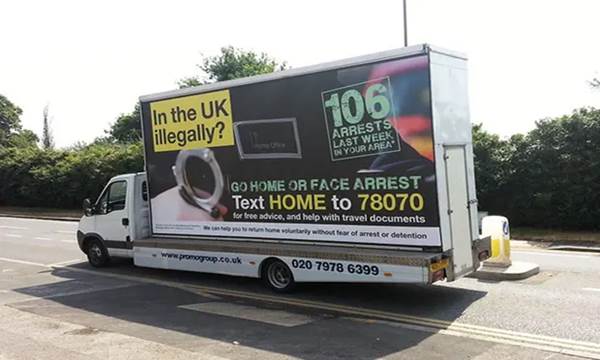
In 2013, however, May made clear that the environment would now become unmistakably hostile. The hostility would be expressed not only in legislation but also in government actions. This included a crude attempt to frighten migrants into leaving the country and to create hostility to them in local communities: in July 2013, the Home Office sent vans, displaying the message, “In the UK illegally? Go home or face arrest”, into six London boroughs. It was a pilot scheme, lasting one month, and the Home Office claimed that it resulted in 60 people “voluntarily” returning to their home countries and that it saved taxpayers’ money.[5] There was, however, a good deal of public disquiet and the vans were not used again.
But the legislation, too, was unmistakably hostile. As May’s Immigration Bill started its journey through parliament, it was obvious that many of its provisions would be particularly worrying for asylum seekers: grounds of appeal against refusal and deportation would be reduced from 17 to four and a “deport first, appeal later” policy would be introduced for people judged as being at no risk of “serious irreversible harm” if returned to their countries of origin, or indeed to other countries similarly approved by the government.[6] This was particularly dangerous since such judgments, made by caseworkers or secretaries of state, are notoriously unreliable.[7] So these legal changes were worrying enough. But it became clear that Home Office definitions of who was an “illegal immigrant” were equally unreliable, and dangerous, as the Windrush scandal unfolded.
What happened to the Windrush generation under the hostile environment policy was particularly scandalous because this whole cohort of people who had been citizens for decades were suddenly told they were not citizens at all. The House of Commons Home Affairs Select Committee, which investigated the scandal, summed up what happened to them in a few succinct sentences. Members of the Windrush generation were
denied access to employment, healthcare, housing and other services in the UK. In some cases, people who had every right to live in the UK were targeted for removal, held in immigration detention, deported or prevented from returning to the UK from visits abroad. Upon trying to resolve their status with the Home Office, they faced obstacles such as “often insurmountable” requirements for decades-worth of evidence to demonstrate their time in the UK and significant application fees.[8]
When it came to removal from the country, some decided, with their history erased, to leave before they could be forcibly removed and thus retain some dignity.[9] For others, the hostile environment ruined their health.
Persecution enforced by law
May’s Bill passed into law, becoming the Immigration Act 2014. It required employers to demand evidence of their employees’ immigration and citizenship status, NHS staff to demand the same of their patients, private landlords of their tenants and banks of their customers. Other public bodies were instructed to do likewise, and new powers were given to check the immigration status of driving licence applicants, refusing those who could not provide evidence and revoking licences already granted.[10] When such checks were made, it turned out that large numbers of people who had lived and worked in the country for decades had no documents to prove their citizenship (no passports, no naturalisation papers). They were declared “illegal”. Most of them were part of the Windrush generation and their descendants.
Rhetoric versus reality
When the Empire Windrush passengers arrived at the UK’s border, no questions were raised about their citizenship or their right to enter and live in the UK. Indeed, for more than a century citizens of the British Empire had enjoyed those rights. In their rhetoric, many UK politicians treated this as a principle to be proud of. In 1954 Henry Hopkinson, Tory Minister of State for Colonial Affairs, declared:
We still take pride in the fact that a man can say civis Britannicus sum [I am a British citizen] whatever his colour may be and we take pride in the fact that he wants to and can come to the mother country.[11]
Moreover, rhetoric apart, the decision to maintain these long-standing rights after the war was taken on hard political and economic grounds: as the countries that had formed the British Empire began to gain their independence, and the Empire became the Commonwealth, good relations with those countries were deemed vital if Britain was to maintain an economic foothold in the regions of the world it once ruled. So, in the very year the Empire Windrush sailed, the British Nationality Act 1948 confirmed those rights to British citizenship.[12] Later, the Immigration Act 1971 confirmed them yet again: although the Act granted only temporary residence to most new arrivals, crucially it still granted Commonwealth citizens protection from deportation.[13] However, by the beginning of the next decade, an erosion of their right to protection had begun. The British Nationality Act 1981 created a new status – that of “British citizen”. In doing so, in the words of Lord Justice Underhill in the Court of Appeal in 2019, it
assimilated the position of Commonwealth citizens to that of other foreign nationals, by requiring them to naturalise … in order to acquire British citizenship.[14]
Arguably, the protection given by the 1971 Act still existed, since it had not been repealed. But by the end of the decade the Immigration Act 1988 had removed it. Section 1(5) of the 1971 Act had ensured that Commonwealth citizens “settled in the United Kingdom at the coming into force of this Act” would retain their freedom “to come into and go from the United Kingdom”.[15] The 1988 Act, however, removed it in a single sentence: “Section 1(5) of the … Immigration Act 1971 … is hereby repealed.”[16] During the passage of the 1988 Act through parliament, concerns had been raised in the House of Lords by Lord Pitt.[17] “I wish that the Government would think through these matters,” he said:
We are talking about people who have been here for 15 years. During those 15 years they have been contributing to the state through taxes, rates, their work and their contributions to society. In 1971 the Government gave them a pledge. I ask them for Christ’s sake to keep it.[18]
Despite this urgent plea, the Bill received the Royal Assent and became the Immigration Act 1988, and the protection given in the 1971 Act was removed. Nevertheless, the confirmation of their rights in the 1948 Act remained and another Act, Labour’s Immigration and Asylum Act 1999, seemed to give similar protection.
“… a great deal of thought …”
Theresa May claimed in the House of Commons in 2014 that the government had “given a great deal of thought to the way in which our measures will operate.”[19] May and her officials certainly noticed a provision in the 1999 Act. It worried them – and they did something about it. The Guardian reported in 2018:
All longstanding Commonwealth residents were protected from enforced removal by a specific exemption in the 1999 Immigration and Asylum Act – a clause removed in the updated 2014 legislation.[20]
They removed it deliberately, without warning and without debate.[21] One attempted justification, once the removal of the clause had been discovered, didn’t wash at all: a later Home Secretary, Amber Rudd, told the House of Commons in 2018 that the clause had been removed because it was unnecessary – there was already protection in the 1971 Act.[22] It didn’t wash, first, because the 1971 protection had been repealed, as we have seen, by the Immigration Act 1988; secondly, if they believed at the time that the protection still existed, why did they inflict the threats and punishments that immediately followed the passing of the 2014 Act? The answer is that they were determined to implement the hostile environment and, after giving the matter a great deal of thought, they removed the protection in the 1999 Act and set about persecuting the Windrush generation.
The consequences were predictable and intended. As employers, NHS staff, landlords, bank staff and other authorities checked the status of their current and potential workers, patients, customers and clients, more and more people were told that their lack of documentary proof of citizenship meant that they were not citizens at all. They were illegal. They had, in the words of Theresa May, “no right to be here”. They had to go. In April 2018, journalist Gary Younge gave examples of the cruelty inflicted on the Windrush generation and their descendants in the name of the “hostile environment”:
There’s Renford McIntyre, 64, who came to Britain from Jamaica when he was 14 to join his mum, worked as a tool setter, and is now homeless and unemployed, after he was fired when he couldn’t produce papers to prove his citizenship. Or 61-year-old Paulette Wilson who used to cook for MPs in the House of Commons. She was put in Yarl’s Wood removal centre and then taken to Heathrow for deportation, before a last-minute reprieve prevented her from being sent to Jamaica, which she last visited when she was 10 and where she has no surviving relatives. Or Albert Thompson, a 63-year-old who came from Jamaica as a teenager and has lived in London for 44 years. He was evicted from his council house and has now been denied NHS treatment for his cancer unless he can stump up £54,000, all because they question his immigration status.[23]
In the next blog, I will tell the story of Hubert Howard, one of the saddest victims of the hostile environment and the Windrush scandal.
[1] James Kirkup, “Theresa May interview: ‘We’re going to give illegal migrants a really hostile reception’”, The Telegraph, 25 May 2012: Theresa May interview: ‘We’re going to give illegal migrants a really hostile reception’ (telegraph.co.uk)
[2] Cited The Guardian, 10 October 2013: Immigration bill: Theresa May defends plans to create ‘hostile environment’ | Theresa May | The Guardian (accessed 28/5/2023).
[3] Playing the Race Card, 7 November 1999, Channel Four Television, London.
[4] Ibid.
[5] Operation Vaken: evaluation report, Home Office and Immigration Enforcement, 31 October 2013: https://www.gov.uk/government/publications/operation-vaken-evaluation-report; Hattenstone, S., “Why was the scheme behind May’s ‘Go Home’ vans called Operation Vaken?”, The Guardian, 26 April 2018: Why was the scheme behind May’s ‘Go Home’ vans called Operation Vaken? | Simon Hattenstone | The Guardian
[6] Immigration Act 2014, s. 17(3), insertion 94B(3).
[7] Mouncer, Bob (2009), Dealt with on their Merits: the Treatment of Asylum Seekers in the UK and France, University of Hull, paras 6.5.9, 6.5.12, 6.6.1-6.6.4: file:///C:/Users/Bob/AppData/Local/Temp/b76ecf82-0f04-4115-975d-917a3a324502_Dealt%20with%20on%20their%20merits.zip.502/519233.pdf; Shaw, J. & Witkin, R. (2004), Get it Right: How Home Office Decision Making Fails Refugees, Amnesty International, London.
[8] The Windrush Compensation Scheme, House of Commons Home Affairs Committee Report (24 November 2021), para. 1: The Windrush Compensation Scheme – Home Affairs Committee (parliament.uk)
[9] “What is Windrush and who are the Windrush generation?”, BBC News 27 July 2023: What is Windrush and who are the Windrush generation? – BBC News
[10] Immigration Act 2014.
[11] Cited, Hayter, T. (2000), Open Borders: The Case against Immigration Controls, Pluto Press, London, p. 44.
[12] Ibid., p. 43.
[13] Immigration Act 1971, ss. 1(5) and 7 (1); Gentleman, A., “‘I’ve been here for 50 years’: the scandal of the former Commonwealth citizens threatened with deportation’”, The Guardian, 21 February 2018: ‘I’ve been here for 50 years’: the scandal of the former Commonwealth citizens threatened with deportation | Immigration and asylum | The Guardian
[14] Case No: CA-2021-000601, Royal Courts of Justice Strand, London, WC2A 2LL (27/7/2022), para. 11: Microsoft Word – Howard for hand-down _2_.docx (dpglaw.co.uk)
[15] Immigration Act 1971, s.1(5): “The rules [made by the Secretary of State relating to how the Act would work in practice] shall be so framed that Commonwealth citizens settled in the United Kingdom at the coming into force of this Act and their wives and children are not, by virtue of anything in the rules, any less free to come into and go from the United Kingdom than if this Act had not been passed.”
[16] Immigration Act 1988, s,1: Immigration Act 1988 (legislation.gov.uk)
[17] David Pitt was born on the Caribbean island of Grenada in 1913. He won the Island Scholarship to have further education abroad and studied medicine at the University of Edinburgh. He returned to the Caribbean, but settled in Britain in 1947. He was given a life peerage in 1975. He died in 1994.
[18] Cited, Williams, W. op. cit., p. 58: 6.5577_HO_Windrush_Lessons Learned Review (publishing.service.gov.uk).
[19] Hansard, House of Commons, 30 January 2014, cols 1124-25: Immigration Bill – Hansard – UK Parliament
[20] Taylor, D., ”UK removed legal protection for Windrush immigrants in 2014”, UK removed legal protection for Windrush immigrants in 2014 | Commonwealth immigration | The Guardian
[21] Ibid.
[22] Hansard, House of Commons, 23 April 2018, cols. 628-29).
[23] Younge, G., “Hounding Commonwealth citizens is no accident. It’s cruelty by design”, The Guardian, 13 April 2018: Hounding Commonwealth citizens is no accident. It’s cruelty by design | Gary Younge | The Guardian
“It’s the right thing to do” – the politicians’ mantra to justify policy
When Home Office minister Baroness Williams and the French Ambassador to the Court of St James assured us that the demolition of the Calais refugee camp (“the jungle”) would not begin until all the children there were safeguarded, many people of goodwill believed them. Moreover, at a higher level, Home Secretary Amber Rudd and her French counterpart, Bernard Cazeneuve, also apparently agreed that children must be protected.
Yesterday’s Guardian report shows these promises to be empty words. Instead, children were abandoned,
“lured out of … the camp in the afternoon with the promise of transport to a reception centre where they could be assessed for asylum or reunification with families in the UK. However, after an hour, no bus had arrived. Police units emerged in force, with riot shields, teargas and taser guns, and began to kettle the group, pressing them into a side street in an industrial estate. Some of the refugees were in tears as it appeared that they would be sleeping on the streets again.”
Once news of this began to circulate, a badly acted charade took place, as Amber was said to have called up Bernard and told him that the children had to be “properly protected”.
Tell that to 16-year-old Hussein from Darfur, where he had already spent five years in a refugee camp. In Calais, after queuing before dawn on three successive days,
“he never made it to the head of the line to be processed, and on Wednesday night became one of the estimated 200 unaccompanied children left to sleep rough. Now he faces a second night in the grass with temperatures dropping and despondency setting in.”
Tell it to the despairing kids being helped by charity workers:
“An atmosphere of despair among charity workers was mirrored by the behaviour of the children, all aged approximately 14 to 17, some of whom huddled against the wall in blankets as the temperature plummeted. One Afghan teenager, wrapped in a yellow and green sleeping bag, said: ‘Fuck France, Fuck Britain. You are racists.’ He was in tears as a French volunteer tried to console him by asking him not to be angry with aid workers. He retorted: ‘You didn’t have to sleep on the side of the road last night – you have documentation, you have money. Fuck France.’”
The boy has insight. “No French or British officials were on the scene with the children,” says the report. Of course they weren’t. The agreement to protect between diplomats and politicians is a charade. Their intent is to punish, and to discourage others. That was David Cameron’s intent when he withdrew support from the Italian-based rescue operation in the Mediterranean in the days of the Tory-LibDem coalition. The song that was sung then was that these people must be taught a lesson – that they will die if they come to Europe. Stop rescuing them. We must let them drown.
It’s the same story now. Punish the kids who came, warn future migrants: “Don’t come here if you’re persecuted, or bombed out of your home or even out of your hospital. We don’t want you.”
You see, despite having earlier agreed, unwillingly and under strong pressure, to bring a tiny proportion of the children into the UK, what’s happened to these remaining kids in Calais is not a mistake or down to bad organisation. It’s deliberate. It’s policy. “It’s the right thing to do.”
And if you don’t like it being done in your name, tell your MP to object. Now.
Here’s the Guardian article: https://www.theguardian.com/world/2016/oct/27/calais-camp-minors-children-abandoned-uk-france-human-rights?utm_source=esp&utm_medium=Email&utm_campaign=GU+Today+main+NEW+H+categories&utm_term=196826&subid=12991040&CMP=EMCNEWEML6619I2
Conflicting objectives?
Alan Johnson, my local MP, who ran Labour’s Remain campaign, blames Jeremy Corbyn for the Brexit vote. He says that Jeremy, or his “office”, “worked against the rest of the Party”, had “conflicting objectives” and had “undermined” the campaign. He offers no evidence. I replied on the Hull Daily Mail’s website today as follows:
“It would be useful to hear some analysis of the way the media marginalised the Labour case for staying. Jeremy was ignored by the mainstream media most of the time, as was Alan Johnson. Just the odd clip or specific comment, almost never a whole speech or extended quotes from their speeches. While the Boris Johnson/Gove v. Cameron show got full coverage, as did Farage’s every move. So the impression was that Labour wasn’t saying much, or was ‘lacklustre’. As for Jeremy’s office ‘working against the rest of the Party’, having ‘conflicting objectives’ and seeking to ‘undermine’ the campaign, you need to give examples, Alan, and say how, why and who. The consequences of just making and repeating accusations are disastrous. Especially when they make no sense.”
Here’s the original article:
EU 2: You will be voting against migrants whichever way you vote
How to vote in the referendum if you support a humane response to the current migration crisis? Many in the No camp sound like they just want to “secure our borders” and keep the migrants out. But if we want a humane response what do we do?
In 2014, when rickety boats filled with people fleeing war and persecution began to sink, dragging their passengers to the bottom of the Mediterranean, or their bodies got washed up on the nearest shore, there were some who shouted, “Close the borders”. The Tory-led coalition (really the Tories dragging the pathetic so-called Liberal Democrats behind them) said, in effect, “Let them drown” and withdrew its support for the Italian-led rescue operations. Under pressure after this common Tory gut reaction Cameron said they would take in a tiny number of refugees – but not from the Mediterranean. They would take them from the refugee camps in Lebanon and elsewhere. Because, you see, people contemplating a journey across the Mediterranean had to learn a lesson: “Don’t set out in the first place.” So when, predictably, the drowning continued, presumably the Tories thought, “Don’t come whining to us – it’s your own fault.” By April 2015 there were fifteen times more deaths of migrants in the Mediterranean that year than in the whole of 2014.
More recently, during the crisis in Calais, in the camp called “the Jungle”, Cameron seems to have been forced (through actual or threatened legal action in the courts) to concede that at least some children there, with family in the UK, have the right to come here. But he’s done bugger all about it and most of them are still in Calais.
It’s arguable that if we vote to leave the EU we will be turning our backs on desperate people and putting their fate in the hands of a politician (whether Cameron or Boris Johnson) who would let migrants drown, let them rot in the garbage of Calais or send them packing back to where they came from.
So what would we be doing if we voted to stay in the EU? Other EU states seemed at first to be different. Germany took large numbers of refugees and there was talk of sharing responsibility across the EU states. But many were reluctant from the start, they couldn’t agree how this might be done and they began to squabble amongst themselves. So there was deadlock and some of them began to close their borders – those borders which, under the Schengen Convention, were the pride and joy of the EU, open borders within the Union. Another cry went up: “Schengen is finished.”
For those who don’t like the EU because they don’t like foreigners this is good news. For them the EU is finished, and good riddance. For those who hoped that the EU would provide a humanitarian solution it is bad news. So how to vote? Jeremy Corbyn is still optimistic as, on behalf of the Labour Party, he argues to vote Yes to the EU:
“‘There has to be an agreement all across Europe that [the EU states] all take a proportion of [the refugees],’ he said. ‘The problem is that the degree of inward-looking politics that’s going on has meant that Greece is making a huge effort, Italy is making a huge effort and Germany is making a huge effort. Every other country is putting barbed wire entanglements along their borders to keep desperate people out … Surely in the 21st century the least we can do is reach out and try to help these people in some way; by the political solution in Syria; by the support for what the Greek government is trying to do and take a proportion all across Europe.’”[1]
That, presumably, would be the policy if there was a Labour government. But yesterday the French began to bulldoze the people in Calais out of their makeshift homes. The French had originally said that the process of moving people would be done by gentle persuasion over many weeks, not with force or violence, not with bulldozers. The French Minister of the Interior spelt this out only last week: the government’s plan, he said, was not “to carry out a brutal evacuation of the camp by using bulldozers, this is not how we operate.” But yesterday the bulldozers appeared and the destruction began.
On Channel 4 News last night Krishnan Guru-Murthy asked Sylvie Bermann, the French ambassador to the UK: “Why did you say ‘no bulldozers’ and then use them?”
Bermann: I think we are using bulldozers to clear the camp, not to force all these migrants to go.
Guru-Murthy: But you said you wouldn’t.
Bermann: Well, our ministers said we wouldn’t force people to go, but at the same time what I cannot understand is – well, your reporter said it was filthy, stinking conditions. So how could you consider it better to live in these squalid conditions than to be relocated in accommodations [sic] where you have water, heating, electricity?
Guru-Murthy: But you don’t have enough space. There are thousands living there and there aren’t enough spaces in the shipping containers. They’re not flats, are they, they’re shipping containers, where you’re suggesting they go and live in?
Bermann: They are temporary accommodations, that’s true, but some of them will be relocated in other camps in France.
Guru-Murthy: Can you guarantee every one of them a comfortable roof over their heads?
Bermann: They will be relocated, but conditions will be far much better [sic] than it was in the Jungle.[2]
At the end of all this ducking and diving, there was no answer to the question, “Why use bulldozers when you said ‘no bulldozers’?” But then Sylvie is a diplomat.
So referendum voters who want a humanitarian solution to the migration crisis aren’t going to get one, in or out of the EU. The Tories will close the UK’s borders either way; the EU states will do the same; and France, our nearest neighbour, will bring out the bulldozers at the drop of a hat despite its much-vaunted pride in being the home of human rights.
How to vote? With some difficulty.
[1] The Guardian, 29 February 2016.
[2] Channel 4 News, 29 February 2016.
EU 1: Thinking aloud about some of the questions: workers’ rights
I haven’t decided how I’m going to vote in the EU referendum. If I vote to leave I will be joining a ramshackle bunch of characters including Michael Gove, Nigel Farage and George Galloway. Shouting with them from the sidelines, as Andrew Raunsley points out in today’s Observer (see link (1) below), are Marine le Pen and Vladimir Putin. And if the No camp wins we might even end up with Boris Johnson as prime minister.
All that is nearly enough to send me into the Yes camp!
But I’m also horrified by the supporters of continued membership who, one way or another, have got us where we are today. Raunsley’s list includes
“the chancellor, foreign secretary and home secretary, most of the rest of the cabinet, the great majority of senior figures from the opposition parties, the bulk of big business and the trade unions, the governor of the Bank of England, the president of the United States and the leader of every European country that anyone might conceivably have heard of.”
That’s almost enough to send me into the No camp!
However, it’s not about lists of clowns, bankers, politicians, or other Very Important People. It is, as Tony Benn always insisted, about “the issues”. Take, for instance, the question of workers’ rights. Would it be better for workers’ rights if we stayed in or if we left?
Let me suggest one argument for staying in. Many unions are saying that workers’ rights will be better protected if we stay in. But I notice the biggest French union, the CGT, says that the latest “reforms” of the Code du Travail announced by the French government will take France back to the 19th century (see link (2) below). And this in a France firmly entrenched in the EU. This game of “reforms” is the game all governments want to play, and no country’s workers are safe, and this suggests that there are no automatic guarantees of workers’ rights in the EU and that whether we’re in or out we’ll have to defend the rights we fought for. M. Martinez is calling on French trade unionists to do that now in France. So the argument for staying in to protect workers’ rights doesn’t seem to be a particularly strong one.
Unless, of course, we add M. Martinez’s element of workers taking action to defend their rights. Then, if we stayed in, it would be easier to join them and any others across the EU doing the same. Wouldn’t Brexit leave British workers weaker against Cameron, and other workers in Europe weaker against their own governments? I think solidarity is better than isolation. And perhaps solidarity across the EU could change it to the advantage of workers beyond the wildest dreams that Cameron has of changing it to the advantage of his rich, arrogant, corporate buddies.
That’s my first thought, anyway. More to come as the campaigning goes on.
(1) Andrew Raunsley’s article: http://www.theguardian.com/commentisfree/2016/feb/21/eu-refendum-tory-party-uk-at-stake
(2) Article in Libération: http://www.liberation.fr/france/2016/02/19/martinez-le-nouveau-code-du-travail-un-retour-au-xixe-siecle_1434633
On responsibility
David Cameron clearly can’t break the habit of a lifetime: he’s going to play the race card again. He seems to have set in motion a nice little scare story. An agreement made some years ago between the UK and France allows UK border control officials to police the borders between France and the UK on the French side in order to stop asylum seekers from ever arriving on British soil. This is a local version of the wider system of Airport Liaison Officers (ALOs) who since the 1990s have been sent to a number of what are called “refugee-producing countries” – that is, persecuting countries – in order to help them stop their terrified citizens from fleeing their borders and applying for asylum here.
Now Cameron is suggesting that if the EU referendum results in the UK leaving the EU France may renege on that agreement, resulting in uncontrolled migration to our shores and migrant camps on the beach at Dover instead of Calais. So the message is vote to stay in the EU and we’ll keep the barbarians out.
Well, I haven’t decided how I’m going to vote. But however I vote it won’t be based on some imagined need to keep refugees out. This refugee crisis, perhaps more than any other, is of our own making. “Jaw-jaw is better than war-war”, said Churchill (of all people!). But the US chose war in Afghanistan as revenge for the Twin Towers and to get rid of the Taliban and al-Quaida. It failed and, with our help, left the country in a mess with the Taliban still alive and kicking today; we chose war in Iraq to get rid of weapons of mass destruction which we knew it didn’t have, left it hopelessly divided and paved the way for the rise of ISIS. We intervened in Libya to save it from Gaddafi and, yes, you’ve guessed it, left it in a mess – arguably, as in the case of Iraq, in a worse mess than it was in under the regime we were so eager to get rid of. Now we’ve agreed to join the airstrikes in Syria, and there’s talk of further military action in Libya (its “peace talks”, like those on Syria, having broken down). All of these interventions have produced innocent victims and, despite claims of “smart bombs” (not again, please), there will be more innocent victims. All these interventions have produced refugees and will continue to do so.
So I’m for the UK taking responsibility for the refugees it has helped to create, in line with its obligations under the Refugee Convention which it has signed. I’m for peace talks, diplomacy, all sorts of jaw-jaw. Whether we are in the EU or out, I’m against Airport Liaison Officers or anybody else preventing people fleeing unmentionable horrors from finding shelter here. And if the EU states are incapable of finding ways to share responsibility for refugees among themselves, perhaps the club is not worth belonging to after all.
I don’t like ending on what feels like a negative note, but it’s all I can manage tonight. Here’s the Cameron story:
http://www.bbc.co.uk/news/uk-politics-eu-referendum-35519210
Tell your MP: “all necessary measures” – against war
The Labour Party decided at its conference this year that military intervention in Syria by the UK should not take place without
- authorisation from the United Nations;
- a comprehensive plan for humanitarian assistance for any refugees who may be displaced by the action;
- assurances that the bombing is directed exclusively at military targets associated with ISIS;
- the subordination of any military action to international diplomatic efforts to end the war in Syria.
I’m not sure if the UN Security Council’s post-Paris call to take “all necessary measures” against ISIS counts as authorisation, although I think David Cameron thinks it does. It looks like he will present proposals for bombing to the House of Commons this week or next and he’s been telling the French president not to worry: it’ll be “shoulder to shoulder” again apparently.
A good many Labour MPs are flexing their shoulders in anticipation of voting with the Tories and against the Labour conference decision and the advice of Jeremy Corbyn, John McDonnell and others. They’re jumping the gun, of course, if you’ll pardon the expression. Even assuming that the Security Council’s “all necessary measures” count as authorisation, there are three other Labour Party conference criteria to be met before Labour MPs should even consider hoisting their shoulders into war. The Guardian thought that meeting all four criteria would be difficult if not impossible “in the short term”. Or in the long term, I would add. Even if, by sleight of hand or smoke and mirrors, Hilary Benn, say, declared they had been met, those vague criteria couldn’t possibly guarantee that refugees would be protected, that only military targets associated with ISIS would be bombed, or that international diplomatic efforts would be able to end the war in Syria while the politicians “pitilessly” (the word used by the French president) extend it.
Politicians quite like shoulder-flexing. But we must absolutely refuse to give them permission. Although John McDonnell has suggested that Labour MPs might have a free vote, I’ve told my MP (Alan Johnson) to vote against war. Please tell yours. And sign a petition, pass a resolution in your union branch, or at your local Labour Party meeting, and go on a demo.
Because the truth is that the history of previous shoulder-to-shoulder events (Afghanistan, Iraq, Libya, then back to Iraq again) cries out for them not to do it again. It doesn’t work. It won’t work with French shoulders either. What it will do (to use a phrase that was quite often used by my mother) is send us all to buggery.
In today’s Guardian, Frankie Boyle argues that “Britain clings to its bombing addiction with the weary rationale of a junkie.” He concludes:
“If we wanted to get well as a society, we would end up like anyone in recovery: sitting around a table talking, having awkward conversations and making compromises. Instead, a few months from now, we’ll be dealing with the kind of horror that is unleashed when British MPs are told they can vote with their consciences.”
Jeremy and John, I don’t know how you’re going to play this but, given the malleability of many Labour MPs’ consciences in the past, I don’t feel safe with a free vote.
 Bob Mouncer's blog