Labour Conference chair Lillis already ignoring votes
Clearly the dirty tricks aren’t over. Thanks for this, skwalker.

Paddy Lillis, the NEC chair who has been chairing Labour’s first conference session this morning, has already been demonstrating contempt for democracy.
The vote this morning to accept/reject the ‘Conference Arrangement Committee’ report, in which the CAC attempts to justify its decision to ignore some of the most key issues raised by Labour constituency parties and members, was voted on by a show of hands that had a huge number of ‘reject’ hands raised – at the very least, it was tight and probably more than those voting to accept, so a proper ballot was required. People at various heights and angles around the hall have confirmed this.
Lillis declared the ‘accept’ vote ‘overwhelmingly carried’.
Subsequently, various people stood to ‘reference back’ (i.e. object to and put to a delegate vote’) the fact that the NEC’s (National Executive Committee) proposed rule changes are offered as a ‘take it or leave it’…
View original post 184 more words
Breaking: irony dead – note blames Owen Smith ‘rally’ ad
This made my day
Irony is widely reported to have died this weekend and to have left a note blaming Owen Smith’s ‘Liberty’ advert for its demise.
Investigators believe the cryptic note referred to the Smith campaign’s paid Facebook ad this weekend, after Smith’s comment during last week’s Labour leadership hustings:
Jeremy shouldn’t mistake mass rallies for a mass movement
The campaign ad uses black-and-white footage of an Aneurin ‘Nye’ Bevan rally from the 1950s in its first few seconds, with a soundtrack of Bevan saying,
Behind us are millions and millions of ordinary men and women who are expecting us to do our duty
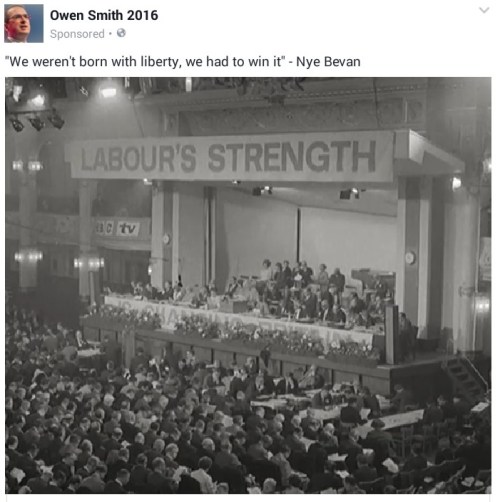
Commenting on the news, Satire – one of Irony’s closes friends – said,
It was just too much. Using black-and-white footage of a 60-year-old mass rally to oppose a man who can raise huge crowds right now in full colour is bad enough, but to do so just a couple of…
View original post 186 more words
Rio rules – OK?
A friend complains about the TV listings: “It’s wall-to-wall Olympics”, he lamented yesterday.
He’s right. I turn to the Radio Times – BBC 1 given over entirely to the Olympics. BBC 4 ditto. Same tomorrow, as far as I can see, and it’s leaked into BBC 2 with the swimming heats at 6pm. On Monday, after a one-and-a-half-hour “Olympic Breakfast” starting at 6am, there’s a break till 1.45pm. Then off we go again and it’s Olympics till 4am Tuesday. the only bit of relief to interrupt this pattern is forced feeding of another kind: EastEnders at 8pm. The excitement promised there isn’t tempting:
“Sharon encourages Grant to talk to Phil, but the two only end up in a bitter argument. Jay and Ben have a heart-to-heart, while Claudette encourages a grieving Pam to visit Paul.”
I don’t know who any of these people are. For all I know they’re in Rio, on a trip paid for by my TV licence fee. I daren’t turn the page to Tuesday. Mind you, in the end it might be less depressing than the news.
And that’s another thing – it leaks into the news as well: apparently the Russians are going to be banned from the Paralympics. Which means that the most vulnerable and deserving are going to be punished for the crimes of the powerful while the rich and famous get off scot free. No change there then. And they certainly know all about that in Brazil.
Conflicting objectives?
Alan Johnson, my local MP, who ran Labour’s Remain campaign, blames Jeremy Corbyn for the Brexit vote. He says that Jeremy, or his “office”, “worked against the rest of the Party”, had “conflicting objectives” and had “undermined” the campaign. He offers no evidence. I replied on the Hull Daily Mail’s website today as follows:
“It would be useful to hear some analysis of the way the media marginalised the Labour case for staying. Jeremy was ignored by the mainstream media most of the time, as was Alan Johnson. Just the odd clip or specific comment, almost never a whole speech or extended quotes from their speeches. While the Boris Johnson/Gove v. Cameron show got full coverage, as did Farage’s every move. So the impression was that Labour wasn’t saying much, or was ‘lacklustre’. As for Jeremy’s office ‘working against the rest of the Party’, having ‘conflicting objectives’ and seeking to ‘undermine’ the campaign, you need to give examples, Alan, and say how, why and who. The consequences of just making and repeating accusations are disastrous. Especially when they make no sense.”
Here’s the original article:
On the eve of a referendum …
Several friends have told me that they are voting Remain in the EU referendum – but with a heavy heart.
I’m voting Remain too, in spite of France tear-gassing protesting workers who are resisting their government’s, and the EU’s, plans to ditch their rights (Jeremy, don’t imagine the EU is on your side here) and tear-gassing (again by France) of refugees in Calais (ditto, Jeremy) and its refusal to allow aid through to Calais. I’m voting Remain because I don’t want Johnsonism and Goveism to have the whip hand in government and I also want to save Jeremy from the Blairites and the assorted Gawd-knows-whatites waiting to get rid of him if there’s a No vote. It’s not the right time to vote Leave.
If we get a Labour government committed to rolling back NHS privatisation, rejecting TTIP, bringing the rail network and the energy companies into public ownership, restoring the trade union rights that have been eroded since Thatcher and getting rid, amongst other noxious things, of zero-hour contracts, that would be several major steps forward. A Corbyn-led government could do that, and it could reaffirm the principles of the Refugee Convention rather than bolster the profits of the tear-gas manufacturers. The EU would certainly oppose such a Labour programme, since much of it would break EU rules, laws and protocols. Then we could oppose the EU, and then, if change proves impossible, vote to leave – and defend policies worth defending.
Will any of that happen?
Don’t know.
But if we vote Leave now, we are playing into the hands of the Right, including the very nasty Right.
Defending workers’ rights against the EU
A major part, perhaps the major part, of Jeremy Corbyn’s argument for remaining in the EU is that we will be able to defend workers’ rights across Europe if we stay in. We enjoy many of them, his argument runs, thanks to the EU and we can defend and maintain them more effectively from inside the club than from outside.
Whether we enjoy them “thanks to the EU” is debatable. But one thing is not. The French Socialist Party (SP) government is busy attacking workers’ rights in France like there’s no tomorrow. And the unions, through strikes and demonstrations, and protest meetings, are opposing the changes. According to today’s Observer, the argument
“boils down to whether it should be as easy in France for employers to sack workers, cut their pay and arbitrarily change their working conditions as it is in post-Thatcher, post-BHS Britain.”
A protest meeting of the Left took place today. One of the participants spoke of the “docility” and “treachery” of SP Members of Parliament and called President Hollande’s government “a government of the right”.
But what was interesting in terms of Jeremy Corbyn’s argument was the claim by Danielle Simmonet from the Parti de Gauche (Party of the Left). She argued that the proposed law was not just a proposal by the French government. It was concocted by the government, the bosses – and the European Union. The proposed law is a “demand” of Brussels, she said, and a “deal” made with the European Union institutions themselves. So how to break this deal? Danielle is clear: “To fight the [proposed] law we need a general rebellion … we need to [be] an insubordinate people.”
So, if we remain, it looks as if our rights will not be protected by the EU. Instead we will have the EU institutions themselves to contend with. Jeremy Corbyn paints too rosy a picture of workers’ rights in the EU. Judging by the current events in France, maintaining and defending them if we vote Remain will take just as much effort and commitment as defending them against Boris Johnson and Michael Gove: it won’t just be a matter of sending Hilary Benn in to the Council of Ministers. We will, beyond that (and perhaps instead of that), have to become “an insubordinate people”.
We can, of course, do that – In or Out.
Here’s the Libération article: http://www.liberation.fr/france/2016/06/12/loi-travail-valls-on-organise-ton-pot-de-depart-dans-la-rue_1458935
And the Observer article: http://www.theguardian.com/commentisfree/2016/jun/04/observer-france-labour-unrest?CMP=Share_iOSApp_Other
Referendum blues 2
Further to my last blog: I mentioned Peter Prescott saying that all EU member states would have to ratify TTIP before it came into force. And I notice that Jeremy Corbyn has pledged that Labour would resist it in parliament and a Labour government would veto it in the EU .
But I am even less sure now that a veto is possible. According to the Foundation for a Free Information Infrastructure (FFII), “After the negotiations, the EU member states may not have a veto on the proposed trade agreement with the US (TTIP/TAFTA). “You can read the details here: https://blog.ffii.org/eu-member-states-may-not-have-a-veto-on-ttip-tafta/
But so far I’ve seen nothing to support Owen Jones’s claim that we have anything like an “exemption”.
Referendum blues, and the dangers of wishful thinking
On Question Time last night, Owen Jones raised the question of the Transatlantic Trade and Investment Partnership (TTIP) and its threat to the NHS remaining in public ownership. He claimed that the UK now has an exemption from TTIP when it comes to the NHS. He said the following:
“Because people protested and campaigned here and all over Europe we not only got an exemption for the NHS (forced upon this government against their will) but because people protested and campaigned all over Europe TTIP lies in ruins. Don’t let anyone say we can’t change the European Union.”
I don’t think we’ve got an exemption and I don’t think TTIP lies in ruins. The latest information I can find after a quick search is from the Daily Mirror and The Guardian of 19 May, where a No. 10 spokesperson is quoted as saying that the government would accept the Commons amendment to the Queen’s speech (put by Peter Lilley (Tory) and Paula Sherriff (Labour), and supported, I think, by the SNP), which proposed that the Commons should
“respectfully regret that a Bill to protect the National Health Service from the Transatlantic Trade and Investment Partnership was not included in the Gracious Speech.”
I understand from this that getting an exemption would involve an Act of Parliament, so I don’t see how Owen Jones can say we’ve got an exemption now. I’d have thought it would mean some more jiggery-pokery at EU Central too.
At my Constituency Labour Party meeting last month, when I asked a question about whether TTIP was a threat to the public ownership of the NHS, Peter Prescott (arguing for a Remain vote), agreed that it was – but claimed that TTIP would have to be agreed to by all 28 members of the EU and that therefore we would have a say at that stage, and that he couldn’t see France, either, agreeing to this aspect of TTIP under a Socialist Party government. He didn’t mention an exemption. (He didn’t mention, either, that President Hollande is apparently the most unpopular president of France since records began, so who knows whether there will be a Socialist Party government of France when TTIP gets to that stage?)
I’m not clear what “accepting the amendment” means anyway, particularly as the said No. 10 spokesperson seemed a bit dismissive of it: “As we’ve said all along,” he said, “there is no threat to the NHS from TTIP. So if this amendment is selected, we’ll accept it.” So, as I said, I don’t believe we’ve got an exemption and Owen Jones’s claim is, at best, wishful thinking.
I could vote either way in the referendum: there are lots of reasons why I’d like to see us out of this club. I hate what the EU and the European Bank did to Greece (they boasted they’d given Tspiras “a mental waterboarding”), I find the claim that the EU will make it easier to defend workers’ rights (also cited by Jones) more than questionable in the week after the French “socialist” government tear-gassed workers protesting against its proposed laws, which are set to tear up their rights, I hate the EU agreement with Turkey to send Syrians (who are the most vulnerable ones) back to Syria. (This means that every time EU bureaucrats or politicians take a breath they are breaking the Refugee Convention.)
But I’m thinking of voting Remain. Part of that has always been because of the racist arguments of a substantial part of the Leave campaign. But (and this is not unconnected with that reason) a successful Leave vote would also likely result in Boris Johnson and Michael Gove running the government, even more enthusiastic in “punishing the poor”, as Ken Loach described the Tories last week, than even Cameron and Osborne. There is no worse prospect, we don’t need it and we don’t deserve it. So I’m inclining at the moment (and this isn’t set in stone) to adopt Paul Mason’s approach: Get out, but not yet. The time to leave would be when a Labour government is prevented by the EU from implementing its programme (e.g. defending the NHS, bringing back the rail network into public ownership) and then, when it becomes obvious we can’t change the EU, calls another referendum. Then we could leave, heads held high, Corbyn intact.
And that’s another thing: on 23 June, a Leave vote would probably mean, not only the rise of Johnson and Gove, but the end of Jeremy Corbyn. Labour MPs would call for a new leadership election before you could say “plot”, and he would be gone.
And then I would retire from politics!
No distinction between goose and gander
Giles Fraser (hero of the Occupy movement at St Paul’s Cathedral for resigning as Dean rather than be party to a police operation against the protesters), argues in an article in The Guardian today, that ISIS’s slaughter of whole minority communities in Iraq and Syria should be recognised as genocide so that, perhaps, one day some of them will be held accountable to the International Court. I agree. Fraser suggests that the Tories are forcing their MPs to vote against recognition of genocide because Turkey is being friendly, helping us to solve the refugee crisis by deporting Syrians back to Syria. For Turkey is sensitive to any talk of genocide – it’s too close to home, too much part of its history – and Cameron doesn’t want to offend his new best friend. We should, says Fraser, be braver than that.
But let’s not talk only about ISIS. With the news today of still more people drowned in the Mediterranean, it is clear that the EU states are failing in their duty to protect refugees, contrary to the Refugee Convention. They should have to answer for that. And shouldn’t EU states themselves be dragged to the International Court for the agreement which allows Turkey to send Syrians packing back to where they will be killed? I’m not an expert in tricky legalistic language, but that kind of sounds like collaborating in genocide to me, as does our conniving with Turkey in its slaughter of the Kurds. Shouldn’t we be done for all of it? Or change our ways? And if we don’t, let’s not pretend to be surprised if ISIS continues to gain ground. After all, we created them and we sustain them.

