Home » Uncategorized (Page 12)
Category Archives: Uncategorized
Null and void? Not for these reasons, M’Lud
According to the Independent’s story below, Brexit may be declared “void” because of illegality and “multiple criminal offences” by Leave-supporting business people and politicians.
I doubt it. That’s not going to happen just because they told lies and broke the law. Lies and broken laws have littered political campaigning since it was invented. Most elections that any of us can remember could be declared “void” if the grounds were that porkies were told and crimes committed.
Moreover, in this particular case, Croft solicitors have definitely come up with the wrong solution. May, they tell us, must consider “how best to conduct another referendum”. This presumably means that, of all people, she and her cabinet must devise one where nobody tells porkies and nobody is a criminal.
Difficult. Not to say – no, I will say it – impossible.
There may be a case for another referendum. This isn’t it. This one seems to sit side by side with the one that says Leave voters “didn’t know what they were voting for”. Now, there’s disdain for you; there’s patronising. The people using this latest argument apparently think Leave voters didn’t know that politicians lie and business “leaders” break the law when it suits them. Give me a break.
The idea that we should have a referendum on the grounds suggested by this case should be greeted with a cascade of mockery and laughter.
Dodgy
Capitalism throws up all sorts of dodgy characters and some of them make a good living advising dodgy governments.
Enter Shanker Singham, former adviser on Brexit to Her Majesty’s government.
Whichever side of the Brexit argument you’re on, Shanker is bad news. His credentials are crap. He claimed in a Facebook profile, says The Guardian, that “he studied law at Oxford. However, his degree there was in chemistry.” Then there is a “biography”, “distributed by a former employer” (Sorry?) that says he assisted “governments in the early privatisations during the Thatcher administration”, yet his career began post-Thatcher (in 1992). Singham denies “that this could be misinterpreted”.
He’s right. It’s clear as day: in the words of Sir Robert Armstrong, Thatcher’s cabinet secretary about her, he was being “economical with the truth”.[1]
May didn’t take his advice. Instead her deal, he says, is “a damage limitation exercise”. That’s why he’s pissed off and touring the studios and editors’ offices. But in or out or somewhere in between, we should be worried. Because we need to find ways of holding governments to account for everything they do and for the way they do everything they do. We have had cause to lose trust in governments of all parties and in the machinery of government (the civil service). Labour governments had plenty of dodgy advisers and spin doctors (remember them?) It had a dodgy dossier that told us that Saddam Hussein had weapons of mass destruction (remember that?). What we need is an end to dodgy characters and dossiers that capitalism produces from the depths of its bowels like there’s no tomorrow. And for a start, we need some integrity.
Enter Jeremy.
[1]https://www.news.com.au/finance/work/leaders/two-moments-of-legal-genius-which-tell-you-more-about-malcolm-turnbull-than-anything-hes-ever-done-in-politics/news-story/99b294dda251d4c3b7de3a5240c1b42b
Just a couple of points about Brexit
The truth is that whether we leave the EU with May’s deal, without a deal, or with a deal that looks more or less like the status quo (which must surely be the real meaning of phrases like “on the same terms as we have at present”) or with some other deal, or whether we just say, “I know, let’s just stay in, it was all a mistake, sorry”, socialists and anyone who thinks another world is possible will still have a fight on their hands.
Jeremy Corbyn said that one of the reasons we should stay was to preserve the workers’ rights gained in the EU. And, sure enough, those rights have often been better in other European countries than in the UK. I worked as an English teacher in France in the first half of the 1990s, and I was gobsmacked to find that, not only was there the right to join a union, you had the right for it to be recognised by the boss. If you wanted a staff representative you just had to ask. If you wanted a union rep, ditto. If you wanted a union rep (and at our language school there were just two union members out of a staff of about 35) an official from the union (in our case the CGT) would come and set up the operation. It meant that the boss was legally obliged to have annual pay negotiations with the union reps, among other obligations. None of this was perfect, but it was a good deal better than the situation in Thatcher’s Britain at that time. And French workers in their unions had fought for such rights well before the EU was even a twinkle in anybody’s eye.
But none of it was permanent either. Even before I left in 1995, there were rumours that these rights were under threat of being removed. One of my students said, “If they try that, there’ll be another revolution!” But Macron has made the most determined attempt so far to weaken and remove those rights. But even before Macron, in 2016, as Corbyn was saying we should remain in order to preserve workers’ rights, the government under Socialist Party president François Hollande was tear-gassing workers demonstrating against its own attack on their rights, an attack prompted from within the EU itself. I wrote in a blog in 2016 that
what was interesting in terms of Jeremy Corbyn’s argument was the claim by Danielle Simmonet from the Parti de Gauche (Party of the Left). She argued that the proposed law was not just a proposal by the French government. It was concocted by the government, the bosses – and the European Union. The proposed law is a “demand” of Brussels, she said, and a “deal” made with the European Union institutions themselves.[1]
So we can stay in to preserve human rights if we like, but they will not simply require preserving but vigorously defending, and probably will have to be fought for all over again. The same goes for all other rights, “standards”, etc.
If we leave the EU we will, for dead certain, have to fight to defend and extend our rights. The state will oppose us because it is a capitalist state, and thus not our friend. Even if we get a Corbyn-led government we will have to fight for change. John McDonnell spoke at a meeting in London recently and talked of “transforming the state”. He said this transformation would involve all of us in our unions, our communities, our pressure groups, etc., and in the Labour Party. The process needed to start now, he said, and it would be at least 10 years before we would see real progress (or as he put it, “two terms”). Of course, the state will resist any such transformation and we will have to hold a Labour government accountable and constantly keep it on track. It will be under enormous pressure to backtrack, abandon the transformation and return to “business as usual”. This will be the case in or out of the EU.
My main reasons for voting Remain in the 2016 referendum were about migration. I felt vindicated when it seemed that just the act of voting and getting their required result made so many people feel they then had the right to perpetrate racist attacks. It’s a small world and there can be no xenophobia or racism, no talk of “them” and “us”. We need to fight for free movement, which must be seen as benefiting both those who move and those who stay put and welcome the movers. A UK that bolts the door or pulls up the drawbridge against the antiquated figure of “the foreigner” will move further and further to the right. It will be going nowhere I want to go and nowhere I want to live. So I will probably vote Remain again if asked, despite the unfriendly – no, that’s too weak, think what they did to Greece – the vicious nature of what Yanis Varoufakis calls “Europe’s deep establishment”.[2]
[1] Defending workers’ rights against the EU: https://bobmouncerblog.wordpress.com/2016/06/12/defending-workers-rights-against-the-eu/
[2] Adults in the Room: my Battle with Europe’s Deep Establishment (2017), Vintage, London.
Attlee’s quiet humanity, Jewish refugees, and a warning against wishful thinking
There must be a whole lot of untold stories like this (see link below) about people and the Jewish children they gave shelter to at that time. Most of those people weren’t famous like Attlee. But it’s a good story about Attlee, who is often characterised as nondescript and not really a warm character. I puzzled about the game he played, mentioned here, where the kids had to guess the name of the figure on the coins. I thought surely it was obviously George VI, and would be the same each time they played it. But then I remembered that, as a child, the coins we had in the 1950s were not all George VI. There was George V, and even Queen Victoria’s head floating around. How many of them were valid currency I don’t know. Incidentally, my father always called Queen Mary (who lived a good few years after George V died) “the old queen”. The later meaning of that phrase, of course, he had no knowledge of! He also maintained that George VI was a Labour supporter, a kind of wishful thinking that has not yet died out: John McDonnell sometimes says the bankers and others are supportive of his plans for a National Investment Bank, higher taxes for the rich and corporations, union representation at work and workers’ part-ownership of their firms. I think he knows he will have a much harder battle on his hands when he becomes Chancellor than this suggests. I hope so.
On learning lessons from the past to build a different future
Patrick Cockburn writes about an almost forgotten episode during the First World War: the Mesopotamia campaign.[1] He visits the British North Gate cemetery in Baghdad. He tells a tale of present-day witchcraft and sorcery and of an arrogant ruling class a century ago, its gung-ho militarism, its lies and selective memory, and notes the complete failure of its successors, a century later, to learn lessons.
For me, he says,
the chief fascination of these cemeteries – whether in Baghdad, Kut, Amara or Basra – is the sheer immensity of the disaster they commemorate, and the extent to which it has been forgotten. Unlike the defeat at Gallipoli and the slaughter on the Somme, the Mesopotamian campaign has faded from British memory, despite the national obsession with the First World War.
There were at least 85,000 British and Indian soldiers “killed, wounded or captured”. But according to the War Graves Commission
the cemetery in Amara on the lower Tigris “commemorates some five thousand servicemen of the Indian Army, of whom only nine are identified as no comprehensive records of the burials were kept by the military authorities”.
Cockburn then tells the story:
The Mesopotamia campaign was grotesquely mismanaged, even by the low standards of the First World War, and those responsible had no wish to recall it. After the publication of a damning official report in 1917, Lord Curzon, a member of the war cabinet, suggested that ‘a more shocking exposure of official blundering and incompetence has not in my opinion been made, at any rate since the Crimean War.’ The intervention began on a small scale in 1914, initially intended to protect the oilfields in south-west Iran from attack by the Ottoman Turks. By 1918, the campaign had ballooned into the biggest British military action outside Europe. In 1915, an overambitious advance, which underestimated the Turks’ fighting strength, aimed at capturing Baghdad to counterbalance the failure at Gallipoli earlier that year. Heavy casualties in a battle at Salman Pak led to a precipitate retreat to Kut, a ramshackle Shia city on a bend in the Tigris a hundred miles south-east of Baghdad. Commanded by Sir Charles Townshend, an insanely egocentric general, 13,000 British and Indian soldiers were besieged there for 147 days between December 1915 and 29 April 1916. Townshend appears deliberately to have allowed his troops to be surrounded: he wanted to make his reputation through a heroic and successful defence of Kut even though he knew his forces were far from their supply base in Basra while the Turks were close to theirs in Baghdad. In order to accelerate the arrival of the British-led forces coming to relieve him he sent misleading information about how long he could hold out, forcing them to attack prematurely and suffer 23,000 casualties while failing to dislodge the well-entrenched Turks. Injured soldiers, their wounds gangrenous and filled with maggots, were crammed into slow-moving river boats and lay in their own excreta for the two weeks it took to reach Basra.
Inside Kut, Townshend became increasingly unbalanced, refusing to visit the hospital where many of his men were lying. He spent much of his time in his house, emerging only occasionally to walk his dog, Spot. He banned his soldiers from sending messages to their families via wireless but dispatched frequent messages of his own asking for promotion. He made no attempt to break out of Kut and, after the surrender, showed little interest in what happened to his men. He and most of his officers were placed by the Turks in comfortable imprisonment, but the other ranks were dispatched on a 700-mile forced march to Turkey during which many died from starvation, beatings, execution, or typhus and cholera. Survivors of the death marches were set to work digging a railway tunnel in the Taurus mountains alongside a few Armenian survivors of the genocide. By the end of the war 70 per cent of the British and 50 per cent of the Indian troops captured at Kut were dead. Released from captivity, Townshend presented himself as a hero of the siege who deserved a senior job. When his promotion was denied, he resigned from the army and became a Conservative MP. Kipling, in his poem ‘Mesopotamia’, which the Daily Telegraph refused to publish (it appeared in the Morning Post instead), furiously denounced the generals who had left the soldiers ‘to die in their own dung’ and predicted that, once the furore had died down, those responsible for the disaster would find a way of keeping their positions:
“When the storm is ended shall we find
How softly but how swiftly they have sidled back to power
By the favour and contrivance of their kind.”
Kipling’s poem was useful reading as the US and British invasion ran into ever deeper trouble a century later, the line about ‘the slothfulness that wasted and the arrogance that slew’ seeming particularly appropriate.
It may be too much to hope for but perhaps, if Labour wins the next election, the corrupt old guard in all parties will lose its influence and never get the chance to “sidle back to power” again. As I wrote that, it seemed to turn into an impossible dream – even a fantasy. But I’ll say it anyway. And here’s another poet to express it, Ben Okri, in the poem he sent to Corbyn in the heady days of 2015:
“Can we still seek the lost angels
Of our better natures?
Can we still wish and will
For poverty’s death and a newer way
To undo war, and find peace in the labyrinth
Of the Middle East, and prosperity
In Africa as the true way
To end the feared tide of immigration?
“We dream of a new politics
That will renew the world
Under their weary suspicious gaze.
There’s always a new way,
A better way that’s not been tried before.”
[1] Read the whole article: “At the North Gate”, Patrick Cockburn, London Review of Books, Vol. 40, No. 19, 11 October 2018: https://www.lrb.co.uk/v40/n19/patrick-cockburn/at-the-north-gate
A Spun Illusion
A poem by Malcolm Evison

 poem & graphics by Malcolm Evison
All together for the Unity March against racism and fascism
Whether you go to this demonstration simply “to take a stand against racism and the far right threat”, writes Kevin Ovenden, or because you “see it as a strategic part of a process of militant struggle leading to a truly radical transformation of Britain”, plan to be there, in London, on 17 November.

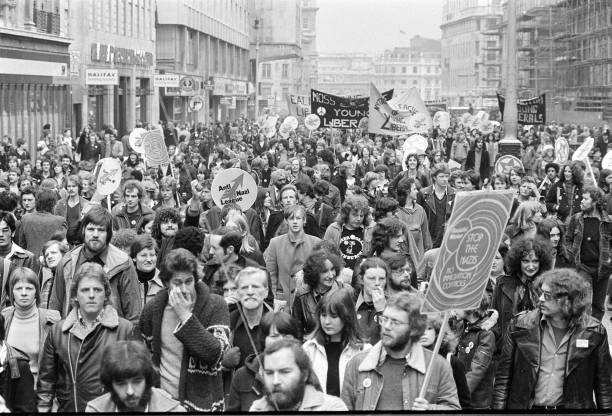 The Anti Nazi League/Rock Against Racism demonstration to the carnival in Victoria Park, East London, in 1978
Well done to all those involved in pulling together the call for a massive national demonstration in London on 17 November against racism and the fascist threat.
It already seems to be generating enthusiasm and it’s clear that the potential number of organisations, campaigns and affinity groups that may throw themselves into it is huge.
I think it’s a crucial initiative, but also a challenge to turn it into an event that can have a decisive political impact.
Why is the demonstration so important?
There has since the shockingly large and violent turnout of the far right in central London in June been a gathering and unifying chorus across the labour movement to build upon the already strong anti-racist efforts in order to produce an even more massive response.
Incidentally, the far right…
View original post 2,015 more words
The liberal agenda: a warning
In this Guardian article (see link below) Lord Adonis (sorry, he writes as Andrew Adonis; he clearly doesn’t approve of the title he’s accepted – how democratic, indeed how liberal, that is!) describes the late Roy Jenkins as “the most transformational liberal home secretary ever” because, apparently, “he legalised both homosexuality and abortion in one of the most skilful ministerial manoeuvres of parliamentary history.” It’s true that Jenkins was Home Secretary at the time. But it was, of course, the determined campaigns by gays and women that were the crucial elements leading to those changes in the law, not really Jenkins. His image at the time, and his image as handed down through the decades, is that he was the great white hope of the liberal intelligentsia. But I’ll tell you what else he did. He voted to cancel the British passports of the Kenyan Asians who fled to the UK from Kenya in 1967-68, thus pandering to the hostile campaigns against them by Enoch Powell, Duncan Sandys and the fascists of the National Front.
The Kenyan Asians were never called refugees but, effectively, that’s what they were. Their presence in Kenya was part of colonial history and their departure a result of the decolonisation process in East Africa. After independence in 1963 Kenya adopted a policy of Africanisation: in the civil service, Africans had to be rapidly promoted; in private firms, Africans had to be employed at worker and management levels. At the time of independence Asians had been offered Kenyan or British citizenship, and many of them chose British. But the 1967 Trade Licensing Act in Kenya made it illegal for non-citizens to trade in rural or outlying urban areas and in a wide range of goods, and many Asians were forced out of business. Many turned to the UK for help. In 1963 the Conservative government, though fresh from passing the first restrictive Commonwealth Immigrants Act, reassured the Kenyan Asians that their UK citizenship was secure. In March 1968 the Labour government, though fresh from declaring Jenkins’ liberal agenda, cancelled this agreement and passed a new Commonwealth Immigrants Act which removed their UK citizenship. In the space of 72 hours. And what happened to the bright, shiny new liberals in the Labour cabinet when the vote was taken? They voted for it. Roy Hattersley expressed remorse 31 years later in an interview (the following quotation and the later quotation from the Jenkins interview come from the Channel 4 documentary Playing the Race Card, which was first broadcast in October-November1999; they are reproduced from memory and are correct in their substance, but may not be word-for-word):
Shirley [Williams] and I stayed up into the small hours discussing what we should do. When you go into politics you want to achieve certain things, but you can’t achieve everything and you often have to make compromises. But there are some things you shouldn’t compromise on, and this was one of them. We should have resigned rather than vote for it.
And Jenkins? He had become Chancellor by the time the Act was passed. He also explained himself 31 years later: he was Chancellor, he explained, travelling abroad and signing deals and agreements with a host of countries. So, he explained,
I think people would have thought it really rather trivial if I had resigned on this issue.
So beware of liberals bearing gifts. And beware of Lord Adonis, who says in the article that Jenkins “was my hero and later my mentor”. He also says that he “fell politically in love with Tony Blair” (what a careful statement that is!). I’m glad he’s against the idea of breaking away from Labour to form a new party (at least at the moment – remember he’s a liberal). But I suspect he will do his best to undermine Corbyn every chance he gets.
To end on a lighter note: he points out that the SDP failed in their aim in the 1980s to “break the mould of British politics”. Tony Benn once captured this failure perfectly to a Question Time audience:
The SDP was formed to break the mould of British politics and last week they held their annual conference in a telephone kiosk in Plymouth.[1]
His Lordship’s article: https://www.theguardian.com/commentisfree/2018/aug/24/labour-party-split-sdp-tories-england
[1] David Owen, a former Labour Foreign Secretary and one of the “Gang of Four” who founded the SDP, was the MP for Plymouth.
Defend Corbyn and the left – no retreats before the slander
Read Kevin Ovenden’s important analysis of the antisemitism furore:
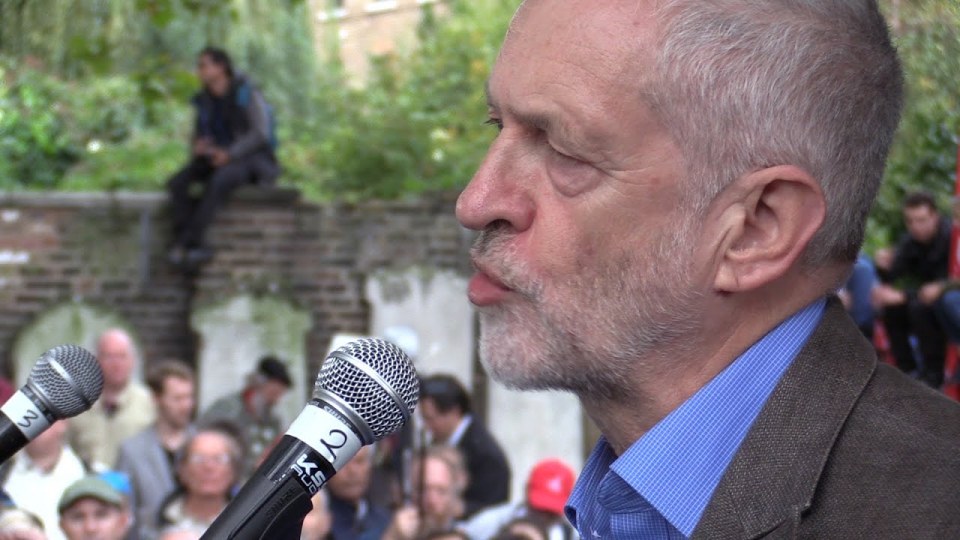 Jeremy Corbyn speaking at the 80th anniversary commemoration of the Battle of Cable Street in East London in 1936 that stopped Oswald Mosley’s fascists marching through the area
The demand that Labour adopt a contested definition of anti-semitism is not about some choice of words or about fighting racism. It is about breaking the left and progressive movements as a political force in Britain. This legal opinion by Hugh Tomlinson QC explains much of what is wrong with the IHRA “working definition” of anti-semitism.
There is also this excellent piece in the London Review of Books last year by former Court of Appeal judge Stephen Sedley. When we see what is seriously wrong with this definition and document the Labour leadership is under pressure to adopt, the wider purpose of the attacks and slurs becomes clear.
Among other points Sedley highlights this from the IHRA definition:
“Manifestations [of anti-semitism] might…
View original post 2,178 more words
 Bob Mouncer's blog