Home » Posts tagged 'asylum'
Tag Archives: asylum
Immigration policy Mahmood-style: no one is safe
In an earlier blog,[1] I explained the first steps in the UK’s new asylum and immigration policy announced by Home Secretary Shabana Mahmood last November. Her hostility to asylum seekers is clear in these proposals: she sees them as abusers of the asylum system. She declares (wrongly) that if you are an asylum seeker off a small boat arriving in Dover you are “illegal”. But her hostility doesn’t stop at asylum seekers. It is extended to recognised refugees and, as we shall see, to a whole range of other migrants.
A quick reminder of the story so far: after you have been granted asylum, you will only be given temporary protection for 30 months instead of the permanent protection offered under the old system. If, before the end of that period, you apply for an extension and the government decides, without consulting you, that you no longer need protection, you will be deported back to your country. If the government does decide that you still need protection, you will get it for another 30 months. You can apply for an extension four times, at a cost of £3,908.50 a throw. If the government eventually agrees that you still need protection, you will nevertheless not be able to apply for indefinite leave to remain (ILR), which gives you permanent status, until you have been here for 10 years (under the previous system it was five years). If you are receiving social security benefits you will have to wait longer (15 or 20 years) before you can apply for ILR.
If you think all this delay and uncertainty is harmful and destabilising to people already traumatised by the experiences that forced them to leave their home countries in the first place, you are right.[2] But Mahmood claims to have provided a solution: the Protection Work and Study Visa scheme. When we last saw this scheme,[3] it was up for consultation. Now the consultation process has ended. The scheme is being rolled out. Against the background of the current changes, it may seem to have one advantage: if you’re on a work-and-study visa, you may get a shorter qualifying period to ILR.[4] This sounds consistent with Mahmood’s claim that migrants are welcome here if they are willing to work and contribute to society. However, we should not take that claim at face value. We should remember that the government’s overriding aim as it introduces the new policy is to discourage all but the most determined (or, indeed, desperate) people from applying, not just for ILR, but for asylum in the first place. It hopes that people seeking safety will see the obstacles being erected and rule out coming here at all. Mahmood says this ploy works, that other European countries have tried it and asylum applications have fallen. She believes that applications must be made to fall in the UK too, and this is the way to do it. She doesn’t say what the solution is for those who need to flee their countries. But then none of her favourite European countries, including Denmark, Belgium and the Netherlands,[5] seem to address that question either.
Mahmood’s policy contradicts her claim that migrants are welcome if they’re ready to knuckle down and work. For one thing, the policy reduces the number of people allowed to work, regardless of the need for labour in any sector of the economy. For example, jobs counted as medium-skilled can no longer be sponsored unless the Migration Advisory Committee[6] recommends an exemption from the new rules, and unless “the industry demonstrates efforts to recruit domestically”.[7] The fact that the policy operates regardless of the need for labour is most clearly seen in the case of social-care workers (generally counted as low-skilled). They were urgently recruited during the Covid pandemic on a promise that, after five years of work in the sector, they would be able to apply for permanent settlement and bring their families here. That promise has now been broken. Indeed, employers can no longer recruit social-care workers from abroad at all: together with the reduction in the number of skilled jobs eligible for visa sponsorship, “overseas recruitment of social care workers also ended on 22 July 2025.”[8]
The government says that to do otherwise would be too costly. A Reuters report notes that between 2022 and 2024,
around 616,000 workers and their dependants moved to Britain on a specific visa for care workers, nurses and doctors. Around 384,000 are expected to become eligible for ILR between 2027 and 2029.[9]
The Home Office claims that, as a result, around 350,000 low-skilled workers and their dependants would cost about £10 billion in public services and benefits, including pensions, during their lifetimes.[10] Is this claim tenable? Not according to Jonathan Portes, Professor of Economics and Public Policy at King’s College, London. He described the estimate as “at best deliberately misleading”. The rule change would only save that amount if “every single person” modelled in the projection left the country.[11]
On the need for workers, the same report notes that:
job vacancies in the sector already stand at nearly three times the national average – a problem that can affect the running of the National Health Service when it cannot discharge patients into care homes, and a major challenge for Britain’s ageing population.[12]
But the government insists that “restricting foreign labour would force care homes to pay higher wages to attract local staff”.[13] At the time of blogging, however, there is no sign that care homes are ready to fulfil this fantasy. Meanwhile, “Britain’s ageing population” will continue to suffer.
Mahmood claims that she wants refugees on temporary core protection to move to the Protection Work and Study Visa route to ILR:
We want to encourage refugees to integrate more fully into the communities providing them sanctuary. To address this, we will encourage refugees to switch out of the Core Protection route wherever possible. We will introduce a new, in-country Protection Work and Study route. A person granted protection will be eligible to apply to move into this route if they obtain employment or commence study at an appropriate level and pay a fee. Once on this route, they will become eligible to “earn” settlement sooner than they would under core protection alone.[14]
It is difficult to see how refugees counted as medium or low skilled will be able to do that under the new scheme, either through employment or through study. Not only are there now increased employment restrictions on medium- and low-skilled migrants, but there are also tougher rules for universities if they want to sponsor students.[15]
However, these restrictions do not apply to all migrants. In particular they do not apply to those the government sees as having more to contribute to the UK, and who are also likely to be more affluent, than your average small-boat traveller. Take, for example, those who are eligible to apply for the Global Talent Visa. This visa has been created “for talented and promising individuals in the fields of science, digital technology and arts and culture wishing to work in the UK”.[16] According to the Home Office,
we are making it easier for top design talent to use the Global Talent visa and come to the UK. To do this, we are expanding the route to include a design pathway, covering additional design roles which are not currently catered for.[17]
Such individuals will not have to spend time worrying about temporary status. The Home Office reassures them:
There’s no limit to how long you can stay in the UK in total, but you will need to renew (“extend”) your visa when it expires. Each extension can last from 1 to 5 years – you choose how long you want the extension to be.[18]
For most migrants, however, this is an impossible dream.
Resistance
Mahmood’s changes to asylum and immigration policy have not gone unchallenged, even from within the Labour Party. A joint letter opposing the asylum changes was sent to Mahmood in January. It was signed by Neil Duncan-Jordan, the Labour MP for Poole, Andrea Egan, the General Secretary of the Unison trade union, and Doctor Gloria-Olivia Vicol, CEO of the Work Rights Centre. It was signed by 53 MPs, 21 peers and 33 civil society organisations. Duncan-Jordan, highlighting the care workers, said:
A Labour Government has lost its way when it’s making policy designed to chase Nigel Farage’s tail instead of doing what’s best for the country. I worked with migrant care workers for years as a trade unionist – they’re decent, hardworking people who do a challenging job in difficult conditions, often for low pay.[19]
He said the policy “pushes a struggling sector closer to crisis” and argued that the government “must not apply these changes to people already here – we punish those who have already built their home and their work around promises our government made them.”
In the next blog: Vanishing rights of appeal.
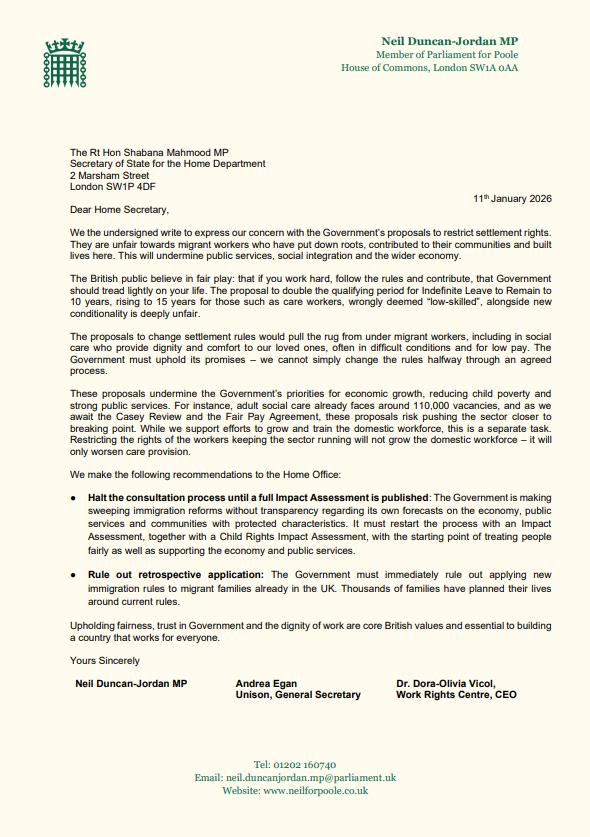
The first page of the letter to Mahmood.
[1]The new asylum regime: the first steps: https://bobmouncer.blog/2026/03/27/the-new-asylum-regime-the-first-steps/
[2] See my earlier blog for concerns expressed by others: The new asylum regime: the first steps, Concerns: The new asylum regime: the first steps « Bob Mouncer’s blog
[3]New and old hostilities: New and old hostilities « Bob Mouncer’s blog
[4] See New and old hostilities, Earn your keep: New and old hostilities « Bob Mouncer’s blog
[5] Restoring Order and Control: A statement on the government’s asylum and returns policy, Foreword from the Home Secretary, and para 2: Restoring Order and Control: A statement on the government’s asylum and returns policy (accessible) – GOV.UK
[6] The Migration Advisory Committee is a public body that advises the government on migration policy (see Migration Advisory Committee – GOV.UK).
[7] Changes to UK visa and settlement rules after the 2025 immigration white paper, House of Commons Library, 20 March 2026, section 1: Changes to UK visa and settlement rules after the 2025 immigration white paper – House of Commons Library
[8] Changes to UK visa and settlement rules after the 2025 immigration white paper, House of Commons Library, 20 March 2026, section 2: Changes to UK visa and settlement rules after the 2025 immigration white paper – House of Commons Library
[9] UK’s migration crackdown risks care home staffing crunch, 22 April 2026: UK’s migration crackdown risks care home staffing crunch | Reuters
[10] UK’s migration crackdown risks care home staffing crunch, 22 April 2026: UK’s migration crackdown risks care home staffing crunch | Reuters
[11] Cited, UK’s migration crackdown risks care home staffing crunch, 22 April 2026: UK’s migration crackdown risks care home staffing crunch | Reuters
[12] UK’s migration crackdown risks care home staffing crunch, 22 April 2026: UK’s migration crackdown risks care home staffing crunch | Reuters
[13]Cited, UK’s migration crackdown risks care home staffing crunch, 22 April 2026: UK’s migration crackdown risks care home staffing crunch | Reuters
[14] Restoring Order and Control: a statement on the government’s asylum and returns policy, 21 November 2025: Restoring Order and Control: A statement on the government’s asylum and returns policy (accessible) – GOV.UK
[15] Changes to UK visa and settlement rules after the 2025 immigration white paper, 20 March 2026: Changes to UK visa and settlement rules after the 2025 immigration white paper – House of Commons Library
[16] Explanatory memorandum to the statement of changes in the Immigration Rules:Explanatory memorandum to the statement of changes in the Immigration Rules: HC 1691, 5 March 2026 (accessible) – GOV.UK
[17] Explanatory memorandum to the statement of changes in the Immigration Rules, para. 5.67: Explanatory memorandum to the statement of changes in the Immigration Rules: HC 1691, 5 March 2026 (accessible) – GOV.UK
[18] Apply for the Global Talent Visa: Apply for the Global Talent visa : Overview – GOV.UK
[19] “Neil Duncan-Jordan MP opposes Home Office planned changes”, Bournemouth Echo: Neil Duncan-Jordan MP opposes Home Office planned changes | Bournemouth Echo
No change from Labour, whatever the Observer says
The Observer article below welcomes Labour leader Keir Starmer’s statement on Labour’s approach to small boats, people smugglers, deportations and refugee policy generally. In contrast to the left’s view that there is little to “differentiate a possible future Labour government from the present Conservative one”, it claims to detect “a sharp dividing line between the government and Labour on asylum policy.” It says Labour is offering a humane, pragmatic and commonsense approach in contrast to the Tories’ populism and its “cruel, unworkable policy”.
The paper is right to say that the government has removed the right of all migrants who have arrived in small boats to claim asylum, when most of them would qualify for refugee status if they did; it is right to deplore the measures the government have introduced “to detain them until they can be deported to another country for their claim to be processed”; in the light of the government’s keenness to deport asylum seekers it deems to be “illegal”, the article is right to point out that no deportation deals have been achieved with any country except Rwanda (and the Supreme Court has yet to rule on the legality of that deal); it is also right to criticise the backlog the government has allowed to develop in the processing of asylum claims, so that “83% of claims made in 2018 had not been processed five years later”. The article is right to condemn the Tory policy package.
But the Observer is wrong to say that the “real difference” between Labour and the Tories is that Labour “would scrap the government’s unworkable and cruel detention and deportation policies, restoring the right of people to claim asylum in the UK.” It will do this, the Observer seems to believe, by investing in “1,000 extra case workers and a returns unit of 1,000 staff to process claims much more quickly and deport those whose claims are rejected.” This would work because Labour would come to a deal with the European Union (EU) “in which the UK would accept a quota of refugees in exchange for being able to return those who cross the Channel in small boats.” But even if such a deal could be reached, we would still be left, under Labour, with the same old “detention and deportation” policy. None of the refugees in small boats will have their claims considered here. If the Observer thinks that shunting vulnerable and desperate people around Europe as they wait for decisions on their future is what it calls “a far better approach”, so be it. The refugees may not agree. Moreover, in the same article, the Observer admits that “pan-European cooperation has never worked well in the bloc and has broken down further in recent years.” The Observer must know it’s clutching at straws.
But there is one thing Starmer has to do before we can believe in this tale of “differentiation” between Labour and the Tories on asylum. He has to commit the Labour Party to repealing the Illegal Migration Act 2022. While the Act remains, Tory policy remains unchanged. Unless it is repealed, there can be no “differentiation” between the parties. In its guidance to the Act, the government makes clear that
anyone arriving illegally in the United Kingdom will not have their asylum claim, human rights claim or modern slavery referral considered while they are in the UK, but they will instead be promptly removed either to their home country or to a safe third country to have their protection claims processed there. (https://www.legislation.gov.uk/ukpga/2023/37/notes/division/3/index.htm)
Obviously the Act must be repealed. But both Starmer and shadow immigration minister Stephen Kinnock have refused to commit to repealing it. While it stands, so does the policy.
The article begins by setting the “Observer view” in the context of Starmer’s political approach as a whole. Keir Starmer, it says,
has made clear that under his leadership a first-term Labour government would stick to tough fiscal rules, and has ruled out making any unfunded spending commitments in the run-up to the next election. That has fuelled criticism from some on the left of his party, who argue that this has limited the extent to which he has been able to differentiate a possible future Labour government from the present Conservative one.
It says Starmer’s asylum policy makes Labour different. It doesn’t.
What that means for our voting intentions next year is up to us all. But it puts a very big strain on mine.
“The Secretary of State [still] doesn’t believe you”
Read this Guardian article: it describes the UK asylum process at its most crucial point (the asylum interview, when individuals are given their main chance to explain why they are seeking asylum). It says that “many asylum interviews are rushed, biased and resolved by ‘cut and paste’ decisions.”
The article contains little that wasn’t known before – but these facts don’t often get publicly aired. The research I did between 2004 and 2009 on the treatment of asylum seekers is now out of date in many ways: it couldn’t have taken into account the upsurge in migration of more recent years, when people struggled across continents, many drowning in the Mediterranean. So to that extent it is out of date. But the story that emerges from this article of how asylum decisions are made today hasn’t changed since I wrote. The treatment of asylum seekers by the Home Office is cynical, ignorant, cruel and shameful. I will focus on just a few of the points raised in the article.
Because of the pressure from Home Office targets (“225 interviews or decision reports a year”), one former caseworker says: “You would have your own stock paragraphs that you put into refusal minutes.” Caseworkers say to themselves, “I’ll just sort of cut and paste the decision I did last week.” This is certainly common practice. But I see it not just as a desperate attempt by the caseworker to “get the job done”, but also as part of the structure of the asylum system. The Home Office gives this cut-and-paste approach official encouragement with its own stockpile of paragraphs which caseworkers are encouraged to use routinely when compiling their reports. So it is not enough for us to find fault with individual caseworkers or for caseworkers to blame themselves. Here is one of the Home Office’s ready-made paragraphs intended to help caseworkers in their task of refusing claims:
Further doubts as to your alleged fear of persecution can be drawn from the fact that you did not leave [COUNTRY] until [DATE]. The Secretary of State holds the view that if your fear of persecution by the [COUNTRY] authorities was genuine you would have left [COUNTRY] at the earliest opportunity and the fact that you did not casts doubt on your credibility.
Of course, many reasons may govern the timing of a refugee‘s departure: the need to find an agent, raise funds to pay the agent (e.g. by selling property), obtain false documents. Even if the journey is through normal channels there will be family concerns which cause delay. Moreover, members of opposition groups committed to political change do not tend to give up their cause easily and may maintain their activism until the last moment. But the cut-and-paste approach discourages any attempt to take these considerations seriously and tends to assume the asylum seeker’s guilt. So an Ethiopian asylum seeker was told that because he had been arrested in January but didn’t leave until May, this delay “detracts from the truthfulness of your claim to be a genuine asylum seeker.”
I met an asylum seeker from Iran who was treated in a similar way. Reza (not his real name) was a member of a political party whose members suffered persecution. After a demonstration in July 2000, during which one of his friends was killed and another went missing, his house was raided by the police and his father-in-law taken in for questioning, Reza and his wife Maryam went into hiding and a senior party member “advised me to get out of Iran if I could”. Even then he hesitated: “I had a family in Iran, I had a lot of property in Iran, I did not want to leave. But I was frightened for my safety.” None of this was unreasonable or slow. In the event he made the arrangements quite quickly – financial and travel arrangements, false passports – and left in September. Unfortunately, none of this impressed his caseworker, who insisted that his departure was tardy: “The Secretary of State holds the view that if your fear of persecution by the Iranian authorities were genuine, you would have left Iran at the earliest opportunity, and the fact that you did not do so casts doubt upon your credibility”, which happens to match exactly the wording of the prepared paragraph from the Home Office stockpile quoted above.
The article mentions transcripts of asylum interviews where “it was evident the caseworker knew very little about the case”, in the context of the pressure to meet the targets, and that was no surprise to me. But pressure to meet targets is not the only worry we should have here: I found that the ignorance of the caseworker often stemmed from Home Office Country Information reports which frequently lacked certain kinds of information entirely or were out of date. Ignorance is a feature of the system. What happens if an asylum seeker claims persecution because of membership of a political party but the party is not mentioned in the Country Report? One caseworker told researchers in 2003:
We need to know whether particular groups or political parties exist, but instead we are told to say that the Secretary of State is not aware of this group so therefore it is unlikely to be of interest to the authorities. But really they have no information on whether the group existed.
This ignorance is then turned into a denial of the asylum seeker’s credibility. A Kurd from Syria was told in his refusal letter:
The basis of your claim is that you fear persecution in Syria because of your political beliefs. You are a member of the Hergirtin. The Secretary of State is not aware that this party actually exists.
Asylum application refused. But, on appeal, the adjudicator discovered that Amnesty International knew of the party’s existence and its long history. Appeal allowed. The Syrian Kurd probably had a good solicitor who had done the necessary research. Not everyone is as lucky by any means and the caseworker (quoted in the article) was right to call the asylum process a “lottery”.
The article says there is a “culture of disrespect” among caseworkers and describes a culture in which jokes are made about asylum applicants, even going so far as to joke about them being tortured. I came across an early example of canteen culture in my research, where an Afghan asylum seeker had clearly been the butt of cynical jokes about his claim, ending in a spoof letter which declared his asylum claim “a pile of pants”. This version of the refusal letter was accidentally sent to his solicitor. According to The Guardian,
Naomi Nicholson, a case worker with the Refugee Legal Centre … had to explain the meaning of the letter to her client … “I was trying to paraphrase the letter starting from the top, but when I got to the fourth paragraph I didn’t know what to say, I was so shocked,” Ms Nicholson said. “I was very embarrassed. It was my country that was saying this to him.” Immigration staff tried to replace the letter with a hurriedly amended one that merely states “the Secretary of State is not satisfied that you have established that you are an Afghan national.”
I could go on, but this is enough. But just to end: anyone who gets frustrated with the sight and sound of Theresa May or Jeremy Hunt answering every question about the NHS with the mantra: “This government has provided more money, more doctors, more nurses, more everything than any previous government …” will understand my frustration at seeing another worn-out phrase near the end of the article: “The UK has a proud history”, says the Home Office, “of providing protection to those who need it.” I have seen and heard this phrase more times than I’ve had hot dinners. It does not reflect the reality of many an asylum seeker’s experience. Neither does the other phrase deployed by Her Majesty’s civil servants in the name, and with the permission, of their Secretaries of State: all asylum claims are “dealt with on their merits”. That was the title of my thesis when I finished my research. But I put a question mark at the end.
Read the article.
 Bob Mouncer's blog