The hostile environment: Labour’s response
In the first blog in this series (https://bobmouncer.blog/2025/03/22/hostile-environment-the-windrush-scandal-i/), I showed how the announcement of a “hostile environment” for migrants by UK Home Secretary Theresa May in 2012 led to suffering and trauma for thousands of people, the Windrush generation. In the second blog (https://bobmouncer.blog/2025/03/26/hostile-environment-the-windrush-scandal-ii/), I told the story of Hubert Howard, who was one of its victims. In the third blog (https://bobmouncer.blog/2025/03/30/hostile-environment-the-windrush-scandal-iii/), I showed how documents that could have prevented the disaster to Hubert and thousands of others were deliberately destroyed; I described how the scandal slowly emerged and the government’s obstinate refusal to roll back on the policy; and I showed how a compensation scheme was finally devised and how it failed so many Windrush victims. In the last blog (https://bobmouncer.blog/2025/04/02/hostile-environment-the-mediterranean-scandal/) I described the Mediterranean scandal, in which the EU, including the UK, stopped rescue operations in the Mediterranean and how a UK government tried to deny its responsibility for the ensuing tragedy.
In this blog, I examine Labour’s response to the hostile environment.
Labour’s response
The two major scandals examined in my previous blogs in this series unfolded, first, under a Tory/LibDem coalition government and then under the subsequent Tory government. But what was Labour’s response to May’s hostile environment? Maya Goodfellow describes it as “the most minimal resistance”.[1] Labour, the official opposition, abstained in the final Commons vote on the Immigration Bill. Sixteen MPs voted against it, but only six of them were Labour MPs: Diane Abbott, Kelvin Hopkins, John McDonnell, Fiona Mactaggart, Dennis Skinner and Jeremy Corbyn. Corbyn said the Bill was
dog-whistle politics, the mantras being that every immigrant is an illegal immigrant who must somehow be condemned, and that immigration is the cause of all the problems in our society … If we descend into a UKIP-generated xenophobic campaign, it weakens and demeans all of us and our society, and we are all the losers for that.[2]
One of the other MPs was Sarah Teather, a LibDem MP and former minister, who had told The Guardian in 2013 that the proposals in the Bill were “hewn from the same rock” as earlier welfare cuts, much of which were “about setting up political dividing lines, and trying to create and define an enemy”.[3] But apart from the six rebels, Labour MPs obeyed their leader, Ed Miliband, and the Labour whips, and abstained in the Commons vote.
By October, Miliband had moved further right. In a by-election campaign in the Rochester and Strood constituency, which UKIP was hoping to win, Miliband declared he would toughen immigration policy if Labour won the general election in May the following year.[4] Echoing Theresa May, he raised familiar spectres and fears about immigration, ignoring its advantages. The UK, he said, “needs stronger controls on people coming here” and promised a new immigration reform Act if he became Prime Minister. His message was:
- If your fear is uncontrolled numbers of illegal migrants entering the country, Labour will crack down on illegal immigration by electronically recording and checking every migrant arrive in or depart from Britain
- If your fear is of widespread migrant benefit fraud, Labour will make sure that benefits are linked more closely to workers’ contributions
- If the spectre that haunts you is, as Margaret Thatcher had put it, that immigrants were bringing an “alien culture” to Britain, Labour understands, and will ensure that migrants integrate “more fully” into society
- Miliband turned his attention to the EU. Arguments about Britain’s EU membership were coming to a head at this time, with both the Tory right and UKIP agitating for the UK to leave. In 2013, Prime Minister David Cameron had agreed to renegotiate Britain’s terms of membership. The renegotiation would be followed by an in/out referendum to take place after the 2015 general election. Miliband, in his by-election speech in 2014, included migration from the EU in his new immigration promises. He claimed that Labour under Tony Blair had wrongly opened the UK to Eastern Europeans when their countries had joined the EU in 2004. He would not let that happen again. If he won the 2015 election, there would be longer “transitional controls” for new EU members before they could move to Britain.
He even told the voters of Rochester and Strood that they didn’t need to vote for UKIP to get these policies: Labour would do the job.
One pledge seemed at first sight to be protective of migrants. Miliband said he wanted to ensure that migrants were not exploited by employers. However, this was, in fact, a reference to another fear – that migrant workers undercut native workers’ wages because bosses often pay lower wages to migrants (often below the minimum wage). However, where this problem exists, its solution lies not in immigration law but in employment law and its enforcement. It also lies in union recognition and legally binding agreements.
As promise followed promise and pledge followed pledge, Miliband began to sound like Theresa May. A few months later, as the 2015 election approached, Labour’s campaign included the issuing of mugs with “Controls on immigration” printed on them.
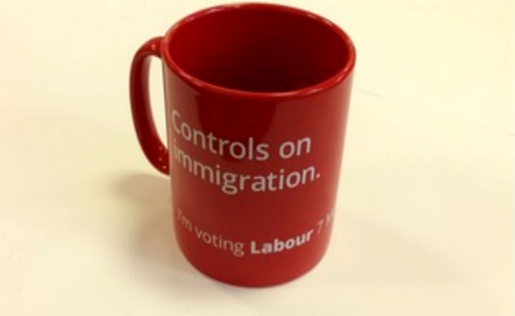
Labour’s immigration controls mug
None of this saved Miliband or his party, and the Tories won the 2015 election; the referendum vote in 2016 in favour of leaving the EU led to David Cameron’s resignation as Prime Minister; he was succeeded by Theresa May; Ed Miliband resigned as Labour leader; Jeremy Corbyn was elected in his place; the process of leaving the EU began. In 2017, Theresa May called another general election, hoping to increase her majority. In the event, the Tory party lost its small overall majority but won the election as the largest single party. But from then on it had to rely on Democratic Unionist Party (DUP) votes to get its business through the Commons.
These parliamentary changes meant nothing for the Windrush generation. The scandal began to come to light in 2017 but their suffering continued beyond the end of the decade, one of the main reasons being that the compensation scheme was seriously flawed. This remained a problem in April 2025, almost a year after the election of a Labour government. The Parliamentary and Health Service Ombudsman (PHSO), Rebecca Hilsenrath, had found that
further harm and injustice are still being caused by failings in the way the scheme is working. We found recurrent reasons for this, suggesting these were not one-off issues but systemic problems.[5]
In response, the Home Office sought to give some reassurance:
This government is committed to putting right the appalling injustices caused by the Windrush scandal and making sure those affected receive the compensation they rightly deserve.[6]
Nevertheless, given the Home Office’s record, we should hesitate before we are reassured. In 2020, the Williams review of the Windrush scandal had made 30 recommendations to the government, all of which were accepted by Priti Patel, Tory Home Secretary at the time. In January 2023, the Home Office unlawfully dropped three of them.[7] Moreover, the department prevented the publication of a report prepared in response to the Williams Review. Williams had said that Home Office staff needed to “learn about the history of the UK and its relationship with the rest of the world, including Britain’s colonial history, the history of inward and outward migration and the history of black Britons.” As a result, the Home Office commissioned an independent report: The Historical Roots of the Windrush Scandal. In the words of Jim Dunton, the report
lays much of the blame for the Windrush scandal on essentially racist measures introduced to restrict the ability of Commonwealth citizens to move to the UK in the years since the second world war.[8]
The report has been available internally since 2022 but, writes Dunton, “the department resisted attempts for it to be made publicly available, including rejecting repeated Freedom of Information Act requests and pressure from Labour MP Diane Abbott.” Then, in early September 2024, after a legal challenge was launched,
a First Tier Tribunal judge ordered the document’s publication, quoting George Orwell’s memorable lines from 1984: “Who controls the past controls the future. Who controls the present controls the past.”[9]
So the Home Office, reluctantly, made the report publicly available, and I will refer to its findings in future blogs. But it is not yet time to take Home Office reassurances at face value. Or Labour’s reassurances, come to that.
In future blogs: more on Labour’s record on immigration and race; and the necessary exposure of a long-standing myth.
[1] Goodfellow, M. (2019), Hostile Environment: How immigrants became Scapegoats, Verso Books, London, loc. 167.
[2] Jack Peat, “Just 6 Labour MPs voted against the 2014 Immigration Act”, The London Economic, 19/04/2018:
[3] Decca Aitkenhead, “Sarah Teather: ‘I’m angry there are no alternative voices on immigration’.”, The Guardian, 12 July 2013.
[4] Andrew Grice, “Ed Miliband attempts to take on Ukip – with toughened immigration policies”, The Guardian, 24 October 2014: Ed Miliband attempts to take on Ukip – with toughened immigration policies | The Independent | The Independent
[5] Adina Campbell, “Payments for Windrush victims denied compensation”, BBC News, 5 September 2024: Payments for Windrush victims denied Home Office compensation – BBC News
[6] Ibid.
[7] Ashith Nagesh & André Rhoden-Paul, “Home Office unlawfully axed Windrush measures”, BBC News, 19 June 2024: Windrush Scandal: Home office unlawfully axed recommendations, court rules – BBC News
[8] Jim Dunton, “Home Office publishes internal ‘roots of Windrush’ report after FoI battle”, Civil Service World, 27 September 2024: Home Office publishes internal ‘roots of Windrush’ report after FoI battle
[9] Ibid.
Hostile environment: the Mediterranean scandal
In the first blog in this series (https://bobmouncer.blog/2025/03/22/hostile-environment-the-windrush-scandal-i/), I showed how the announcement of a “hostile environment” for migrants by UK Home Secretary Theresa May in 2012 led to suffering and trauma for thousands of people, the Windrush generation. In the second blog (https://bobmouncer.blog/2025/03/26/hostile-environment-the-windrush-scandal-ii/), I told the story of Hubert Howard, who was one of its victims. In the third blog, I showed how documents that could have prevented the disaster to Hubert and thousands of others were deliberately destroyed; I described how the scandal slowly emerged and the government’s obstinate refusal to roll back on the policy; and I show how a compensation scheme was finally devised and how it failed so many Windrush victims. In this blog, I tell how another scandal erupted involving the UK government, though this time it was an EU-wide scandal. It was, however, perfectly in line with the UK’s hostile environment policy toward migrants. It should be counted as part of it.
The Mediterranean scandal
David Cameron and Theresa May were part of another immigration scandal, though they were not the only ones involved. In October 2014, Italy brought its routine search-and-rescue operations (called Mare Nostrum) to an end. The scheme rescued migrants crossing the Mediterranean Sea from Libya, most of them in unseaworthy boats. In the 12 months between October 2013 and October 2014, according to the Commons Home Affairs Select Committee, “Mare Nostrum saved 100,000 lives, but the Italian Government could not afford to maintain the operation at the cost of €9 million a month”[1] and had, for some time, been pressing the EU (which still included the UK as a member-state) to play a larger role in the operation. When Mare Nostrum came to an end, the EU’s response was to replace the Italian scheme with its own much more limited scheme, Triton. The difference between the two schemes was that Mare Nostrum undertook “a proactive search and rescue operation across 27,000 square miles of sea”[2] whereas, under Triton, the EU simply operated a coastguard patrol that reached out no further than 12 miles from the coast. Routine search-and-rescue operations were over. The EU argued that the search-and-rescue operations represented a “pull factor” for migrants: they attempted the dangerous crossing because they thought they would be rescued if they got into difficulties.
The Home Office carefully sheltered under the EU roof as officials sought to justify the removal of search and rescue: “Ministers across the EU”, the Home Office said,
have expressed concerns that search-and-rescue operations in the Mediterranean … [are] encouraging people to make dangerous crossings in the expectation of rescue. This has led to more deaths as traffickers have exploited the situation using boats that are unfit to make the crossing.[3]
One year later, Cameron and his Deputy Prime Minister Nick Clegg (leader of the Liberal Democrats), admitted that Triton was flawed. As the EU had scaled back the search-and-rescue operations to no more than coastguard patrols, hundreds more people had died. Then, after two disasters in quick succession in which a total of 1,200 people had died, Cameron declared that the plan to reduce crossings and deaths was “not successful”. He then sought to distance himself from it as much as possible by stressing the EU’s role as if it had nothing to do with him: the decision to stop search and rescue, he said,
was made by the EU and Italy as well. They found at some stage it did look like more people were taking to boats. So they, the EU, decided to end that policy and have a coastguard policy. That hasn’t worked either.[4]
It is worth noting that the decision to stop search and rescue was not a joint decision between Italy and the EU: the decision was at first made, as we have seen, by Italy alone on grounds of cost.[5] Nevertheless, the EU’s earlier unwillingness to play a larger role contributed to Italy’s decision.
Like Cameron, Nick Clegg also managed to distance himself from the policy in an attempt to avoid blame being attached to him or his party: he too claimed the decision to stop search and rescue was taken by “the EU”. He also claimed credit for the Liberal Democrats, who had, he said, called for an urgent review of “the EU’s policy”:
The EU’s decision to end routine search-and-rescue operations in the Mediterranean last year was taken with good intentions. No one expected the number of deaths to fall to zero, but there was a view that the presence of rescue ships encouraged people to risk the crossing. That judgment now looks to have been wrong. That’s why the Liberal Democrats have called for an urgent review of the EU’s policy …[6]
Once the consequences of the removal of search and rescue had become clear and public, the EU rolled back on the disastrous “coastguard patrols only” policy: it introduced a new search-and-rescue policy and Cameron pledged ships and helicopters and ordered the Royal Navy flagship HMS Bulwark to Malta to join the operations. This was a U-turn and it involved a significant change in the government’s language: its policy in the Mediterranean was now about “rescuing these poor people” rather than depicting them as reckless and foolish migrants.[7] But by June that year it was announced that the deployment of HMS Bulwark was being reviewed, which raised the question that, if it was to be withdrawn, would it be replaced? On 17 June, Labour MP Hilary Benn asked Chancellor George Osborne, who was standing in for Cameron at Prime Minister’s Questions in the Commons:
… we learned yesterday that [HMS Bulwark’s] deployment is under active review. Having made a grave error last October in withdrawing support from the Mare Nostrum search and rescue operations, will the right hon. Gentleman assure the House that the Government will continue to save the lives of those in peril on that sea?[8]
Osborne replied that “no one should in any way doubt Britain’s determination to play its role in helping with this situation”:
Taking people out of the water and rescuing them is essential – we are a humanitarian nation and we need to deal with those issues – but, in the end, we must break the link that enables someone to get on a boat and then claim asylum in Europe and spend the rest of their lives on the European continent.[9]
The government’s priorities became clearer on 22 June when Defence Secretary Michael Fallon announced that HMS Bulwark (19,000 tonnes, 176 metres long; 3,000 lives saved, according to government figures[10]) was to be replaced by HMS Enterprise (3,700 tonnes, 90.6 metres long, able to hold up to 120 people; part of the government’s “intelligence-led effort” to solve the crisis).[11] Despite this obvious reduction in search-and-rescue capacity and the priority it was given, Downing Street said that HMS Enterprise would be gathering intelligence “while continuing to rescue people as necessary”. However, one month later Enterprise had “not rescued any migrants since deploying to the Mediterranean to support the common security defence policy operation”.[12] So “rescuing these poor people” had apparently ceased to be “absolutely essential” and had given way to intelligence gathering. From now on, intelligence would be gathered while search-and-rescue operations vanished entirely.
[1] Migration Crisis (2015), Report by the Commons Home Affairs Select Committee, paras. 79-81: House of Commons – Migration Crisis – Home Affairs Committee (parliament.uk)
[2] Home Affairs Committee, House of Commons, Migration Crisis:
[3] Alan Travis, “Home Office defends decision for UK to halt migrant rescues”, The Guardian, 28 October 2014.
[4] Rowena Mason, “Cameron and Clegg admit axing search and rescue in Mediterranean has failed”, The Guardian, 22 April 2015: Cameron and Clegg admit axing search and rescue in Mediterranean has failed | Immigration and asylum | The Guardian
[5] Home Office minister James Brokenshire confirmed this in an answer during an urgent question in the House of Commons, when a Tory MP had suggested that the EU had withdrawn support from Mare Nostrum: ”To be clear, the EU is not withdrawing anything. Mare Nostrum is an Italian initiative. It is supported by the Italian navy, and ultimately decisions will be taken by the Italian Government.” (Refugees and Migrants (Search and Rescue Operation) (Urgent Question), col. 404, 30 October 2014: Refugees and Migrants (Search and Rescue Operation) – Hansard – UK Parliament
[6] Nick Clegg, “The solution to the deaths in the Mediterranean lies on land, not at sea”, The Guardian, 22 April 2015: The solution to the deaths in the Mediterranean lies on land, not at sea | Nick Clegg | The Guardian
[7] Ian Traynor, “European leaders pledge to send ships to Mediterranean to pick up migrants”, The Guardian, 23 April 2015: European leaders pledge to send ships to Mediterranean to pick up migrants | European Union | The Guardian
[8] Commons Hansard, “Prime Minister’s Questions”, 17 June 2015, col. 312: House of Commons Hansard Debates for 17 Jun 2015 (pt 0001) (parliament.uk)
[9] Ibid.
[10] HMS Enterprise to replace HMS Bulwark in the Mediterranean, Ministry of Defence: HMS Enterprise to replace HMS Bulwark in the Mediterranean – GOV.UK (www.gov.uk)
[11] Ibid.
[12] Alan Travis, “HMS Bulwark’s replacement yet to rescue any migrants in Mediterranean”, The Guardian, 27 July 2015HMS Bulwark’s replacement yet to rescue any migrants in Mediterranean | Migration | The Guardian:
 Bob Mouncer's blog