Hostile environment: the Windrush scandal III
The first blog in this series (https://bobmouncer.blog/2025/03/22/hostile-environment-the-windrush-scandal-i/), I showed how the announcement of a “hostile environment” for migrants by UK Home Secretary Theresa May in 2012 led to suffering and trauma for thousands of people, the Windrush generation. In the second blog (https://bobmouncer.blog/2025/03/26/hostile-environment-the-windrush-scandal-ii/), I told the story of Hubert Howard, who was one of its victims. In this third blog, I show how documents that could have prevented the disaster to Hubert and thousands of others were deliberately destroyed. I describe how the scandal slowly emerged and the government’s obstinate refusal to roll back on the policy; and I show how a compensation scheme was finally devised and how it failed so many Windrush victims.
Sabotage?
The passports held by the Windrush arrivals in 1948, and by those who arrived in subsequent years, eventually expired, and many were never renewed and were later lost. Moreover, many of the children who travelled with their parents did so on their parents’ passports and subsequently had none of their own. This did not pose any problems – until they were asked to provide documentation to prove their status. The government refused to accept work records, tax and National Insurance or NHS records as evidence of citizenship. Yet if a lack of passports was the problem, there were other documents that could have been used to solve it: the landing cards completed by the Windrush passengers during their voyage, which they presented to immigration staff on arrival, The cards had been carefully collected and eventually stored in a basement room at the Home Office. According to BBC News, they were later “used by officials to help subsequent generations to prove they had a right to remain in the UK.”[1] But, in 2010, the Home Office destroyed them.[2] Once they were destroyed, members of the Windrush generation and their descendants discovered they had no way of proving their legal status.
Passing the buck
The decision to physically destroy the landing cards was taken in October 2010, under the Tory/LibDem coalition government when Theresa May was Home Secretary. In April 2018, however, when she was Prime Minister, she was questioned about the decision by Jeremy Corbyn in the House of Commons:
Corbyn: “Did the Prime Minister – the then Home Secretary – sign off that decision?”
May: “No. The decision to destroy the landing cards was taken in 2009 under a Labour government.”[3]
May had avoided the question, which was about her responsibility for the 2010 decision to physically destroy the landing cards. Instead, attempting to put the blame on Labour, she diverted attention to what seems to have been the original decision-in-principle, taken in 2009.[4] According to the Home Office, that decision was an administrative decision taken in the context of the digitalisation of Home Office files. The UK Border Agency had approved a business case to get rid of paper records, including the cards.[5] Under the Data Protection Act 1998, personal information should only be kept for long periods if it is strictly necessary to do so. According to the UK Border Agency in 2018, its judgement in 2009 had been that “the information on the [boarding cards] was of limited value and not sufficient to justify continued retention.”[6] This judgement seems to have been made despite their proved usefulness in determining status.
So far, it looks as if these decisions were made by officials, behind closed doors, without the direct involvement of politicians. Indeed, while May was avoiding Corbyn’s question, her spokesperson in Downing Street helpfully claimed that the decision to actually do a destruction job on the landing cards in 2010 was also an “operational decision”, implying that Theresa May was not involved.[7] Not surprisingly, Labour politicians also hastened to deny any past involvement: Alan Johnson, Labour Home Secretary in 2009, said it was “an administrative decision”.[8] Johnson said he “had absolutely no recollection at all of being involved” in the landing cards decision.[9] Jacqui Smith, his predecessor at the Home Office until June of that year, said it was “not a policy decision she had made”.[10]
Doubts about politicians’ claims of innocence, however, were raised by Lord Kerslake, a former head of the civil service. He told BBC Newsnight that “the Borders Agency was effectively part of the civil service and it took its advice and direction from ministers.”[11] It was, he said, “pretty unlikely” that the Home Office would destroy records. “But the truth is we don’t know,” he said. “We need to investigate this in more detail to understand what happened.” Nevertheless, whoever was ultimately responsible, irreversible decisions had been made, with dire consequences for the Windrush generation.
The gathering storm
The plight of the Windrush victims was slow to emerge. But public awareness grew, largely due to press reports about individuals. The Guardian began to publish the results of its major investigation in late 2017. In February 2018, the Jamaican High Commissioner in London, Seth George Ramocan, said, “In this system one is guilty before proven innocent rather than the other way around,” and joined with other Caribbean diplomats in calling on the government to be “more compassionate”.[12] There was widespread anger at the plight of Albert Thompson when he was denied cancer treatment. On 21 March, at Prime Minister’s questions in the House of Commons, Theresa May refused to intervene in his case, saying it was the responsibility of the hospital to make the decision. About Albert himself she said he needed to “evidence his settled status in the UK.”[13] May insisted on this despite mounting evidence that none of these people had ever been “illegal migrants” and despite the disastrous consequences of the hostile environment policy on all its Windrush generation victims.
On 15 April 2018, during the Commonwealth Heads of Government Meeting (CHOGM) in London, Downing Street refused a formal request by the High Commissioners of 12 Caribbean Commonwealth countries for a meeting between their heads of government and Theresa May to discuss the Windrush scandal.[14] Pressure on the government increased and Home Secretary Amber Rudd apologised in the House of Commons for the way people had been treated. Bizarrely, she blamed Home Office officials for being too focused on policy. They had, she said, forgotten the importance of the individual.[15] The next day, May made an unconvincing – indeed, confusing – apology to the Caribbean leaders gathered at the summit. She told them her government was not “clamping down on Commonwealth citizens”. It was all the fault of the new rules (which she herself had introduced) which had “resulted in some people, through no fault of their own, now needing to be able to evidence their immigration status.” She did not, however, offer to abolish those rules or to roll back on her demand that Albert Thompson should “evidence his settled status in the UK”. Instead, she declared that “the overwhelming majority of the Windrush generation do have the documents that they need, but we are working hard to help those who do not.”[16] None of these apologies and promises would make any difference to the Windrush victims.
Smoke and mirrors
Amber Rudd resigned as Home Secretary two weeks later, after denying knowledge of Home Office deportation targets, some of which she had herself proposed to Theresa May. On 30 April, Sajid Javid, her replacement as Home Secretary, gave the hostile environment a new name. He explained:
I don’t like the phrase hostile. So the terminology is incorrect and I think it is a phrase that is unhelpful … [The policy] is about a compliant environment and it is right that we have a compliant environment.[17]
This word game was meaningless. It was an exercise in smoke and mirrors in which nothing changed: the Windrush victims were still “illegal”, with “no right to be here”. Like Theresa May and Amber Rudd before him, Javid wanted to maintain a hostile environment. Giving it a new name did nothing for its victims, who had been legal and “compliant” since the day they arrived in the country – or, in the case of their descendants, since the day they were born. Javid pledged to “do whatever it takes to put [the situation] right”; he even claimed that because of his own Asian background[18] he was “personally committed to and invested in resolving the difficulties faced by the … Windrush generation.”[19] But he gave no sign the policy would change in anything other than its meaningless new name. As Labour MP Stella Creasy tweeted while he was still answering questions in the House of Commons:
Just told the new Home Secretary whether he calls it compliant or hostile, it’s deeds not words that matter in how he treats Windrush generation.[20]
Compensation
The details of the Windrush scandal began to emerge in 2017. The Windrush Scheme, established in 2018. enabled more than 13,800 victims of the scandal to receive documentation confirming their legal status as citizens. But they had received no compensation for their unjust treatment, and the ruin it had brought to their lives. But in 2019 the Windrush Compensation Scheme seemed to promise some redress to the Windrush generation. Unfortunately, as the Commons Home Affairs Select Committee reported in December 2021, “instead of providing a remedy, for many people the Windrush Compensation Scheme has actually worsened the injustices faced as a result of the Windrush scandal.”[21] For one thing, the Home Office seemed unable to decide how many victims there were. The Committee reported that “four years after the Windrush scandal broke, the Government does not have a confirmed figure for the total number of people affected.”[22] The Home Office’s original assessment was that there would be 15,000 eligible claims. But in February 2020 a “revised impact assessment” was given which reduced the number to 11,500. In July 2021, the Home Secretary announced another reduction: now the numbers were somehow between 4,000 and 6,000. The reasons for this reduction were unclear, based as it was on “information from the Windrush Scheme and the Windrush Compensation Scheme, but also using some judgement where information is limited.”[23] The meaning of “using some judgement” is not clear. The Committee identified “a litany of flaws in the design and operation of the Windrush Compensation Scheme.”[24] The scheme placed “an excessive burden on claimants to produce documentary evidence of the losses they suffered.”[25] This obsession with documentation, or the lack of it, was the same obsession that denied its victims citizenship status in the first place. Clearly no lessons had been learned in the intervening period. There were also “long delays in processing applications and making payments, and inadequate staffing of the scheme; a failure to provide urgent and exceptional payments to individuals in desperate need.”[26] There were delays in supporting grassroots campaigns designed to reach eligible claimants. Given the nature of the Windrush scandal as a consequence of the hostile environment policy, we should not assume the Home Office’s goodwill or trust its changing numbers. Moreover, on the question of numbers, many thousands suffered from the effects of having their citizenship status wrongly denied and, not surprisingly, attention has tended to focus on the Caribbean Windrush generation. But, the Committee noted,
people from other Commonwealth and non-Commonwealth countries have also been affected. The children and grandchildren of people who could not evidence their lawful status have also faced difficulties.[27]
The Committee summarised the failure of the Windrush Compensation Scheme as of November 2021:
Our inquiry found that the vast majority of people who have applied for compensation have yet to receive a penny: for some, the experience of applying for compensation has become a source of further trauma rather than redress, and others have been put off from applying for the scheme altogether. We are deeply concerned that as of the end of September, only 20.1% of the initially estimated 15,000 eligible claimants have applied to the scheme and only 5.8% have received any compensation. It further compounds the Windrush scandal that twenty-three individuals have died without receiving compensation for the hardship they endured.[28]
By June 2023, 34 had died. The Committee also noted that “the design and operation of this scheme contained the same bureaucratic insensitivities that led to the Windrush scandal in the first place.” This was, it said, “a damning indictment of the Home Office, and suggests that the culture change it promised in the wake of the scandal has not yet occurred.”[29]
But the Windrush scandal was not the only scandal of the hostile environment. David Cameron and Theresa May were part of another scandal that emerged from the policy, one which also caused immense suffering and was responsible for many deaths. More of that in the next blog.
[1] “Windrush Investigation urged over landing cards”, BBC News, 19 April 2018: Windrush: Investigation urged over landing cards – BBC News
[2] Windrush: Theresa May hits back at Labour over landing cards”, BBC News, 28 April 2018 Windrush: Theresa May hits back at Labour over landing cards – BBC News
[3] Cited, Liz Bates, “Decision to destroy Windrush landing documents taken under Labour, insists Theresa May” PoliticsHome, 18 April 2018: Decision to destroy Windrush landing documents taken under Labour, insists Theresa May
[4] Windrush: Theresa May hits back at Labour over landing cards”, BBC News, 28 April 2018 Windrush: Theresa May hits back at Labour over landing cards – BBC News
[5] “Who destroyed the Windrush landing cards?”, Channel 4 News FactCheck: FactCheck: who destroyed the Windrush landing cards? – Channel 4 News
[6] Ibid.
[7] Ibid.
[8] “Windrush: Alan Johnson says landing cards decision was made in 2009”, BBC News, 20 April 2018: Windrush: Alan Johnson says landing cards decision was made in 2009 – BBC News
[9] Windrush: Theresa May hits back at Labour over landing cards”, BBC News, 28 April 2018 Windrush: Theresa May hits back at Labour over landing cards – BBC News
[10] Ibid.
[11] “Windrush Investigation urged over landing cards”, BBC News, 19 April 2018: Windrush: Investigation urged over landing cards – BBC News
[12] Gentleman, A., “Caribbean diplomats ask UK for more compassion for citizens”, The Guardian, 22 February 2018: Caribbean diplomats ask UK for more compassion for citizens | Immigration and asylum | The Guardian
[13] Gentleman, A., “Windrush U-turn is welcome, but May’s policy was just cruel”, 16 April 2018: Windrush U-turn is welcome, but May’s policy was just cruel | Immigration and asylum | The Guardian
[14] Gentleman, A. “No 10 refuses Caribbean request to discuss children of Windrush”, The Guardian, 15 April 2018: No 10 refuses Caribbean request to discuss children of Windrush | Commonwealth immigration | The Guardian
[15] Gentleman, A., “The week that took Windrush from low-profile investigation to national scandal”, The Guardian, 20 April 2018. The week that took Windrush from low-profile investigation to national scandal | Commonwealth immigration | The Guardian
[16] “Windrush generation: Theresa May apologises to Caribbean leaders”, BBC News, 17 April 2018: Windrush generation: Theresa May apologises to Caribbean leaders – BBC News
[17] Steven Poole, “Compliant environment’: is this really what the Windrush generation needs?”, The Guardian, 3 May 2018: ‘Compliant environment’: is this really what the Windrush generation needs? | Reference and languages books | The Guardian
[18] Javid was born in Rochdale, Lancashire, to a British Pakistani family
[19] Andrew Sparrow, “Sajid Javid disowns ‘hostile environment’ phrase in first outing as home secretary”, The Guardian, 30 April 2018: Sajid Javid disowns ‘hostile environment’ phrase in first outing as home secretary – as it happened | Amber Rudd | The Guardian
[20] Twitter post, @stellacreasy, 30 April 2018.
[21] House of Commons Home Affairs Select Committee Report, 7 December 2021: The Windrush generation has been failed by the Compensation Scheme (shorthandstories.com)
[22] The Windrush Compensation Scheme, House of Commons Home Affairs Committee Report (24 November 2021), para 9: The Windrush Compensation Scheme – Home Affairs Committee (parliament.uk)
[23] Letter to Yvette Cooper MP, Chair of the Home Affairs Select Committee, from Home Secretary Priti Patel MP (20 July 2021).
[24] The Windrush Compensation Scheme, House of Commons Home Affairs Committee Report (24 November 2021), Summary: The Windrush Compensation Scheme – Home Affairs Committee (parliament.uk)
[25] Ibid., para. 9.
[26] Ibid.
[27]Ibid., para 2.
[28] Ibid., Summary.
[28]Ibid., para 2.
[28] Ibid., Summary.
[29] Ibid.
Hostile environment: the Windrush scandal II
The first blog in this series[1] showed how the announcement of a “hostile environment” for migrants by UK Home Secretary Theresa May in 2012 led to suffering and trauma for thousands of people, the Windrush generation. In this second blog, I tell the story of Hubert Howard, who was one of its victims.

Hubert Howard
We begin Hubert’s story in 1960, when his mother brought him to the UK from Jamaica when he was three years old. They were Citizens of the United Kingdom and Colonies (CUKCs), and Commonwealth citizens, and thus had the right to enter and reside in the UK. In his Court of Appeal hearing in 2019, Lord Justice Underhill made clear that Hubert’s residence, “was lawful from his first arrival in 1960.”[2] When Jamaica gained independence in 1962, Hubert automatically acquired Jamaican nationality (and thus ceased to be a CUKC). But he remained a Commonwealth citizen. This meant, Underhill explained, that “his right to reside in the United Kingdom was unaffected.”[3] Nevertheless, as we have seen,[4] the Acts of 1981 and 1988 did undermine that right. In particular, the British Nationality Act 1981 removed Hubert’s status as citizen and turned him into a foreigner. It imposed a limited transition period of five years during which individuals like Hubert would have to register themselves as British if they wanted to stay British. In her Windrush Lessons Learned Review, Wendy Williams noted that the transition period ended on 31 December 1987.[5] Once that period had expired the only way for Hubert to regain his legality and British status was through naturalisation.
Many of the Windrush generation, however, neither registered nor applied for naturalisation.[6] There were several reasons for this: the Home Office was afraid it would not be able to cope with the numbers that would apply and, the Williams Review found, it “wanted to develop advertising that was informative but didn’t ‘stimulate a flood of enquiries’.”[7] Moreover, officials managed the numbers by telling some applicants that “they didn’t have to register and wouldn’t face removal if they withdrew their applications.”[8] A leaflet issued in 1987 advised:
If you have the right to register but you don’t want to, you do not have to. Your other rights in the United Kingdom will not change in any way. You will not lose your entitlement to social benefits, such as health services, housing, welfare and pension rights, by not registering. Your position under immigration law is not changed.[9]
In the light of what happened later, when the Windrush victims lost all those entitlements, this piece of disinformation is startling. Regrettably, but not surprisingly, some people accepted the advice and did not register. Williams also highlighted another disincentive: applications “cost £60 (approximately £180 in today’s prices), with no dispensation for people on benefits.”[10] But not least among the reasons for not registering themselves as British or applying for naturalisation was that the Windrush generation took it for granted that they didn’t need to: they had come to the “mother country”, they were already British.[11] So, although around 130,000 people did apply for citizenship, many let the deadline pass.[12] One of them was Hubert Howard.
When Hubert’s mother retired, she decided to return to Jamaica. In 2005 she became ill with cancer and Hubert applied for a passport so he could visit her. His application was refused because, in the view of the Home Office, he had no documentary proof of his British citizenship. In 2006, his mother died, and he applied again so that he could go to her funeral. His application was again refused. In the end, he was never able to visit her grave. (This means, of course, that his legal rights as a member of the Windrush generation were being denied long before the hostile environment was announced in 2012, and we will return to this point in a later blog.) Hubert made several subsequent attempts to obtain confirmation of his status. After one of them, in 2011 (by which time Hubert had had 51 years of residence and a long work record), the Home Office wrote to him:
You confirmed that you entered the UK in the 1960s as a child and have lived in the UK since that time, but you are uncertain of your immigration status. In order to apply for British citizenship, you will first need to obtain confirmation of your immigration status in the UK based on your residence here.[13]
That was, of course, exactly what he was asking the Home Office to provide, since it was the government department responsible. As for his long work record, the Home Office brought it to an end in 2012: “My employers”, said Hubert,
were told by the Home Office that they had to get rid of me, otherwise they would get fined. All I needed was for the Home Office to say I was legal, but they said I was an overstayer and I didn’t have status. I tried to argue they were wrong. I left my job in 2012.[14]
In 2014, Hubert made another attempt, this time applying for a No Time Limit (NTL) confirmation of his status. The Home Office replied, once again shifting the responsibility and the burden of proof on to Hubert’s shoulders:
In order to qualify for this [you] must demonstrate that [you] are free from immigration time restrictions in the UK … [You are] unable to demonstrate that [you] have been continuously resident in the UK … the Secretary of State is not satisfied that [you are] entitled to an NTL endorsement and [your] application is therefore refused.[15]
Four years later, in February 2018, Hubert received this advice from another Home Office official:
Your case has recently been brought to my attention as you have been having certain issues due to not holding a document to confirm your status … Given your circumstances it would be advisable to make an NTL application.[16]
Huber did so. Eventually, after years of refusing to acknowledge the obvious, the Home Office finally relented and, on 10 May 2018, confirmed the knowledge it had possessed all along:
We’ve confirmed that you entered the UK before 1 January 1973. We consider that you have had indefinite leave to remain [ILR] from that date.[17]
Unfortunately, ILR was not enough. Hubert’s troubles were not yet over: he still had to apply for British citizenship. When he did so, his application was rejected on the grounds that he did not meet the “good character requirement” which had to be met for the naturalisation application to succeed. His failure to meet the requirement was the result of an argument with a receptionist at his GP surgery about a form he had filled in relating to his social security benefits. He was unable to work due to leukaemia, which he had suffered from since 2014. During the argument he had allegedly grabbed the receptionist’s finger while trying to take the form from her, and the police were called. Hubert was charged with common assault, found guilty and given a suspended prison sentence of 12 months.[18] The Home Office continued to reject his citizenship application in subsequent reviews but, finally, on 16 October 2019, an official wrote:
Mr Howard’s application has now been reviewed in the light of all the additional information and evidence provided, including that provided in Mr Howard’s current judicial review proceedings. The review has considered his immigration history and his current circumstances, in particular noting his long residence in the UK, the time that has now elapsed since his criminal conviction in June 2018, and his current ill health. I am pleased to say that, in view of the circumstances of his case, the Secretary of State is satisfied that discretion should now be exercised in his favour on an exceptional basis and Mr Howard’s application for British Citizenship has been approved.[19]
Hubert died from leukaemia three weeks later. In 2018, he had succinctly summed up his experience:
They basically messed up my life. I had a steady job. They took my job away, stating quite clearly I had no status in this country. It broke my heart losing my job with Peabody. It was the best job I was ever in. When my mum passed away, I wasn’t there, and I still have not been at her graveside.[20]
In the next blog:
Sabotage?
Smole and mirrors
A failed compensation scheme
[1] Hosrile Environment: the Windrush scandal I: Hostile Environment: the Windrush Scandal I « Bob Mouncer’s blog
[2] Case No: CA-2021-000601, Royal Courts of Justice Strand, London, WC2A 2LL (27/7/2022), para. 8: Microsoft Word – Howard for hand-down _2_.docx (dpglaw.co.uk)
[3] Ibid., para. 9.
[4] Hostile Environment: the Windrush scandal I: https://bobmouncerblog.wordpress.com/2025/03/22/hostile-environment-the-windrush-scandal-i/
[5] Wendy Williams (2020), Windrush Lessons Learned Review, p. 59: 6.5577_HO_Windrush_Lessons Learned Review (publishing.service.gov.uk)
[6] Ibid., and “Court of Appeal finds Windrush migrants’ experience of hardship irrelevant to British citizenship applications”, Deighton Pierce Glyn Solicitors (DPG), 27 July 2018: Court of Appeal finds Windrush migrants’ experience of hardship irrelevant to British citizenship applications – DPG Law
[7] Wendy Williams (2020), p. 59: 6.5577_HO_Windrush_Lessons Learned Review (publishing.service.gov.uk)
[8] Ibid.
[9] Ibid.
[10] Ibid.
[11] Ibid.
[12] Ibid.
[13] Cited, ibid.
[14] Gentleman, A., ”’I’ve been here for 50 years’: the scandal of the former Commonwealth citizens threatened with deportation”, The Guardian, 21 February 2018: ‘I’ve been here for 50 years’: the scandal of the former Commonwealth citizens threatened with deportation | Immigration and asylum | The Guardian
[15] Cited in “Court of Appeal finds Windrush Migrants’ experience of hardship irrelevant to British citizenship applications”, Deighton Pierce Glynn, Solicitors (DPG Partners): Court of Appeal finds Windrush migrants’ experience of hardship irrelevant to British citizenship applications – DPG Law (no date).
[16] Ibid.
[17] Ibid.
[18] Ibid.
[19] Case No: CA-2021-000601, Royal Courts of Justice Strand, London, WC2A 2LL (27/7/2022), para. 8: Microsoft Word – Howard for hand-down _2_.docx (dpglaw.co.uk), para 30.
[20] Gentleman, A., ”’I’ve been here for 50 years’: the scandal of the former Commonwealth citizens threatened with deportation”, The Guardian, 21 February 2018: ‘I’ve been here for 50 years’: the scandal of the former Commonwealth citizens threatened with deportation | Immigration and asylum | The Guardian
Hostile Environment: the Windrush Scandal I
****************************
Dedication
To Nurse Thelma Rock, her mother, and her son Colin, who were our neighbours in the 1950s. Thelma’s mother slept at our house until she found a place of her own.
They were part of the Windrush generation
*****************************
Introduction
The creation of a “hostile environment” for migrants was announced by Theresa May, the UK’s Conservative (Tory) Home Secretary, in 2012. Although she said it was intended for “illegal” migrants, it turned out that, under this policy, almost anyone could be made “illegal” if they were either a migrant themselves or a descendant of one. This became clear as the Windrush scandal unfolded.
“Windrush scandal” is the name eventually given to the UK government’s cruel and unjust treatment of thousands of British citizens, notably in – though not confined to – the decade following 2012. The citizens in question were members of the “Windrush generation”, who had come perfectly legally from British colonies and ex-colonies in the Caribbean, to work in the UK, helping to rebuild the country after the Second World War. The first group came by boat, the SS Empire Windrush, in 1948. The scandal affected the original arrivals and their descendants, as well as subsequent arrivals and their descendants. Under Theresa May’s new legislation, they were told they were not British after all. They were sacked from their jobs and deprived of their citizenship rights. The policy was set up to fulfil the election promise of Prime Minister David Cameron in 2010 that he would reduce immigration to “less than tens of thousands” a year. In her turn, May undertook to ensure the removal of “illegal” migrants from the country. Some of the Windrush generation were indeed deported.
In this series of blogs, I will tell how the hostile environment was set up and how it was used against the Windrush generation, highlighting the case of one of its victims, Hubert Howard, to show in personal terms the devastating impact of the scandal on individuals. I will examine the response of the government after the scandal was revealed in 2017.
I will argue that what happened was not simply an accident. or the result of bureaucratic mismanagement, or due to poor judgment on the part of politicians and officials; it was the result of deliberate acts of government, having at their root the history of UK and European racism. I will show (contrary to the myth that post-war governments encouraged and welcomed these post-war immigrants) that, from the start, Labour and Conservative governments actively sought, by administrative means, to discourage and prevent them from coming to Britain. Later, they alleged that such immigration was harmful to British society in various ways. The allegations were proved embarrassingly groundless. These attempts continued throughout and beyond the 1950s, until parliament was finally provided with an excuse to pass the restrictive Commonwealth Immigration Act 1962.
I will show that in subsequent years the Conservative Party remained against large-scale immigration of black people into the UK and imposed strict legislative controls on them; I will also show that the Labour Party, though disguising its own hostility, introduced similar restrictive legislation. I will discuss the Labour Party’s approach to immigration and highlight events during the governments of Tony Blair and Gordon Brown between 1997 and 2010 suggesting that the hostile environment existed under Labour well before Theresa May’s announcement in 2012.
I will examine the failed compensation scheme set up by the Tory government and, finally, I will show that Windrush victims are still being targeted today, under a Labour government claiming to be committed to change.
But I begin with the announcement of the hostile environment policy and show how the Windrush scandal followed and how it became a catastrophe for so many people.
Creating hostility
During the UK general election campaign in 2010, David Cameron, leader of the Tory opposition, pledged to reduce the UK’s net immigration per year to “less than tens of thousands” if he became Prime Minister. After the election, he led a coalition government with the Liberal Democrats (LibDems). He appointed Tory MP Theresa May as Home Secretary, who seemed as determined as he was to get immigration numbers down. She announced her intention in an interview in The Telegraph in 2012, saying,“The aim is to create, here in Britain, a really hostile environment for illegal immigrants.”[1] The following year she introduced an Immigration Bill, which would become law in 2014, and explained its purpose in the following way:
Most people will say it can’t be fair for people who have no right to be here in the UK to continue to exist as everybody else does with bank accounts, with driving licences and with access to rented accommodation. We are going to be changing that because we don’t think that is fair … What we don’t want is a situation where people think that they can come here and overstay because they’re able to access everything they need.[2]
She was careful to say that her hostility was directed at people who were “illegal” and thus to imply that the hostility was “fair”. But we will see how easy it was for her to pin the “illegal” label on innocent people, make false accusations against them and turn their lives upside down.
At this stage, May’s legislation and her language could be seen as simply in line with a long-standing Tory approach to immigration. Her comments were reminiscent of remarks by a previous Home Secretary, referring specifically to asylum seekers: in 1995 Michael Howard had declared that the UK was seen as
a very attractive destination because of the ease with which people can get access to jobs and to benefits. And while, for instance, the number of asylum seekers for the rest of Europe are [sic] falling the number in this country are [sic] increasing [and] only a tiny proportion of them are genuine refugees.[3]
Likewise, Tory Social Security Secretary Peter Lilley told the Tory Party Conference in the same year:
Genuine political refugees are few. The trouble is our system almost invites people to claim asylum to gain British benefits. That can’t be right – and I’m going to stop it. Britain should be a safe haven, not a soft touch.[4]
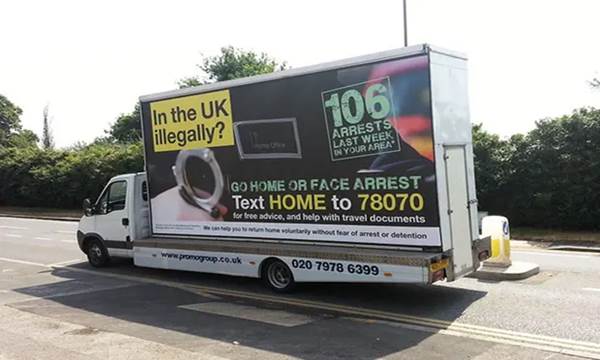
In 2013, however, May made clear that the environment would now become unmistakably hostile. The hostility would be expressed not only in legislation but also in government actions. This included a crude attempt to frighten migrants into leaving the country and to create hostility to them in local communities: in July 2013, the Home Office sent vans, displaying the message, “In the UK illegally? Go home or face arrest”, into six London boroughs. It was a pilot scheme, lasting one month, and the Home Office claimed that it resulted in 60 people “voluntarily” returning to their home countries and that it saved taxpayers’ money.[5] There was, however, a good deal of public disquiet and the vans were not used again.
But the legislation, too, was unmistakably hostile. As May’s Immigration Bill started its journey through parliament, it was obvious that many of its provisions would be particularly worrying for asylum seekers: grounds of appeal against refusal and deportation would be reduced from 17 to four and a “deport first, appeal later” policy would be introduced for people judged as being at no risk of “serious irreversible harm” if returned to their countries of origin, or indeed to other countries similarly approved by the government.[6] This was particularly dangerous since such judgments, made by caseworkers or secretaries of state, are notoriously unreliable.[7] So these legal changes were worrying enough. But it became clear that Home Office definitions of who was an “illegal immigrant” were equally unreliable, and dangerous, as the Windrush scandal unfolded.
What happened to the Windrush generation under the hostile environment policy was particularly scandalous because this whole cohort of people who had been citizens for decades were suddenly told they were not citizens at all. The House of Commons Home Affairs Select Committee, which investigated the scandal, summed up what happened to them in a few succinct sentences. Members of the Windrush generation were
denied access to employment, healthcare, housing and other services in the UK. In some cases, people who had every right to live in the UK were targeted for removal, held in immigration detention, deported or prevented from returning to the UK from visits abroad. Upon trying to resolve their status with the Home Office, they faced obstacles such as “often insurmountable” requirements for decades-worth of evidence to demonstrate their time in the UK and significant application fees.[8]
When it came to removal from the country, some decided, with their history erased, to leave before they could be forcibly removed and thus retain some dignity.[9] For others, the hostile environment ruined their health.
Persecution enforced by law
May’s Bill passed into law, becoming the Immigration Act 2014. It required employers to demand evidence of their employees’ immigration and citizenship status, NHS staff to demand the same of their patients, private landlords of their tenants and banks of their customers. Other public bodies were instructed to do likewise, and new powers were given to check the immigration status of driving licence applicants, refusing those who could not provide evidence and revoking licences already granted.[10] When such checks were made, it turned out that large numbers of people who had lived and worked in the country for decades had no documents to prove their citizenship (no passports, no naturalisation papers). They were declared “illegal”. Most of them were part of the Windrush generation and their descendants.
Rhetoric versus reality
When the Empire Windrush passengers arrived at the UK’s border, no questions were raised about their citizenship or their right to enter and live in the UK. Indeed, for more than a century citizens of the British Empire had enjoyed those rights. In their rhetoric, many UK politicians treated this as a principle to be proud of. In 1954 Henry Hopkinson, Tory Minister of State for Colonial Affairs, declared:
We still take pride in the fact that a man can say civis Britannicus sum [I am a British citizen] whatever his colour may be and we take pride in the fact that he wants to and can come to the mother country.[11]
Moreover, rhetoric apart, the decision to maintain these long-standing rights after the war was taken on hard political and economic grounds: as the countries that had formed the British Empire began to gain their independence, and the Empire became the Commonwealth, good relations with those countries were deemed vital if Britain was to maintain an economic foothold in the regions of the world it once ruled. So, in the very year the Empire Windrush sailed, the British Nationality Act 1948 confirmed those rights to British citizenship.[12] Later, the Immigration Act 1971 confirmed them yet again: although the Act granted only temporary residence to most new arrivals, crucially it still granted Commonwealth citizens protection from deportation.[13] However, by the beginning of the next decade, an erosion of their right to protection had begun. The British Nationality Act 1981 created a new status – that of “British citizen”. In doing so, in the words of Lord Justice Underhill in the Court of Appeal in 2019, it
assimilated the position of Commonwealth citizens to that of other foreign nationals, by requiring them to naturalise … in order to acquire British citizenship.[14]
Arguably, the protection given by the 1971 Act still existed, since it had not been repealed. But by the end of the decade the Immigration Act 1988 had removed it. Section 1(5) of the 1971 Act had ensured that Commonwealth citizens “settled in the United Kingdom at the coming into force of this Act” would retain their freedom “to come into and go from the United Kingdom”.[15] The 1988 Act, however, removed it in a single sentence: “Section 1(5) of the … Immigration Act 1971 … is hereby repealed.”[16] During the passage of the 1988 Act through parliament, concerns had been raised in the House of Lords by Lord Pitt.[17] “I wish that the Government would think through these matters,” he said:
We are talking about people who have been here for 15 years. During those 15 years they have been contributing to the state through taxes, rates, their work and their contributions to society. In 1971 the Government gave them a pledge. I ask them for Christ’s sake to keep it.[18]
Despite this urgent plea, the Bill received the Royal Assent and became the Immigration Act 1988, and the protection given in the 1971 Act was removed. Nevertheless, the confirmation of their rights in the 1948 Act remained and another Act, Labour’s Immigration and Asylum Act 1999, seemed to give similar protection.
“… a great deal of thought …”
Theresa May claimed in the House of Commons in 2014 that the government had “given a great deal of thought to the way in which our measures will operate.”[19] May and her officials certainly noticed a provision in the 1999 Act. It worried them – and they did something about it. The Guardian reported in 2018:
All longstanding Commonwealth residents were protected from enforced removal by a specific exemption in the 1999 Immigration and Asylum Act – a clause removed in the updated 2014 legislation.[20]
They removed it deliberately, without warning and without debate.[21] One attempted justification, once the removal of the clause had been discovered, didn’t wash at all: a later Home Secretary, Amber Rudd, told the House of Commons in 2018 that the clause had been removed because it was unnecessary – there was already protection in the 1971 Act.[22] It didn’t wash, first, because the 1971 protection had been repealed, as we have seen, by the Immigration Act 1988; secondly, if they believed at the time that the protection still existed, why did they inflict the threats and punishments that immediately followed the passing of the 2014 Act? The answer is that they were determined to implement the hostile environment and, after giving the matter a great deal of thought, they removed the protection in the 1999 Act and set about persecuting the Windrush generation.
The consequences were predictable and intended. As employers, NHS staff, landlords, bank staff and other authorities checked the status of their current and potential workers, patients, customers and clients, more and more people were told that their lack of documentary proof of citizenship meant that they were not citizens at all. They were illegal. They had, in the words of Theresa May, “no right to be here”. They had to go. In April 2018, journalist Gary Younge gave examples of the cruelty inflicted on the Windrush generation and their descendants in the name of the “hostile environment”:
There’s Renford McIntyre, 64, who came to Britain from Jamaica when he was 14 to join his mum, worked as a tool setter, and is now homeless and unemployed, after he was fired when he couldn’t produce papers to prove his citizenship. Or 61-year-old Paulette Wilson who used to cook for MPs in the House of Commons. She was put in Yarl’s Wood removal centre and then taken to Heathrow for deportation, before a last-minute reprieve prevented her from being sent to Jamaica, which she last visited when she was 10 and where she has no surviving relatives. Or Albert Thompson, a 63-year-old who came from Jamaica as a teenager and has lived in London for 44 years. He was evicted from his council house and has now been denied NHS treatment for his cancer unless he can stump up £54,000, all because they question his immigration status.[23]
In the next blog, I will tell the story of Hubert Howard, one of the saddest victims of the hostile environment and the Windrush scandal.
[1] James Kirkup, “Theresa May interview: ‘We’re going to give illegal migrants a really hostile reception’”, The Telegraph, 25 May 2012: Theresa May interview: ‘We’re going to give illegal migrants a really hostile reception’ (telegraph.co.uk)
[2] Cited The Guardian, 10 October 2013: Immigration bill: Theresa May defends plans to create ‘hostile environment’ | Theresa May | The Guardian (accessed 28/5/2023).
[3] Playing the Race Card, 7 November 1999, Channel Four Television, London.
[4] Ibid.
[5] Operation Vaken: evaluation report, Home Office and Immigration Enforcement, 31 October 2013: https://www.gov.uk/government/publications/operation-vaken-evaluation-report; Hattenstone, S., “Why was the scheme behind May’s ‘Go Home’ vans called Operation Vaken?”, The Guardian, 26 April 2018: Why was the scheme behind May’s ‘Go Home’ vans called Operation Vaken? | Simon Hattenstone | The Guardian
[6] Immigration Act 2014, s. 17(3), insertion 94B(3).
[7] Mouncer, Bob (2009), Dealt with on their Merits: the Treatment of Asylum Seekers in the UK and France, University of Hull, paras 6.5.9, 6.5.12, 6.6.1-6.6.4: file:///C:/Users/Bob/AppData/Local/Temp/b76ecf82-0f04-4115-975d-917a3a324502_Dealt%20with%20on%20their%20merits.zip.502/519233.pdf; Shaw, J. & Witkin, R. (2004), Get it Right: How Home Office Decision Making Fails Refugees, Amnesty International, London.
[8] The Windrush Compensation Scheme, House of Commons Home Affairs Committee Report (24 November 2021), para. 1: The Windrush Compensation Scheme – Home Affairs Committee (parliament.uk)
[9] “What is Windrush and who are the Windrush generation?”, BBC News 27 July 2023: What is Windrush and who are the Windrush generation? – BBC News
[10] Immigration Act 2014.
[11] Cited, Hayter, T. (2000), Open Borders: The Case against Immigration Controls, Pluto Press, London, p. 44.
[12] Ibid., p. 43.
[13] Immigration Act 1971, ss. 1(5) and 7 (1); Gentleman, A., “‘I’ve been here for 50 years’: the scandal of the former Commonwealth citizens threatened with deportation’”, The Guardian, 21 February 2018: ‘I’ve been here for 50 years’: the scandal of the former Commonwealth citizens threatened with deportation | Immigration and asylum | The Guardian
[14] Case No: CA-2021-000601, Royal Courts of Justice Strand, London, WC2A 2LL (27/7/2022), para. 11: Microsoft Word – Howard for hand-down _2_.docx (dpglaw.co.uk)
[15] Immigration Act 1971, s.1(5): “The rules [made by the Secretary of State relating to how the Act would work in practice] shall be so framed that Commonwealth citizens settled in the United Kingdom at the coming into force of this Act and their wives and children are not, by virtue of anything in the rules, any less free to come into and go from the United Kingdom than if this Act had not been passed.”
[16] Immigration Act 1988, s,1: Immigration Act 1988 (legislation.gov.uk)
[17] David Pitt was born on the Caribbean island of Grenada in 1913. He won the Island Scholarship to have further education abroad and studied medicine at the University of Edinburgh. He returned to the Caribbean, but settled in Britain in 1947. He was given a life peerage in 1975. He died in 1994.
[18] Cited, Williams, W. op. cit., p. 58: 6.5577_HO_Windrush_Lessons Learned Review (publishing.service.gov.uk).
[19] Hansard, House of Commons, 30 January 2014, cols 1124-25: Immigration Bill – Hansard – UK Parliament
[20] Taylor, D., ”UK removed legal protection for Windrush immigrants in 2014”, UK removed legal protection for Windrush immigrants in 2014 | Commonwealth immigration | The Guardian
[21] Ibid.
[22] Hansard, House of Commons, 23 April 2018, cols. 628-29).
[23] Younge, G., “Hounding Commonwealth citizens is no accident. It’s cruelty by design”, The Guardian, 13 April 2018: Hounding Commonwealth citizens is no accident. It’s cruelty by design | Gary Younge | The Guardian
 Bob Mouncer's blog