Home » 2014 (Page 4)
Yearly Archives: 2014
“Liberal agenda” masks “political cowardice”
After donning the white trousers (see previous blog: https://bobmouncerblog.wordpress.com/2014/03/31/pinching-the-tories-white-trousers/ ) what did Labour do?
Race relations
After Labour’s tightening of immigration controls following the 1964 election, the rest of the 1960s saw the development of a new approach to race and immigration in the UK: the race-relations approach. This was tacitly supported by the Conservatives, who were also worried by the uncertain consequences of the racial hatred stirred up at Smethwick. Conservative frontbencher Robert Carr saw the consensus between the two parties as “a marriage … of convenience – not from the heart.”[1] Labour insisted that its liberal credentials were intact because the approach’s emphasis on integration was the key to social peace, the mark of a “civilised society”. But (crucially, and to justify the tightening-up of the Act) it would have to include immigration controls if it was to be successful. In 1965 Home Office minister Roy Hattersley expressed it thus: “Integration without control is impossible, but control without integration is indefensible.”[2] When Roy Jenkins became home secretary in 1966 he laid out his policy stall in a speech which was to become a foundation text for the new approach. He emphasised the integration side of Hattersley’s equation, defining it both negatively and positively:
“I do not regard [integration] as meaning the loss, by immigrants, of their own national characteristics and culture. I do not think we need in this country a “melting pot”, which will turn everyone out in a common mould, as one of a series of carbon copies of someone’s misplaced vision of the stereotyped Englishman.”[3]
He defined integration positively as “cultural diversity, coupled with equality of opportunity in an atmosphere of mutual tolerance”, and added: “If we are to maintain any sort of world reputation for civilised living and social cohesion, we must get far nearer to its achievement than is the case today.” Here was the moral, political and social justification for his liberal agenda and the multicultural society that would evolve from it.
Contradiction
There was, however, a contradiction at the heart of the approach which has dogged it ever since: it is inconsistent to claim to want to celebrate cultural diversity in society on the one hand and discriminate against black and Asian immigrants on the other. Thirty-four years later Roy Hattersley admitted as much: “If your immigration restrictions are too repressive you encourage bad race relations rather than encourage contentment and satisfaction, because you are saying, ‘We can’t afford any more of these people here’, and the implication is that there is something undesirable about these people.”[4] The truth is that race relations policy was not the result of high principle (as suggested by Gaitskell’s opposition to the 1962 Act or by Jenkins’s exposition of his liberal agenda) but of the complete abandonment of principle after 1964. After Smethwick “the government panicked”, explained Barbara Castle. The tightening-up of restrictions by Labour was done “out of political cowardice, not political conviction.”[5] So the whole liberal project had its origin in a surrender to racism.
A “half-hearted affair” for “a people apart”
This helps to explain the weakness of the first Race Relations Act in 1965 and the inadequacies of the second in 1968. The 1965 Act prohibited “incitement to racial hatred” but did not cover discrimination in housing and employment, did not contain criminal sanctions against those who discriminated, and did not apply to the police. A. Sivanandan, working at the Institute for Race Relations, described it as “a half-hearted affair which merely forbade discrimination in ‘places of public resort’ and, by default, encouraged discrimination in everything else: housing, employment, etc.”[6] Moreover, the Race Relations Board, set up under the Act to provide for a conciliation process to deal with discrimination in public places, sent the wrong message: “To ordinary blacks,” Sivanandan argued, such structures “were irrelevant: liaison and conciliation seemed to define them as a people apart who somehow needed to be fitted into the mainstream of British society – when all they were seeking was the same rights as other citizens.” The ineffectiveness both of the Act and the Board is summed up by Hayter:
“The first person to be charged under this Act was Michael X, a black militant. When Duncan Sandys, a prominent Tory MP, attacked a government report on education by stating that ‘The breeding of millions of half-caste children will merely produce a generation of misfits and increase social tension’, the Race Relations Board was unable or unwilling to prosecute him.”[7]
The 1968 Race Relations Act went further by bringing employment and housing into its ambit, but its inadequacies were apparent:
“The Act introduced fines on employers who were found to discriminate on the grounds of race, and compensation, but not reinstatement, for the people discriminated against … but the enforcement powers of the Race Relations Board remained weak.”[8]
Moreover, the anti-discrimination provisions still did not apply to the police. Jenkins had faced opposition from the police when discussing the first Act and in 1968 the new home secretary, James Callaghan, bowed to similar pressure. The year 1968 also saw the passing of another Commonwealth Immigrants Act.
In the next blog: the Kenyan Asians and Enoch Powell.
[1] Playing the Race Card, October-November 1999, Channel Four Television, London.
[2] Favell, A. (2001), Philosophies of Integration: Immigration and the Idea of Citizenship in France and Britain, Palgrave, Basingstoke, p. 104.
[3] Cited, ibid.
[4] Playing the Race Card, October-November 1999, Channel Four Television, London.
[5] Ibid.
[6] Cited, Fryer, P. (1984), Staying Power: the History of Black People in Britain, Pluto Press, London, p. 383.
[7] Hayter, T. (2000), Open Borders: the Case against Immigration Controls, Pluto Press, London, p. 35.
[8] Ibid.
Pinching the Tories’ white trousers
To continue the story from where the earlier blog left off, when the Bill to impose racist immigration controls became the Commonwealth Immigrants Act 1962.
Labour had opposed the Bill throughout its passage through parliament – largely because it regarded the Bill as incompatible with the Commonwealth ideal. Moreover, such principles were apparently non-negotiable: “I do not care whether or not fighting this Commonwealth Immigration Bill will lose me my seat”, declared MP Barbara Castle, “for I am sure that the Bill will lose this country the Commonwealth.”[1] The speech against the Bill by the Labour leader, Hugh Gaitskell, was admired even by some on the Conservative benches. Yet, once Labour had won the 1964 election, the new government set about making the Act even more restrictive.
Pressures
Why should this have been so? First, there was pressure on the government from Whitehall. Bruce Paice (head of immigration, Home Office, 1955-1966) had argued hard over the years for immigration controls. Even in retirement he was unable to conceal his contempt for the immigrants who came and the politicians and civil servants who allowed them to come for so long. “How on earth people got the money to come here from places like West Africa and Barbados I’ve no idea”, he said in 1999.[2] “They never seemed to earn anything when they were there, and most of them I think didn’t make much effort to earn anything much when they were here either.” He had tried to persuade senior officials that the solution was a simple one:
“I remember going to see Sir Arthur Hutchinson, Deputy Secretary, and I said all that was really needed was to give me the same powers about British subjects as I had about aliens. And he said in effect, ‘Oh, don’t be silly,’ he said, you know, there couldn’t be any question of such a thing.”
In 1962 Paice had his way: Commonwealth immigrants now had to queue with “aliens” for permission to enter. “The fact that I might be influencing, for good or ill, the lives of other people”, he later commented, “was to me just one of those things. It didn’t cost me any sleepless nights. Somebody has to do this kind of job, and I was quite happy to do it.”
Secondly, there was pressure from public opinion. When the debate on the Act began, support for immigration controls stood at 76%. But the Labour Party’s campaign against the Bill changed the situation: by the end of its passage through the House of Commons, support for controls had fallen to 62% (Jenkins 1999). It looked as though a strong campaign had changed people’s minds. Nevertheless a majority of 62% was still a majority – and Labour was starting to think about the next election. Even before the Bill was passed, there were signs that Labour’s commitment to the rights of free entry and settlement of Commonwealth citizens was less than firm. During the third reading of the Bill, Labour frontbencher Denis Healey hinted that controls might be necessary in the future.[3] After Gaitskell’s unexpected death the new leader, Harold Wilson, gave a further hint of change. While opposing the renewal of the Act in November 1963 he nevertheless told the House of Commons: “We do not contest the need for control of Commonwealth immigration into this country.”[4] When the election came in 1964 the Labour Party manifesto declared:
“Labour accepts that the number of immigrants entering the United Kingdom must be limited. Until a satisfactory agreement covering this can be negotiated with the Commonwealth, a Labour Government will retain immigration control.”[5]
Smethwick
If this was the case before the election, tighter controls became inevitable after it. Labour’s shadow foreign secretary, Patrick Gordon Walker, had lost his seat in Smethwick, in the West Midlands, to a Conservative, Peter Griffiths. One of the slogans daubed on walls during the campaign became notorious in British electoral history: “If you want a nigger for a neighbour, vote Labour.” Griffiths denied being the author, but added: “I would not blame anyone who said that … it was a manifestation of popular feeling.”[6] Smethwick, like many similar inner-city areas, suffered housing shortages and other problems, due not to immigrants but to policy failures both at national and local levels. But Griffiths blamed immigrants – and Gordon Walker blamed the Conservatives for letting so many into the country.[7] At an election meeting in Birmingham, Wilson did manage to identify the real issue:
“There is a very real problem of overcrowding which the Government has neglected. We are not having this immigrant question used as an alibi for the total Tory failure to handle the problems of housing, slums, schools and education in this country.”[8]
However, after the election the government set about tightening the controls.
Collapse
The Conservatives had enforced the Act fairly loosely – Commonwealth relations had to be managed and public opinion had to be nurtured. Once Labour gained power in 1964, however, restrictions were increased. From September work vouchers were only issued to people with firm job offers or specific skills. Such a policy favoured whites, as the working party in 1961 had suggested it would.[9] Vouchers granted were limited to 8,500 a year in 1965. Restrictions on dependants included “nephews and cousins and children over 16”:
“In future, dependants would be expected to produce either an entry certificate or appropriate documents to establish identity at the port of entry. This was the origin of the system of entry control which saw the posting – to those Commonwealth countries that were sources of immigration – of Entry Control Officers whose job was to validate evidence of identity and issue entry certificates.”[10]
During the ensuing period of Labour government, restrictions became tighter, to the point that in 1969 The Economist declared that Labour had “pinched the Tories’ white trousers”.[11]
In the next blog: when a “liberal agenda” masks “political cowardice”.
[1] Hayter, T. (2000), Open Borders: the Case against Immigration Controls, Pluto Press, London, p.46.
[2] Playing the Race Card, October-November 1999, Channel Four Television, London.
[3] Hayter, T. (2000), Open Borders: the Case against Immigration Controls, Pluto Press, London, p. 46.
[4] Foot, P. (1968), The Politics of Harold Wilson, Penguin Books, Harmondsworth, p. 252.
[5] Ibid., p. 254.
[6] Foot, P. (1970), The Rise of Enoch Powell, Penguin Books, Harmondsworth, p. 68.
[7] Playing the Race Card, October-November 1999, Channel Four Television, London.
[8] Hayter, T. (2000), Open Borders: the Case against Immigration Controls, Pluto Press, London, p. 50.
[9] Spencer, I. (1997), British Immigration Policy since 1939: the Making of Multi-Racial Britain, Routledge, London, p. 116.
[10] Ibid., pp. 135-6.
[11] Hayter, T. (2000), Open Borders: the Case against Immigration Controls, Pluto Press, London, p. 51.
Take Part In Boycott Workfare Week Of Action This Week
Good arguments and links here against Workfare. By the way, ask the Salvation Army why they’re still taking part in the Mandatory Work Activity scheme instead of protesting against it.

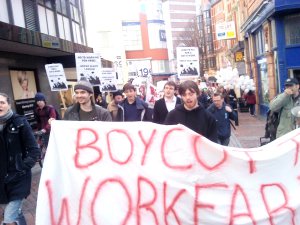 Next week sees a week of action against workfare, as the government introduces the harshest forced labour scheme yet seen – “community work placements”. These placements are full time, lasting for 6 months and build upon the failure of the “Community Action Programme” pilot scheme which had no effect on the chances of someone finding work.
Workfare is the system whereby unemployed and disabled people are forced to work for charities, community organisations and companies under threat of having their benefits stopped entirely for up to three years for unemployed people and losing 70% of their benefits indefinitely for disabled people.
The schemes vary from the theoretically voluntary “Work Experience Programme” to the definitely mandatory “Mandatory Work Activity”. The schemes vary in length from 2 weeks to 2 months, but the government has decided this isn’t enough, since none of the schemes are proving to be any…
View original post 482 more words
Racist mission accomplished
Continuing the story from the previous blog: as we have seen, although governments and their officials dearly wanted to impose racist immigration controls right from the start, they hesitated. We will look at some more of the reasons and see how a Tory government finally got its wish, embodied in the Commonwealth Immigrants Act 1962. But it took that long. Here are some of the reasons.
The Commonwealth connection
It was not only the complications of “kith and kin” in the “white” Commonwealth that made governments delay legislation. The UK’s relationship with the Commonwealth as a whole was also a factor. In a period of decolonisation and the building of Commonwealth institutions, UK governments trod carefully. For example, openly discriminatory legislation “would jeopardise the future association of the proposed Federation of the West Indies with the Commonwealth”.[1] Politicians tried to persuade governments in the Caribbean and the Indian subcontinent to control the flow of migrants at source. They had some success in India and Pakistan, but not in the Caribbean. In 1958 Sir Henry Lintott, Deputy Under-Secretary of State at the Commonwealth Relations Office, advised caution on the question of legislation. There had been calls for immigration controls in the wake of the Notting Hill riots (provoked by extreme right-wing groups such as the League of Empire Loyalists). Sir Henry advised that in these circumstances immigration controls would imply that “the British people are unable to live with coloured people on tolerable terms”:
“This could be immensely damaging to our whole position as leaders of the Commonwealth which, in its modern form, largely draws its strength from its multi-racial character. If, therefore, strong pressure develops for the introduction of legislation to control immigration, I would hope that some way could be found to delay action and to permit passions to cool.”[2]
These arguments were supported not only by many in the Conservative Party in the mid 1950s but by the Labour Party too. In 1958 Arthur Bottomley spoke for the Labour front bench against legislation to control immigration:
“The central principle on which our status in the Commonwealth is largely dependent is the ‘open door’ to all Commonwealth citizens. If we believe in the importance of our great Commonwealth, we should do nothing in the slightest degree to undermine that principle.”[3]
With a House of Commons majority of only fifteen, the Conservative government was vulnerable. Similar considerations had applied in January 1955 when Home Secretary Gwilym Lloyd George presented his ideas for restrictive legislation to the cabinet. The cabinet judged that “such a bill would not obtain the full support of the Conservative Party and would be opposed in the House by the Labour opposition and outside the House by the Trades Union Congress.”[4]
The working party evidence
Another obstacle to immediate legislation was the fact that the working parties set up to provide evidence of the “undesirability” of black immigrants failed to do so. They described “coloured women” as “slow mentally” and said that their “speed of work” was unsatisfactory. They claimed there was “a disproportionate number of convictions for brothel keeping and living on immoral earnings” among West Indian men and made references to “the incidence of venereal disease among coloured people.”[5] But they failed to make the case for immigration legislation. The committee with the specific mandate to investigate “social and economic problems” relating to “coloured workers” must have been a particular disappointment. In August 1955 the committee’s draft statement went to the cabinet. The allegation of a high incidence of venereal disease was included here – but only as a “suggestion”. The author of the report admitted that there were no figures to support the claim. Spencer summarises the committee’s findings:
Although “coloured” immigration was running at the rate of about 30,000 a year … even those arriving most recently had found jobs easily and were making “a useful contribution to our manpower resources”. Unemployment … could not be regarded as a problem, nor could undue demands on National Assistance or the National Health Service … The immigrants were for the most part law-abiding except for problems with [cannabis] and living off the immoral earnings of women. Though the immigrants had not been “assimilated” there was no evidence of racial tension and it was apparent that some “coloured” workers in the transport industry had made a favourable impression.[6]
The same was true of the working party’s reports between 1959 and 1961. “Viewed objectively”, writes Spencer, “the reports of the Working Party consistently failed to fulfil the purpose defined in its title – to identify ‘the social and economic problems arising from the growing influx of coloured workers’. In the areas of public order, crime, employment and health there was little noteworthy to report to their political masters.”[7] Moreover, the Treasury, when asked whether black and Asian immigration benefited the economy, “gave the clear advice that on economic grounds there was no justification for introducing immigration controls: most immigrants found employment without creating unemployment for the natives and, in particular by easing labour bottlenecks, they contributed to the productive capacity of the economy as a whole.”[8]
But, in the end, the working party managed to construct an argument for controls.[9] “‘Assimilability’ – that is, of numbers and colour – was the criterion that mattered in the end.” Between 1959 and 1961 there were large increases in the numbers of blacks and Asians entering the UK. At the beginning of the period there were around 21,000 entries a year; by the end they had risen to 136,000 (though much of this last figure may have been due to the fact that the government had signalled its intention to introduce legislation and larger numbers had decided to come in order to “beat the ban”). Working party officials compensated for their inability to find existing problems by predicting that they would arise later:
“Thus in February 1961, whilst it was admitted that black immigrants were being readily absorbed into the economy, [officials predicted] ‘it is likely to be increasingly difficult for them to find jobs during the next few years’. Further, it was doubtful if the ‘tolerance of the white people for the coloured would survive the test of competition for employment.’”
There would be “strains imposed by coloured immigrants on the housing resources of certain local authorities and the dangers of social tensions inherent in the existence of large unassimilated coloured communities.” The working party recommended immigration controls. It was “prepared to admit that the case for restriction could not ‘at present’ rest on health, crime, public order or employment grounds” but
“[i]n the end, the official mind made recommendations based on predictions about … future difficulties which were founded on prejudice rather than on evidence derived from the history of the Asian and black presence in Britain.”
Now there was just one obstacle impeding the introduction of controls.
Public opinion
One of the government’s worries about introducing legislation had been the uncertainty of public opinion. Racist stereotyping in the higher echelons of government could also be found among the general population. Bruce Paice (head of immigration, Home Office, 1955-1966), interviewed in 1999, believed that “the population of this country was in favour of the British Empire as long as it stayed where it was: they didn’t want it here.”[10] It is true that hostility towards black people existed throughout the 1950s, and in 1958 the tensions turned into violent confrontation. In Nottingham and in the Notting Hill area of London there were attacks on black people, followed by riots, orchestrated by white extremist groups.[11] After these explosions racist violence continued but became more sporadic, ranging from individual attacks to mob violence.[12] Nevertheless, for much of this period governments had not been confident that public opinion would be on its side when it came to legislation on immigration control. In November 1954 the colonial secretary wrote a memorandum expressing the hope that “responsible public opinion is moving in the direction of favouring immigration control”. There was, however, “a good deal to be done before it is more solidly in favour of it.”[13] In June 1955 cabinet secretary Sir Norman Brook wrote to prime minister Anthony Eden expressing the view that, evident as the need was for controls, the government needed “to enlist a sufficient body of public support for the legislation that would be needed”. In November 1955 the cabinet recognised that public opinion had not “matured sufficiently” and public consent, conclude Carter et al., “could only be assured if the racist intent of the bill were concealed behind a cloak of universalism which applied restrictions equally to all British subjects.”[14]
Mission accomplished
By 1961 the cloak was in place, and a Bill could be prepared. Home secretary R.A. Butler donned the cloak in a television interview: “We shall decide on a basis absolutely regardless of colour and without prejudice,” he told the interviewer. “It will have to be for Commonwealth immigration as a whole if we decide [to do it].”[15] He removed the cloak, however, when he explained the work-voucher scheme at the heart of the Bill to his cabinet colleagues:
“The great merit of this scheme is that it can be presented as making no distinction on grounds of race or colour … Although the scheme purports to relate solely to employment and to be non-discriminatory, the aim is primarily social and its restrictive effect is intended to, and would in fact, operate on coloured people almost exclusively.”[16]
The Bill passed into law and became the Commonwealth Immigrants Act 1962.
How did Labour respond to the Bill and then to the Act? We shall see in the next blog that at first the signs looked good.
[1] Ibid., p. 82.
[2] Spencer, I. (1997), British Immigration Policy since 1939: the Making of Multi-Racial Britain, Routledge, London, p. 102.
[3] Foot, P. (1968), The Politics of Harold Wilson, Penguin Books, Harmondsworth, p. 251.
[4] Spencer, I. (1997), British Immigration Policy since 1939: the Making of Multi-Racial Britain, Routledge, London, p. 76.
[5] Playing the Race Card, October-November 1999, Channel Four Television, London.
[6] Spencer, I. (1997), British Immigration Policy since 1939: the Making of Multi-Racial Britain, Routledge, London, p. 78.
[7]Ibid., p. 119.
[8] Hayter, T. (2000), Open Borders: the Case against Immigration Controls, Pluto Press, London, p. 48.
[9] Spencer, I. (1997), British Immigration Policy since 1939: the Making of Multi-Racial Britain, Routledge, London, pp. 118-120.
[10] Playing the Race Card, October-November 1999, Channel Four Television, London.
[11] Favell, A. (2001), Philosophies of Integration: Immigration and the Idea of Citizenship in France and Britain, Palgrave, Basingstoke, p. 103.
[12] Fryer, P. (1984), Staying Power: the History of Black People in Britain, Pluto Press, London, p. 380.
[13] Cited, Carter, B., Harris, C. & Joshi, S. (1993), “The 1951-55 Conservative Government and the Racialization of Black Immigration”, in James, W. & Harris, C. (eds), Inside Babylon: the Caribbean Diaspora in Britain, Verso, London, p. 66.
[14] Ibid., p. 68.
[15] Playing the Race Card, October-November 1999, Channel Four Television, London.
[16] Cited, Hayter, T. (2000), Open Borders: the Case against Immigration Controls, Pluto Press, London, p. 47.
“a type of labour … not suitable for use”
With immigration looking set to be an election issue next year, I want to do a few blogs on how successive British governments have dealt with immigration, asylum and race since the Second World War. With UKIP and the Tories trying to outflank each other in keeping xenophobia and racism alive, anti-racists eager to get rid of the Tories must demand that Labour does not play that game from now on. As my blogs will show, Labour has consistently and disgracefully played the race card in the past and the result has been policymaking indistinguishable from that of the Tories. A quick look at history may give us a timely warning of what to expect if Labour does it again.
We’ll start in 1945 and the end of the Second World War, when the need for workers to reconstruct Britain was urgent and the country was almost bankrupt.
A plan to reconstruct
The task of reconstruction in the UK after the Second World War was massive and daunting: many workers had been killed in the fighting and much of the country’s infrastructure and industry had been destroyed in the bombing. Moreover, the government was committed to social change, for the people had demanded not just victory but a better world. The politicians remembered how the First World War had been followed by the Russian Revolution and Quintin Hogg (later Lord Hailsham) warned the House of Commons in 1943 that “if you do not give the people social reform, they are going to give you social revolution”.[1] As historian Eric Hobsbawm noted:
“Nobody dreamed of a post-war return to 1939 … as statesmen after the First World War had dreamed of a return to the world of 1913. A British government under Winston Churchill committed itself, in the midst of a desperate war, to a comprehensive welfare state and full employment.”[2]
Civis Britannicus sum
Such a project would require much work and many workers, and the story of how the job was eventually done is usually told in terms of the willing recruitment of black and Asian workers from the colonies and ex-colonies to augment the labour force. As more and more colonies achieved independence, imperial rhetoric about British rule over an empire “on which the sun never sets” gave way to a Commonwealth rhetoric used by both the Labour and Conservative parties for many years following the war. Labour leader Hugh Gaitskell told his party conference in 1961:
“I believe with all my heart that the existence of this remarkable, multiracial collection – association – of independent nations, stretching across five continents, covering every race, is something that is potentially of immense value to the world.”[3]
More specifically, in 1954, Henry Hopkinson, Conservative minister of state at the Colonial Office, declared that colonial subjects’ right of free entry into the UK was
“not something we want to tamper with lightly … We still take pride in the fact that a man can say civis Britannicus sum [I am a British citizen] whatever his colour may be and we take pride in the fact that he wants to and can come to the mother country.”[4]
Indeed, for at least a century no distinction had been made between citizens of the British Empire regarding their right to enter Britain. The reasons for this were economic and political: from the middle of the nineteenth century “the economic imperatives of the free flow of goods, labour and services within the Empire enhanced the feeling that such distinctions were likely to be detrimental to broad imperial interests”.[5] In the post-war period Britain wanted to foster good relations with the newly independent countries in order to keep a foothold, particularly in terms of economic power, in the regions of the world it once ruled. These were the realities which underlay the softer talk of the Commonwealth and the continued right of free entry into Britain for all its members – and it was against this background that the British Nationality Act 1948 was introduced. Its purpose in defining UK and Colonies citizenship, it has been argued, was not to reaffirm rights of free entry but to “curb colonial nationalism”.[6] Nevertheless, within this context, the Act did confirm those rights.
“… we cannot force them to return …”
The hard post-war reality, however, proved to be very different from the soft rhetoric, for another narrative dominated policymaking from the outset. It had little to do with giving members of the Commonwealth family a warm welcome from mother. Rather it reflected a darker picture: Empire as the enslavement, exploitation and repression of subject peoples, justified (when thought necessary) only by notions of their inferiority.
The 1945 Labour government attempted from the beginning to limit the number of black and Asian Commonwealth and colonial citizens allowed into the country. It resorted to administrative methods of control, many of doubtful legality and most of them secret. The government’s first action was to ensure the early repatriation of the black workers who had been urgently recruited from the colonies during the war. It also set about discouraging them from returning. This was true in the case of about a thousand Caribbean technicians and trainees recruited to work in war factories in Merseyside and Lancashire. In April 1945 an official at the Colonial Office had minuted that, because they were British subjects, “we cannot force them to return” – but it would be “undesirable” to encourage them to stay.[7] The Ministry of Labour managed to repatriate most of them by the middle of 1947. Then, in order to discourage them from returning, an official film was distributed in the Caribbean,
“showing the very worst aspects of life in Britain in deep mid-winter. Immigrants were portrayed as likely to be without work and comfortable accommodation against a background of weather that must have been filmed during the appallingly cold winter of 1947-8.”[8]
Redistribution of labour and recruitment from Europe
But the need for labour remained and the government tried to solve the problem in two ways – neither of which involved importing labour from the colonies. First, it tried to increase labour mobility within the existing population and, secondly, it imported labour from Europe.
A Ministry of Labour report[9] had predicted before the end of the war that there would not be sufficient mobility of labour within the country to face the challenges of the post-war world. Workers would have to be more willing to move into sectors where they were needed most. Virtually no one could be excluded, it was said, for everyone had to be part of the reconstruction project, even the unskilled and those “below normal standards”. In 1947 the government issued an invitation for people to go to their local labour exchanges to register themselves. Some incentives (in the form of Ministry of Labour hostels and training) were provided, plus the threat of prosecution.[10] The presenter of the radio programme Can I Help You? entered into the spirit of the government’s intentions: “The hope is … to comb out from plainly unessential [sic] occupations people who could be better employed; and to get the genuine drones in all classes to earn their keep …”
Prime minister Clement Attlee had hoped that this project would provide what he had identified as the “missing million” workers but six months later only 95,900 of the “drones” had responded.[11] Moreover, one source of home-grown labour had hardly been tapped in this exercise: women, essential during the war, were now told to go back to the home and make way for the men returned from battle. There were still sectors where women might work (e.g. textiles) but, as Harris notes, “their ability to do so was greatly hampered by the reluctance of the government to maintain the war-time level of crèche provision”. Thus an important source of labour was largely excluded.
In the case of immigration from Europe, the government set up Operation Westward Ho in 1947 in order to recruit labour from four sources: Poles in camps throughout the UK, displaced persons in Germany, Austria and Italy, people from the Baltic states and the unemployed of Europe. It was partly knowledge of this recruitment which inspired pleas to the British government from the governors of Barbados, British Guiana, Trinidad and Jamaica. Each of these territories was suffering from high unemployment, with consequent discontent among their populations, and the governors wrote to London arguing that Britain could solve its own problem and theirs by accepting these workers into the UK. In response to this, an interdepartmental working party was set up which decided that there was no overall shortage of labour after all. Spencer records that the working party’s minutes display “entirely negative attitudes to colonial labour”:
“One senior official at the Ministry of Labour expressed the view that the type of labour available from the empire was not suitable for use in Britain and that displaced persons from Europe were preferable because they could be selected for their specific skills and returned to their homes when no longer required. Colonial workers were, in his view, both difficult to control and likely to be the cause of social problems.”[12]
“… the object is to keep out coloured people”
Opposition to black and Asian immigration continued throughout the next decade, with successive British governments seeking to justify legislation to control it. Hayter observes that the delay in introducing the legislation “was caused by the difficulty of doing so without giving the appearance of discrimination”.[13] There is no doubt, however, about the racist nature of the intent to do so. From 1948 onwards various working parties and departmental and interdepartmental committees were set up to report on the “problems” of accepting black immigrant workers into the UK. All of them were created in the hope of providing evidence that black immigrants were bad for Britain. There was the “Interdepartmental Working Party on the employment in the United Kingdom of surplus colonial labour”, chaired by the Colonial Office; the Home-Office-based “Interdepartmental Committee on colonial people in the United Kingdom”; the “Cabinet Committee on colonial immigrants”; and the one that really gave the game away: the “Interdepartmental Working Party on the social and economic problems arising from the growing influx into the United Kingdom of coloured workers from other Commonwealth countries”. Whew!
Committees reported, cabinets discussed their findings and much correspondence passed between ministers and departments. Lord Salisbury (Lord President of the Council and Leader of the House of Lords) wrote in March 1954: “It is not for me merely a question of whether criminal negroes should be allowed in … it is a question of whether great quantities of negroes, criminal or not, should be allowed to come”.[14]
Lord Swinton, secretary of state for Commonwealth relations, saw a difficulty and wrote to Salisbury: “If we legislate on immigration, though we can draft it in non-discriminatory terms, we cannot conceal the obvious fact that the object is to keep out coloured people.” In the case of the “old Dominions” (i.e. the “white” Commonwealth – Canada, Australia, New Zealand), he noted a “continuous stream” of people coming to the UK “in order to try their luck; and it would be a great pity to interfere with this freedom of movement”.[15] Moreover, such interference would undermine the strong ties of kith and kin between the UK and the “white” Commonwealth.
Swinton also believed that those strong ties would be further weakened by the development of a large “coloured” community in Britain – declaring that “such a community is certainly no part of the concept of England or Britain to which people of British stock throughout the Commonwealth are attached”. “Swinton held the view strongly”, wrote Spencer, “that immigration legislation which adversely affected the rights of British subjects should be avoided ‘if humanly possible’ and if it did become inevitable it was better for the legislation to be overtly discriminatory than to stand in the way of all Commonwealth citizens who wished to come to Britain”.[16]
There were, however, several obstacles to overcome before racist controls could be introduced. We will see in the next blog how these obstacles were overcome.
[1]Philo, G. (undated), Television, Politics and the New Right, Glasgow University Media Group, p. 2. Available from http://www.gla.ac.uk/centres/mediagroup
[2] Hobsbawm, E. (1995), Age of Extremes: the Short Twentieth Century, 1914-1991, Abacus, London, 161.
[3] Playing the Race Card, October-November 1999, Channel Four Television, London.
[4] Cited, Hayter, T. (2000), Open Borders: the Case against Immigration Controls, Pluto Press, London, p. 44.
[5] Spencer, I. (1997), British Immigration Policy since 1939: the Making of Multi-Racial Britain, Routledge, London, p. 53.
[6] Carter, B., Harris, C. & Joshi, S. (1993), “The 1951-55 Conservative Government and the Racialization of Black Immigration”, in James, W. & Harris, C. (eds), Inside Babylon: the Caribbean Diaspora in Britain, Verso, London, p. 57.
[7] Spencer, I. (1997), British Immigration Policy since 1939: the Making of Multi-Racial Britain, Routledge, London, p. 39.
[8] Ibid., p. 32.
[9] Harris, C. (1993), “Post-war Migration and the Industrial Reserve Army”, in James, W. & Harris, C. (eds), Inside Babylon: the Caribbean Diaspora in Britain, Verso, London, p. 16.
[10] Ibid., pp. 18-19.
[11] Ibid., pp. 17-18.
[12] Spencer, I. (1997), British Immigration Policy since 1939: the Making of Multi-Racial Britain, Routledge, London, p. 40.
[13] Hayter, T. (2000), Open Borders: the Case against Immigration Controls, Pluto Press, London, p. 46.
[14] Carter, B., Harris, C. & Joshi, S. (1993), “The 1951-55 Conservative Government and the Racialization of Black Immigration”, in James, W. & Harris, C. (eds), Inside Babylon: the Caribbean Diaspora in Britain, Verso, London, p. 65.
[15] Spencer, I. (1997), British Immigration Policy since 1939: the Making of Multi-Racial Britain, Routledge, London, pp. 64, 67.
[16] Ibid., pp. 67-68.
“It rests on injustice”
Forgive me, but there’s no end to quoting Tony Benn. These are taken more or less at random.
He always had confidence in the people he represented. When he won the battle for the right to get rid of his inherited peerage and sit in the House of Commons again he knew that without the support of his Bristol constituents he wouldn’t have won at all. On the night he was finally re-elected, he congratulated them and thanked them:
“You have defeated the Tory cabinet, you have defeated the House of Lords, you have defeated the courts. You have changed the constitution of this country by your own power.”
When MPs take up their elected seats they have to swear an oath of allegiance to “Queen Elizabeth the Second, her heirs and successors”. In earlier times, if anyone refused, they went to jail. Today, if they refuse, they get fined £500 a day until they agree. So they don’t refuse! Benn got round it by adding an explanation and the words “under protest” to the oath: So it was:
“As a committed republican, under protest, I take the oath required of me by law under the Parliamentary Oaths Act 1866 to allow me to represent my constituency: I, Tony Benn, under protest, do solemnly and sincerely declare and affirm, etc., etc.”
There’s a brilliant video somewhere of him doing that! No surprise, then, that when describing the opening of parliament for a BBC television documentary he pointed out:
“When the Queen came that day and sat on the red carpet she was sitting just above the spot where Charles I stood trial and was condemned to death by the Commons.”
And even when he was being mischievous, there was a political point to be made:
“There’s an absolute hierarchy of lavatories in the Houses of Parliament: the bishops have their own lavatory, so do the peers, and the peeresses. There are separate lavatories for members and others for lady members. There are male and female staff lavatories. They even have lavatories for gentlemen. But it all ends up in the same place.”
But he wasn’t being mischievous when, in 1981, at the height of his inspirational powers, he passionately urged the Labour Party conference to face the truth:
“We tried to make capitalism work with good and humane Labour governments and we haven’t succeeded. Because it can’t work. Because it rests on injustice.”
When Thatcher resigned he didn’t see why there should be any difficulty repealing Thatcherite laws, although Thatcherite ideas in people’s heads, he thought, would take longer to erase. So he told the House of Commons he had “a little Bill” to bring forward: “It’s called the Margaret Thatcher Global Repeal Bill.” Well, it didn’t pass, and Blair took the ideas of Thatcherism and ran with them, imposing them on his own party in the process.
It is this we’re left to deal with, to reverse. And how we’re going to do it – and how we’re going to do it without Tony Benn – I don’t know. But we will have to try.
Tony Benn
At Paul Foot’s memorial meeting at Hackney town hall in 2004, Tony Benn read the obituary of William Morris written by the editor of The Clarion the week that Morris died in 1896. Tony Benn applied it to Paul Foot. Sadly, it is now time to pay the same tribute to Tony Benn. He inspired us, supported us and gave us reason to hope that we could bring about socialist change. We haven’t done it yet but, if and when we do, it will be due, in no small way, to him. We owe him an enormous debt. Read The Clarion on Morris and remember Tony Benn:
“I cannot help thinking that it does not matter what goes into the Clarion this week, because William Morris is dead. And what socialist will care for any other news this week, beyond that one sad fact? He was our best man, and he is dead …
“It is true that much of his work still lives, and will live. But we have lost him, and, great as was his work, he himself was greater … he was better than the best. Though his words fell like sword strokes, one always felt that the warrior was stronger than the sword. For Morris was not only a genius, he was a man. Strike at him where you would, he rang true … he was our best man. We cannot spare him; we cannot replace him. In all England there lives no braver, kinder, honester, cleverer, heartier man than William Morris. He is dead, and we cannot help feeling for a while that nothing else matters.”
And here’s a couple of quotes from the man himself:
On the poll tax: “The last time they tried to impose the poll tax was 1381 – and protesters cut the chancellor’s head off and stuck it on a pole on Westminster Bridge. So Mr Major [John Major was Chancellor of the Exchequer] had better watch out, because you never know what’s going to happen!”
On a demonstration against Thatcher’s policies (and here he produces one of his famous lists – he always had a list!): “It was a great demonstration. People came from all over the region – women and men, young and old, employed and unemployed, skilled and unskilled, black and white, straight and gay – all protesting against Mrs Thatcher’s plans for the region – and that’s our hope. Frankly.”
On how the media are not all-powerful (I can’t remember which election he’s talking about here): Just before the election, the Sun newspaper got all the information they could find on me and sent it to a psychiatrist in America. When the result came back, they put it on the front page on the morning of the election: ‘BENN IS STARK STARING BONKERS, SAYS PSYCHIATRIST’. When the result of the election was announced, I found I’d increased my majority! So you see, they aren’t all-powerful, and they can’t tell us what to think.”
But they do try, and governments do try, to control us and keep us passive. This is from an interview in the last couple of years: “The way they control us is to frighten us all the time, and divide us and demoralise us. If you want to win you mustn’t be frightened, you mustn’t be divided, you mustn’t be demoralised and you mustn’t be cynical. And once people discover that, then it’s astonishing what can be achieved.”
RIP Tony Benn
Flora’s story IV
15 February 2014
“We love Flora,” said Stephen Rippon, the chair of the meeting in support of Flora attended by community groups in Hull last night, and that was the theme throughout the meeting. Speaker after speaker told of her personal qualities and commitment to the community. The meeting, held in Princes Avenue Methodist Church, took the form of a prayer meeting, and was organised by Hull Open Doors Project, which supports asylum seekers and refugees as well as other immigrant workers. At the end of the meeting, the following petition was signed by everybody:
“We, the undersigned, gathered at a meeting of community groups in Hull on 14 February 2014, ask Home Secretary Theresa May to release Flora Wanyu Yennyuy from detention at Yarl’s Wood Immigration Detention Centre and to grant her indefinite leave to remain in the UK.
“Flora came to the UK in 2007 to do a Master’s Degree at the University of Hull, and she was awarded an MSc in Environmental Technology in 2010. She was granted a work visa, but when the relationship on which it was based broke down due to domestic violence against her, the work visa was cancelled. She is now in detention for a second time, awaiting deportation on 3 March.
“Flora has been consistently in employment, paid her taxes, and has not claimed state benefits. She has also become an integral part of the community in the churches she attends, as well as at the Open Doors Project and other community groups in Hull. She was also a trustee at the Mental Health Action Group charity.
“We believe that it is unjust for her to be detained and it would be unjust to deport her. She should be released from Yarl’s Wood Detention Centre and granted indefinite leave to remain in the UK so that she can continue to work and contribute to society as she has been doing in Hull since her arrival.”
I posted the petition to Theresa May today, accompanied by the following covering letter:
“Dear Mrs May,
“I am writing concerning the immigration case of Flora Wanyu Yennyuy.
“At a meeting of local community groups and friends of Flora at Princes Avenue Methodist Church last night, called to support Flora Wanyu Yennyuy and her right to stay in the UK, concern was expressed at her detention at Yarl’s Wood IRC and at the government’s stated intention to deport her on 3 March. We do not believe this decision to be just.
“During the meeting, Flora’s work and dedication to the local community in Hull was reiterated and celebrated and at the end of the meeting we all signed the enclosed petition.
“We know that you have received a number of representations on Flora’s behalf and we add this one in the hope that you will, after considering all the facts in her case, order her release from detention and grant her leave to remain in the UK …”
And now, of course, we wait.
If you haven’t already signed Flora’s online petition, please do so here:
Whose war was it anyway?
Time: 1915; place: Port Glasgow, where the Clyde shipbuilders were at the heart of the war effort. They produced battle cruisers, destroyers, minesweepers and merchant ships.
In February 1915, the Clyde workers went on strike. They saw the bosses making a packet out of the war, while they were being called to hard work and sacrifice. Profits had soared and what the Clyde workers did was an early rejection of the notion that “we’re all in it together”. Instead they called what the bosses were doing by its proper name: “profiteering”. They went on strike over a number of issues, including pay. The government arrested the strike leaders and, after three weeks, the strike collapsed.
In the second episode of Britain’s Great War (now there’s a dead giveaway of a title!), Jeremy Paxman told some of this story. And he managed to put the strike leaders down by calling them “ringleaders” (Oxford English Dictionary: “a person who initiates or leads an illicit or illegal activity”).
But he ends with an interview with two present-day trade unionists with a sense of what the history meant, Davie Torrance and Davie Cooper. Paxman raised the question of strikes being acts of “disloyalty” in time of war. Davie Cooper explained to him:
“There was a feeling there that it wasn’t our war, it was the bosses trying to carve out more capital for themselves. That was the feeling.”
“But”, protested Paxman, “vast numbers of people did volunteer.”
“Ah well,” said Cooper, “people got conned. They’re still conning people to go to Afghanistan and Iraq.”
“The point, of course,” said Davie Torrance, “is that the people who wished to continue with the war, to a great extent, were profiteers – and racketeers in many cases. So therefore to say that we were less than patriotic, I don’t think is quite correct.”
Paxman frowned. “Do you really think that the ruling classes unnecessarily prolonged the war so that some people could make money out of it?”
I was reminded of Sassoon’s Declaration: “I believe that this war … has now become a war of aggression and conquest.” He protested “against the political errors and insincerities for which the fighting men are being sacrificed.” His politics may not have been the politics of the Clydeside workers, but he had just as strong a sense of being conned and used as they did.
“Yeah,” replied Torrance. “It’s a fair assumption.”
The next part of the story proved the trade unionists’ case and showed the government there were limits to what it could get away with. The landlords of Glasgow’s overcrowded Govan tenements raised their tenants’ rents while many of the men were away at the war. The women who remained fought back. In November 1915 the men of the shipyards joined them in a big and noisy demonstration outside the court where rent strikers were being tried. The government halted the case against the rent strikers and promised a Rent Restriction Act which protected tenants from exploitation. It fixed rents at pre-war levels.
Generosity on the part of the government? No, it was fear – they knew, this time, they were beaten. During a panicky phone call from Glasgow’s Sheriff to Lloyd George (the Minister for Munitions), the Sheriff said, “They’re threatening to pull down Glasgow!”
“Stop the case,” said Lloyd George.
That’s the way to do it.
Flora’s story III
The developments in Flora’s case come thick and fast, but make no sense. On 28 January the Home Office informed Flora’s legal adviser that her biometric data had to be taken and noted that her case was complicated because of human rights issues. On the face of it, this admission of human rights complications might have been a cause for hope. However, on 29 January, the Home Office wrote that her application for leave to remain had failed and that she had until 12 February to arrange her departure. This seemed to ignore, not only the previous letter, but also the fact that she was already detained at Yarl’s Wood.
Next, the 12 February deadline was also ignored, as the first attempt to deport Flora was made at Yarl’s Wood, also on 29 January. The attempt foundered because Flora had not been given the required 72 hours’ notice of deportation.
On 2 February, an officer from the security firm Serco informed Flora that a flight had been booked for her for the following day, 3 Feb. The officer asked her if she was “comfortable” about going to “administration” to talk to them about it. She replied that she again hadn’t been given the 72 hours’ notice, and refused to go. 2 hours later two male Serco officers came to her room and made the same request. She refused.
3 February came and went. Flora still has no idea what will happen next. Flora is depressed and on medication as a result of her experience of domestic violence which triggered this series of events. After speaking to her on the phone, her partner Keith says: “I am now concerned that her mental health may be affected by her detention as she sounds as though she is becoming more depressed.”
Flora should be released from detention immediately. If you have not already signed the petition (https://www.change.org/petitions/theresa-may-secretary-of-state-release-wanyu-flora-yennyuy-from-detention) please do so. It would also be helpful, considering Flora’s urgent need to get out of Yarl’s Wood, if you could also email Home Secretary Theresa May (mayt@parliament.uk) and Immigration Minister Mark Harper: (ministerforimmigration@homeoffice.gsi.gov.uk)
 Bob Mouncer's blog